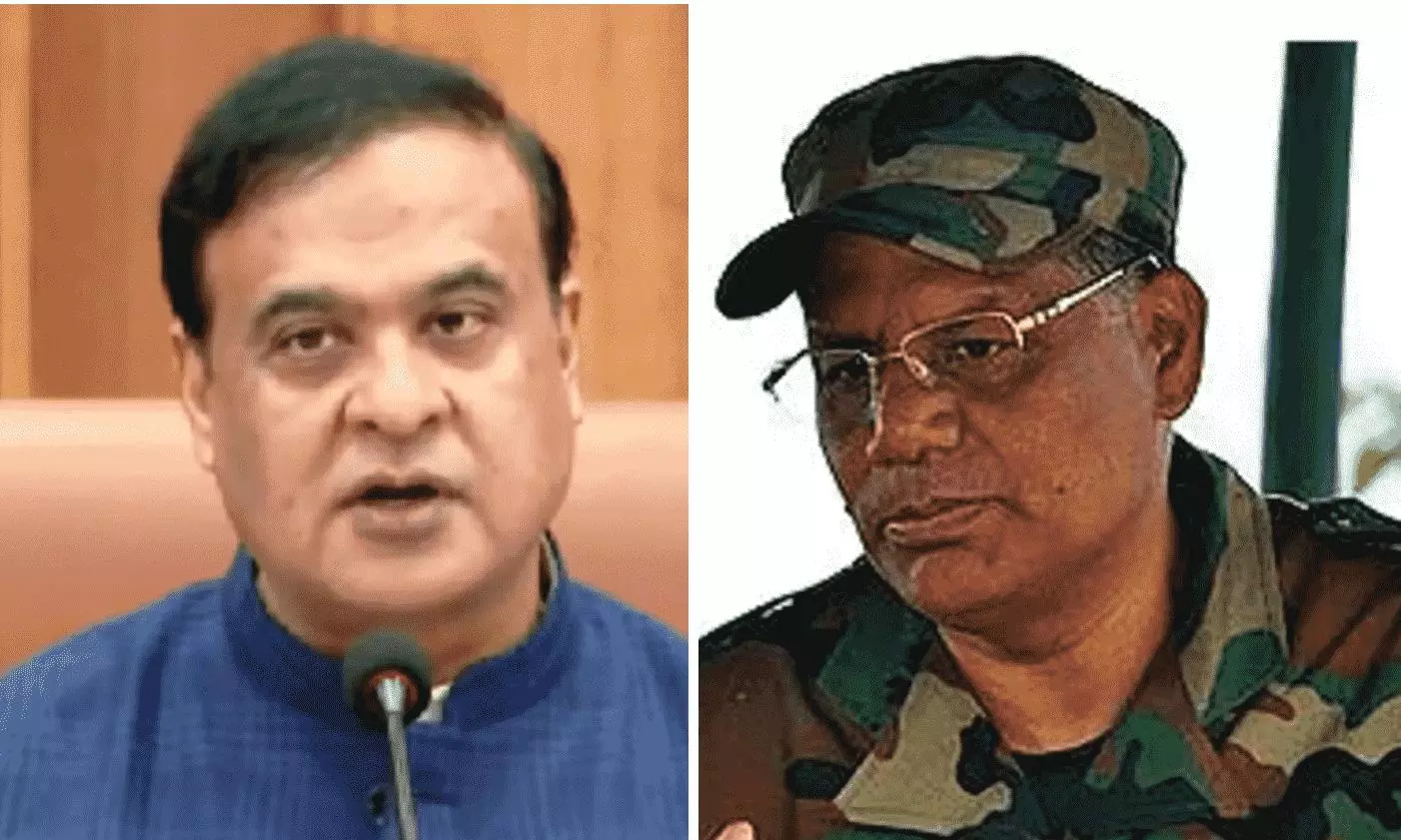
Is Assam CM’s glorification of ULFA-I chief Paresh Baruah an endorsement of insurgency?
Despite Himanta’s clarification, critics say naming an insurgent commander as preferred icon for public murals was unusual for a sitting CM, even if accompanied by a disclaimer

Assam Chief Minister Himanta Biswa Sarma has stirred the hornet’s nest by invoking ULFA-I commander-in-chief and separatist leader Paresh Baruah as an alternative to Che Guevara, while suggesting street artists to consider painting murals of regional icons instead of foreign revolutionaries.
With Baruah being a highly controversial figure in Assam’s socio-political landscape, critics say the chief minister’s glorification could be interpreted by the public as encouragement to endorse the commander-in-chief of a banned organisation. The fact that no action has been taken against Sarma for his statement, which could have invited action under the UAPA for an ordinary citizen, has exposed the double standards maintained for those in power.
Clarification on Zubeen Garg mural
Speaking to reporters on July 10, Sarma said artists who wished to paint a revolutionary on Guwahati’s flyovers should choose a figure rooted in Assam rather than that of Che Guevara. “If artists want to paint a revolutionary connected to Assam, they should paint Paresh Baruah, not Che Guevara,” he said.
Also read: Why Jalukbari’s minority pockets chose Congress over Himanta Sarma
The statement came during a clarification over the erasure of a portrait of singer Zubeen Garg at Ganeshguri. The mural, carrying the phrase “Comrades never die,” had become a gathering point for many admirers of Garg following his death.
Sarma later added that he neither accepted Baruah’s ideology nor endorsed him, and that his point was only about identifying a revolutionary figure with genuine roots in Assam. The clarification did little to calm the controversy.
The chief minister said the state government had not ordered the mural’s removal and that the two artists who drew it had erased it themselves after concluding that the likeness was unsatisfactory. He added that future public reproductions of Garg’s portrait would use a single reference photograph provided by the singer’s family.
‘Why paint Che Guevara everywhere?’
While discussing murals on city flyovers, Sarma questioned the frequent use of Che Guevara’s image. “Why paint Che Guevara everywhere when he has no connection with Assam?” he asked.
Referring specifically to the Ganeshguri site, located near the place where the October 30, 2008 serial blasts occurred (in which more than 82 people died and thousands were injured), he said public art there should honour victims of terrorism and carry anti-terrorism messages.
Also read: How Assam CM Himanta Biswa Sarma became the strategist who rewired the state’s politics
It was in that context that he mentioned Paresh Baruah as an alternative figure linked to Assam’s history.
Sarma’s disclaimer helps little
Baruah is the commander-in-chief of ULFA-Independent, the faction of the United Liberation Front of Asom (ULFA) that did not join the 2023 peace accord signed by the organisation’s pro-talks faction. ULFA-I remains banned under the Unlawful Activities (Prevention) Act (UAPA), and its stated objective of an independent Assam has not changed under Baruah’s leadership.
Also read: IED blast conspiracy in Assam: NIA chargesheets ULFA (I) chief Paresh Baruah, 2 others
Sarma later added that he neither accepted Baruah’s ideology nor endorsed him, and that his point was only about identifying a revolutionary figure with genuine roots in Assam.
The clarification did little to calm the controversy. Critics argued that naming a serving insurgent commander as a preferred subject for public murals was unusual for a sitting chief minister, even if accompanied by a disclaimer.
Parallels drawn
Some political observers noted that by contrasting Baruah with Che Guevara, Sarma had effectively described him as a revolutionary figure associated with Assam’s history.
Also read: Iron fist and velvet glove: Inside India’s Chanakyan strategy against Naga insurgents
The debate has also revived memories of past cases in which ordinary citizens faced scrutiny over alleged expressions of sympathy for banned organisations. Critics cited the 2022 arrest of a 19-year-old under the UAPA over a poem that did not name ULFA-I but was interpreted by investigators as sympathetic to the outfit.
No case has been registered in connection with the chief minister’s statement.
CM's ULFA links, Baruah adulation
The controversy has also drawn attention to Sarma’s own political history. Before becoming the BJP’s most prominent leader in Assam, Sarma was widely believed to have maintained channels of communication with ULFA during the insurgency years and later played a role in efforts to bring sections of the organisation to the negotiating table.
In previous interviews, Sarma has described Baruah as an educated and intellectual person, and said that he communicates with him through intermediaries every few months, and has offered him safe passage to visit Assam as part of efforts to encourage dialogue.
Also read: Hostage logic, killing fields: How horizontal ethnic conflicts eclipse Northeast vertical struggles
Supporters of the chief minister say these contacts were aimed at advancing peace negotiations, while critics argued that engaging an insurgent leader in back-channel discussions is very different from suggesting his image for public murals.
Paradox of rejecting Che
Another layer of the controversy emerged from Sarma’s criticism of Che Guevara. While rejecting the Argentine revolutionary as a symbol for Assam, Sarma suggested that the state’s public spaces should instead celebrate figures such as Jyotiprasad Agarwala, Bishnu Rabha and Bhupen Hazarika.
Critics responded by pointing out that both Jyotiprasad Agarwala and Bishnu Rabha were committed communists and of Assam’s leading Marxist intellectuals, while Bhupen Hazarika’s artistic and political development was closely linked to the Indian People’s Theatre Association (IPTA), which has strong Left influences.
Also read: India's hard-won victory over Red rebellion faces governance test
Sarma also told reporters that he did not know who Che Guevara was before going on to criticise Cuba’s present economic condition. The statement drew sharp reactions from the Students' Federation of India (SFI).
The Opposition has warned that ordinary citizens could be placed in a difficult position if they interpreted the chief minister’s remark as encouragement to publicly display the portrait of the commander-in-chief of a banned organisation.
SFI state secretary Rajdeep Mahanta questioned how a leader with a political science background could claim not to know Che Guevara. SFI also denied that Marshall Baruah, who painted the original Zubeen Garg mural, was a member of the organisation.
Sarma maintained that his objection was procedural and related to unauthorised painting on public infrastructure rather than to any particular artist or political subject.
Opposition takes case to Governor
The controversy escalated further when former Leader of the Opposition Debabrata Saikia submitted a representation to Governor Lakshman Prasad Acharya seeking an explanation from the chief minister regarding what he described as the public glorification of the leader of a proscribed organisation.
“The statement raises a serious question as to whether different standards are being applied to ordinary citizens and to those in positions of power when it comes to association with or glorification of proscribed organisations,” Saikia said.
Also read: Govt says AFSPA will go from the Northeast. It has been going, bit by bit, since 2022
In his representation, Saikia argued that ULFA-I has been repeatedly declared unlawful since the early 1990s for activities aimed at the secession of Assam from India and for acts considered subversive to the country’s sovereignty and integrity.
Why CM’s statement is risky
He warned that ordinary citizens could be placed in a difficult position if they interpreted the chief minister’s remark as encouragement to publicly display the portrait of the commander-in-chief of a banned organisation.
Saikia also referred to past instances in which students and young people allegedly faced detention or imprisonment over symbolic expressions interpreted as sympathetic to ULFA.
Also read: Why Paresh Barua joining peace talks may not bring the end of insurgency in Northeast
He urged the Governor to seek a detailed clarification from the chief minister on the intent, context and implications of the statement, and to ensure that law-enforcement agencies apply the law consistently.
Saikia further requested that public authorities avoid remarks that could be perceived as legitimising leaders of proscribed organisations and instead reaffirm the state’s commitment to constitutional values, peace and democratic methods of political expression.
Chief Minister Sarma has not issued any further clarification beyond his statement that he does not endorse Baruah or his ideology and was referring only to a figure with roots in Assam’s history.