Why ST tag remains a poll ‘jumla’ for 6 Assam communities
Despite repeated promises by BJP during polls, proposal remains on paper, with Centre giving no clarity on timeline, Bill in Parliament or reservation benefits

The Centre's decision not to introduce any legislation on Scheduled Tribe (ST) status for six Assam communities — Tai Ahom, Koch-Rajbongshi, Chutia, Moran, Matak and Tea Tribe (Adivasi) — during the upcoming Monsoon Session of Parliament has once again raised doubts about a promise that has resurfaced before almost every major election since 2014.
Long line of approvals pending
Last week, Union Tribal Affairs Minister Jual Oram clarified that no Bill is scheduled for the Monsoon Session to grant ST status to these six communities because the proposal has not yet completed the process laid down under Article 342 of the Constitution.
Also read: Tribal body revives demand to strip ST status from converts ahead of Assam UCC Bill
Before any legislation reaches Parliament, the Assam government’s recommendation must be examined by the Registrar General of India (RGI), reviewed by the National Commission for Scheduled Tribes (NCST), approved by the Union Cabinet and only then introduced as a Bill. Oram offered no timeline, saying only that the Centre would take a decision “at the appropriate time.”
Unions voice frustration
For organisations representing the six communities, the statement has reinforced long-standing frustration. All Assam Tai Ahom Students' Union (AATASU) president Basanta Gogoi warned that the organisation would launch an agitation if the government continued to delay the issue.
A GoM report doesn’t give a clearer understanding of the reservations, hinting that the said communities may not receive reservation in government jobs, Parliament, the Assembly or Central services.
Tai Ahom Yuva Parishad Assam (TYPA) president Bijay Rajkonwar said the latest development strengthened the belief among many that the promise was largely election-driven. According to him, the organisation will review its next course of action after the monsoon.
Koch Rajbongshi Development Council (KRDC) chairman Pranab Narayan Dev struck a more resigned note. He said he never expected the issue to be resolved this year and observed that organisations no longer have the same capacity to mobilise people for a mass movement. In his view, the focus should now shift towards development.
Also read: Modi’s unfulfilled guarantee: Why tempers are boiling among Assam’s tea tribes against BJP
The Janagostiya Mahasabha, which coordinates the demand of all six communities, has reiterated that its primary demand remains the passage of the Constitution (Scheduled Tribes) Order (Amendment) Bill. If Parliament cannot take it up immediately, it has suggested that the President of India issue an ordinance. The organisation has also sought a tripartite meeting involving the Union Home Minister, Assam Chief Minister Himanta Biswa Sarma and its coordination committee, while asking the state government to clarify its position.
Questions on proposal’s feasibility
However, the uncertainty is not limited to the delay in Parliament. Questions have also emerged over the proposal itself. Tai Ahom researcher Arunabh Konwar has questioned the utility of the proposed "ST-Valley" category, arguing that it does not appear to provide reservation benefits. The CPI(M), through its publication People's Democracy, has gone further, describing the entire exercise as electoral optics and suggesting that the government may simply allow the proposal to remain unresolved instead of pursuing legislation.
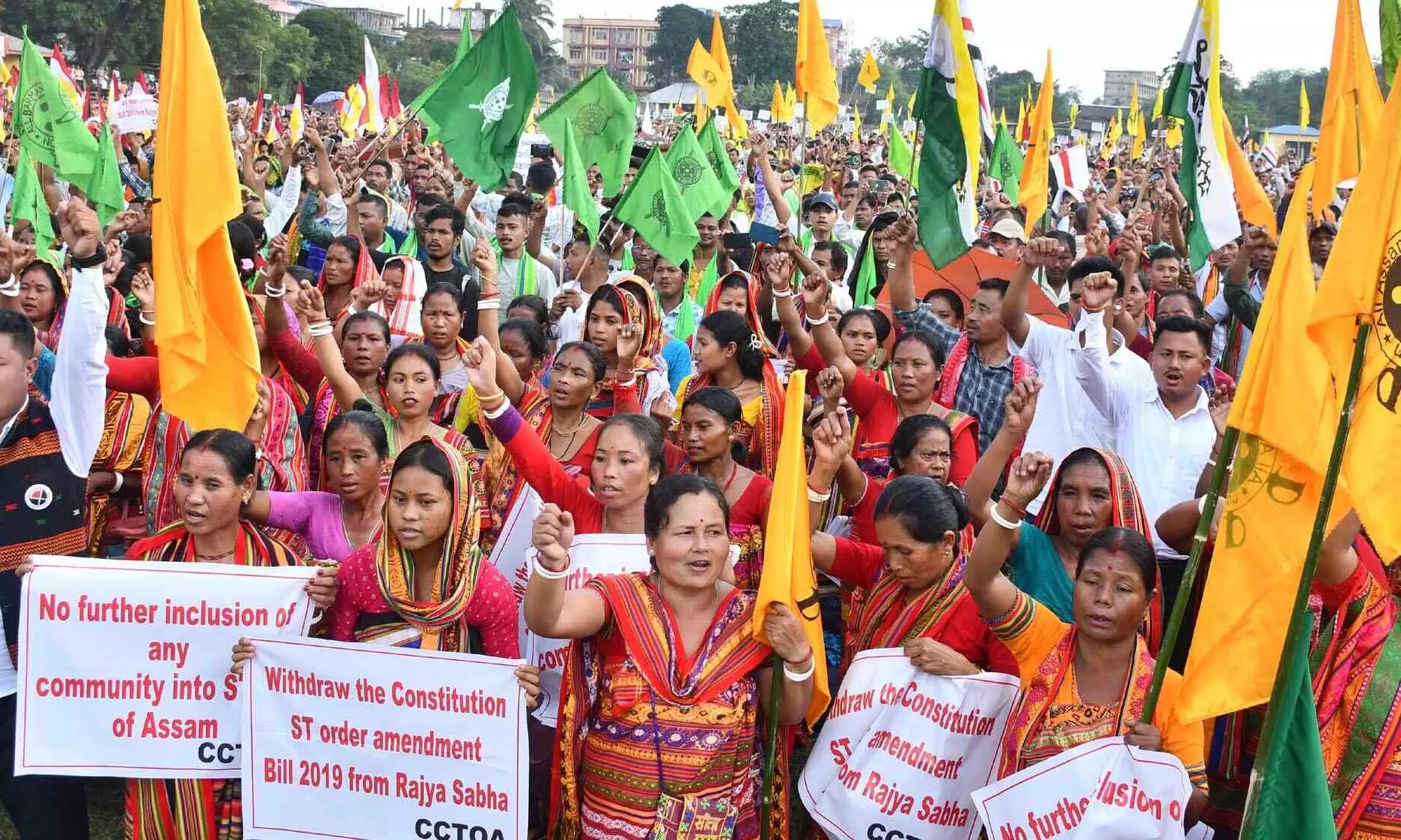
The demand itself is not new. A Bill introduced in the Rajya Sabha in January 2019 lapsed without being passed after facing opposition from organisations representing Assam's existing Scheduled Tribes, including the Coordination Committee of Tribal Organisations of Assam (CCTOA) and the All Assam Tribal Students' Union (AATSU).
What GoM report recommends
The Group of Ministers (GoM) constituted by the Assam government submitted its report on November 29, 2025. It recommended creating a separate ST-Valley category for Tai Ahom, Chutia, Tea Tribes (Adivasis), and Koch-Rajbongshi communities (residing outside undivided Goalpara district). It recommended including Moran, Matak, and Koch-Rajbongshi communities living in undivided Goalpara and the old Kokrajhar district under the Bodoland Territorial Region within the existing ST (Plains) category.
Also read: Govt report on ST status splits Assam into celebrations and protests
The report, however, leaves its biggest question unanswered. It doesn’t give a clearer understanding of the reservations, hinting that the said communities may not receive reservation in government jobs, Parliament, the Assembly or Central services because no workable mechanism could be evolved. That decision has effectively been left to the Centre.
Raijor Dal president and Sivasagar MLA Akhil Gogoi criticised the proposal, arguing that ST-Valley is not a category recognised either by the Constitution or the Central list of STs. According to him, creating a third category alongside ST (Plains) and ST (Hills) amounts to misleading people rather than resolving the issue.
How new 'tribes' would change dynamics
The Koch-Rajbongshi population in Assam is estimated at around 70 lakh, nearly one-fourth of the state's population. Tea Tribe or Adivasi communities are also estimated at roughly 70 lakh, accounting for around 18 to 20 per cent of the population. Estimates for the Tai Ahom population range from 20 lakh to 46 lakh, with some placing it even higher if all descendants of the original settlers are counted. The Chutia and Matak communities are each estimated at over 20 lakh, while the Moran population is around one lakh.
Since inclusion in the ST list is a Central subject under Article 342, Opposition parties have accused the BJP of repeatedly raising expectations without taking the process to its conclusion.
Also read: SIR hearings trigger Rajbongshi voter anxiety, put BJP on the spot
By comparison, Assam’s officially recognised STs—14 in the plains and 15 in the hills—had a combined population of 38,84,371 according to the latest Census, representing 12.44 per cent of the state's population. Inclusion of all six communities could increase the tribal population from roughly 12 per cent to nearly 40 per cent, fundamentally altering Assam's social and political landscape.
Assam currently provides 7 per cent reservation for Scheduled Castes, 10 per cent for ST (Plains), 5 per cent for ST (Hills), 27 per cent for OBC and MOBC categories combined, and 10 per cent for Economically Weaker Sections.
Why are existing tribes protesting?
Existing tribal organisations remain firmly opposed to the proposal. CCTOA president Aditya Khakhlary argues that the six communities together number between 80 and 90 lakh, more than twice the population of the existing Scheduled Tribes.
His concern is that if all Scheduled Tribes are eventually treated as one category during delimitation, the present tribal communities could lose political representation in panchayats, autonomous councils, the Assembly and Parliament because constituency reservation depends on the local ST population.
Also read: Assam citizenship verdict shows one missing link can cost you your nationality
Assam currently has only two reserved Lok Sabha constituencies—Kokrajhar and Diphu—and 19 reserved Assembly seats out of 126.
Whether the six communities eventually receive ST status will depend not only on political will but also on constitutional scrutiny, administrative approval and resolving concerns raised by existing tribal organisations.
Khakhlary has also questioned the reservation implications. Assam's total reservation presently stands at 59 per cent. If the six communities are included as Scheduled Tribes, reservation could exceed 70 per cent, well beyond the 50 per cent ceiling laid down by the Supreme Court in the 1992 Indra Sawhney judgment. Although the GoM proposed a separate ST-Valley roster, CCTOA believes that distinction may prove difficult to sustain once competition begins over scholarships, hostel seats, welfare schemes and recruitment.
Doubts over ST credentials
AATASU has consistently maintained that the six communities do not satisfy the criteria for tribal identification outlined by the Lokur Committee in 1965. It argues that the Ahom, Chutia, Moran and Matak communities have historically been part of mainstream Assamese society and were therefore excluded from both the Constitution (Scheduled Tribes) Order, 1950 and the earlier Bordoloi-Thakkar Committee report.
Also read: 15 documents not enough to prove citizenship: Assam man declared foreigner by HC
On the Tea Tribe issue, AATASU cites both the 1947 Bordoloi-Thakkar report and the Lokur Committee, which held that tea garden labourers brought from central India during the colonial period could not be regarded as indigenous tribes of Assam. Both AATASU and CCTOA also point out that these communities already receive reservation under OBC or MOBC categories and have separate autonomous or development councils. Their argument is that the present demand is ultimately about political reservation rather than welfare benefits.
Opposition attacks BJP for ‘false’ promises
Since inclusion in the ST list is a Central subject under Article 342, Opposition parties have accused the BJP of repeatedly raising expectations without taking the process to its conclusion.
Assam Congress president and Lok Sabha MP Gaurav Gogoi has accused the BJP of trying to impose a uniform identity on a state defined by ethnic diversity. According to him, Assam's strength lies in recognising its distinct communities, languages and traditions, while the unresolved ST issue has repeatedly resurfaced before elections without a lasting solution.
The BJP first promised ST status for the six communities after forming the government at the Centre in 2014. Similar assurances were made during the 2016 Assembly election, the 2019 and 2024 Lok Sabha elections, the 2021 Assembly election and again ahead of the 2026 Assembly polls.
Also read: Why Assam-Bangladesh border remains unsealed even after 10 yrs of BJP govt
The latest statement by the Union Tribal Affairs Minister also indicates that the proposal has not yet completed scrutiny by the Registrar General of India. Equally significant is the fact that the GoM itself could not resolve how reservation benefits would work under the proposed ST-Valley category. Without answers to these questions, the proposal remains incomplete.
Whether the six communities eventually receive ST status will depend not only on political will but also on constitutional scrutiny, administrative approval and resolving concerns raised by existing tribal organisations. For now, there is no timeline from the Centre, no Bill in Parliament and no clarity on reservation benefits. After more than a decade of repeated promises, the issue appears no closer to resolution than it was when the first assurances were made.