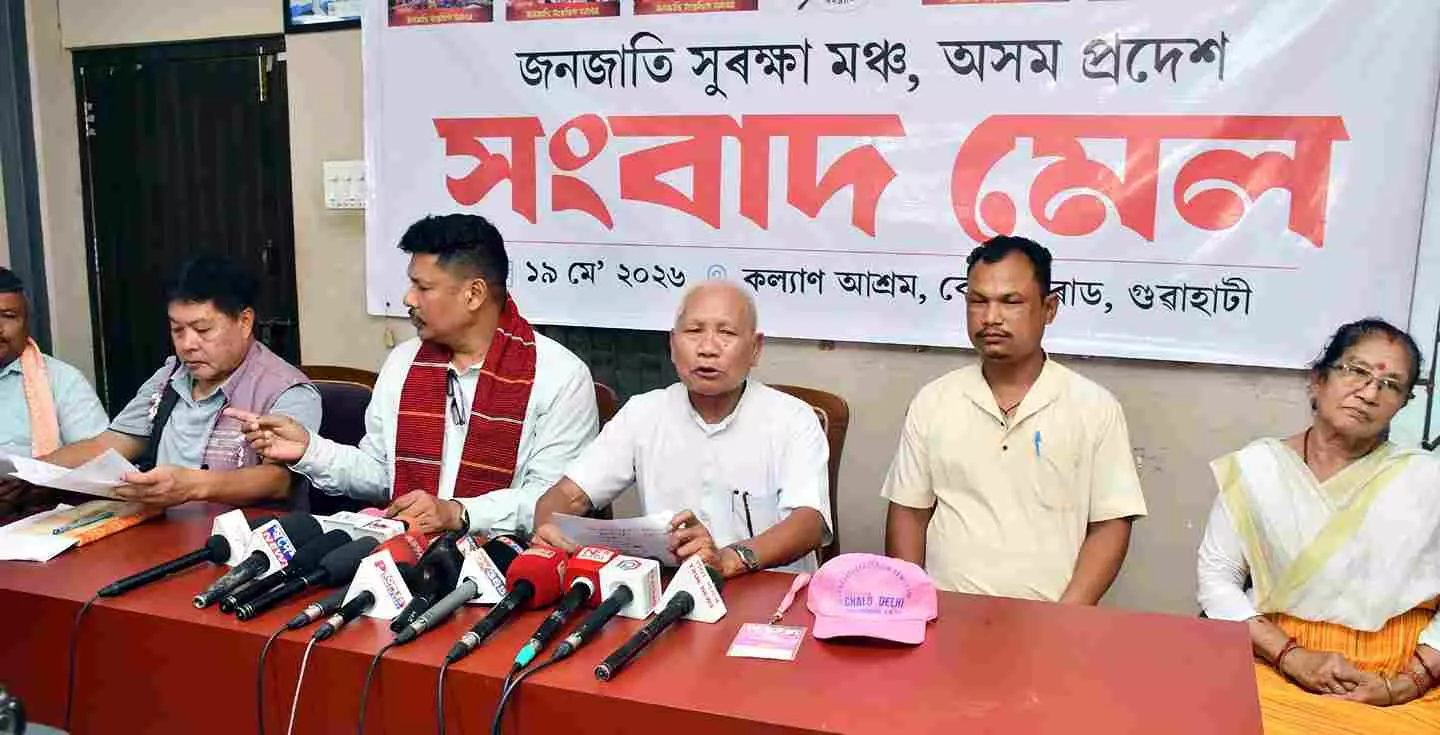
Amid the intensifying political and social debate surrounding the proposed implementation of the Uniform Civil Code (UCC) in Assam, the RSS-backed Janajati Suraksha Manch (JSM) has renewed its demand for the removal of Scheduled Tribe (ST) status from tribal people who have converted to Christianity or Islam.
This contentious demand has resurfaced at a critical juncture, as the Assam government finalises plans to introduce its UCC Bill in the state Assembly on May 26, 2026. And, even as neighbouring Arunachal Pradesh too is moving towards the implementation of the Arunachal Pradesh Freedom of Religion Act (APFRA), 1978, aimed at protecting indigenous faiths and traditional belief systems.
Tribal cultural mobilisation
Against this backdrop, the JSM has announced a major mobilisation programme titled “Delhi Chalo”, scheduled to be held at the Red Fort Ground in New Delhi on May 24. The event, named “Tribal Cultural Conclave 2026”, is being organised on the occasion of the 150th birth anniversary of tribal freedom fighter and icon Birsa Munda.
According to the organisation, the conclave is expected to witness participation from more than 1.5 lakh people representing over 500 tribal communities from different parts of the country.
JSM Northeast convenor Binud Kumbang said the gathering would be one of the largest tribal cultural mobilisations held in the national capital.
He said participants from across the country would travel to Delhi at their own expense and would take part in cultural processions showcasing traditional tribal attire, customs and practices. “For the first time, tribal communities from across India are assembling in such large numbers in Delhi around issues related to their religion, culture and traditions,” Kumbang said.
Further, he added that the cultural procession would begin from five different locations in Delhi, symbolically representing the diversity of tribal traditions, before converging at the Red Fort for a mass public meeting.
Kumbang also said Union Home Minister Amit Shah has accepted an invitation to attend the programme as chief guest.
Curbing conversions
One of the central demands to be raised at the conclave is the “delisting” of tribal people who have converted to Christianity or Islam from the Scheduled Tribe category. The organisation has been arguing that individuals who convert from their “original tribal faith” and no longer follow traditional tribal customs, rituals and cultural practices should not continue to receive constitutional safeguards and reservation benefits meant for Scheduled Tribes.
According to JSM leaders, the demand is linked to the protection of indigenous tribal identity, language, customs and belief systems.
The organisation has also sought a strong central legislation to curb what it describes as illegal or unethical religious conversions among tribal communities across the country.
The JSM’s demand is centred around amendments to Article 342A of the Constitution, which empowers the President to notify Scheduled Tribes, while allowing Parliament to modify the list.
The group wants provisions for automatic removal of ST status if a tribal person converts to Christianity or Islam. JSM leaders have claimed that converted tribal individuals continue to avail reservation benefits in jobs, education and welfare schemes while also accessing facilities available to religious minority communities, which they argue creates imbalance and injustice for non-converted tribal groups.
The organisation further maintained that large-scale religious conversions have led many tribal communities to gradually move away from their traditional languages, rituals and indigenous cultural practices.
The issue is not new in Assam and the north-east. On March 26, 2023, the JSM organised a major “Chalo Dispur” rally in Guwahati demanding measures to safeguard traditional tribal culture and identity in Assam and the Northeast.
The organisation had then claimed that over one lakh people from different tribal communities, including Bodos, Rabhas, Mishings, Dimasas, Tiwas, Karbis, tea tribes and Sonowal-Kacharis, participated in the day-long programme.
At that rally too, the organisation alleged that tribal communities were becoming victims of “unethical conversion” and demanded legal safeguards to preserve indigenous traditions and customs.
Strong opposition
However, the demand for delisting converted STs has triggered strong opposition from legal experts, church representatives and sections of civil society.
Senior advocate of the Gauhati High Court and former MP Ram Prasad Sharma dismissed the demand, saying Scheduled Tribe status is not granted on the basis of religion. “ST status is not given based on religion. So, there is no question of delisting ST converts. It is an absurd demand,” Sharma said.
Reacting to the JSM’s position, John S Shilshi, editor of the Northeast Catholic Research Forum (NECARF), said the organisation’s arguments were based on the assumption that conversion automatically disconnects people from their tribal roots and identity. He said such claims ignored the fact that many Christian tribal communities in the north-east continue to preserve and practise their indigenous traditions, languages and social customs.
Shilshi also criticised the portrayal of tribal communities as easy targets for religious conversion. He said such narratives indirectly questioned the judgement and independent thinking ability of tribal people themselves.
No threat from Christianity
Referring to allegations that Christianity promotes foreign influence, he said churches in the north-east are now entirely managed by local communities and leaders. The churches have played a major role in preserving tribal languages and traditions by ensuring that scriptures, hymns and religious teachings are available in local tribal languages, he added.
Shilshi also dismissed suggestions that Christianity poses a threat to governance or social stability in the region. Shilshi further pointed out that many Christian voters in the north-east have supported the BJP in recent years because of visible improvements in infrastructure, connectivity and the overall security situation. He said incidents of insurgency-related violence, bomb blasts and ambushes have reduced significantly over the years, creating a more stable environment across the region.
The renewed debate over religious identity, tribal rights and reservation benefits is unfolding at a politically sensitive time, with Assam preparing to table the UCC Bill in the Assembly just two days after the proposed JSM conclave in Delhi.
The presence of Union Home Minister Amit Shah as the chief guest at the “Delhi Chalo” programme has also raised questions in some quarters over whether the BJP leadership is indirectly backing the demands raised by the JSM. Critics argue that such developments could further deepen mistrust and social divisions among tribal communities.