Three years on, renewed violence in Manipur casts a long shadow over calls for peace
Protesters say the violence began with coordinated attacks on Meitei villages, claiming that justice for victims is still elusive even after three years

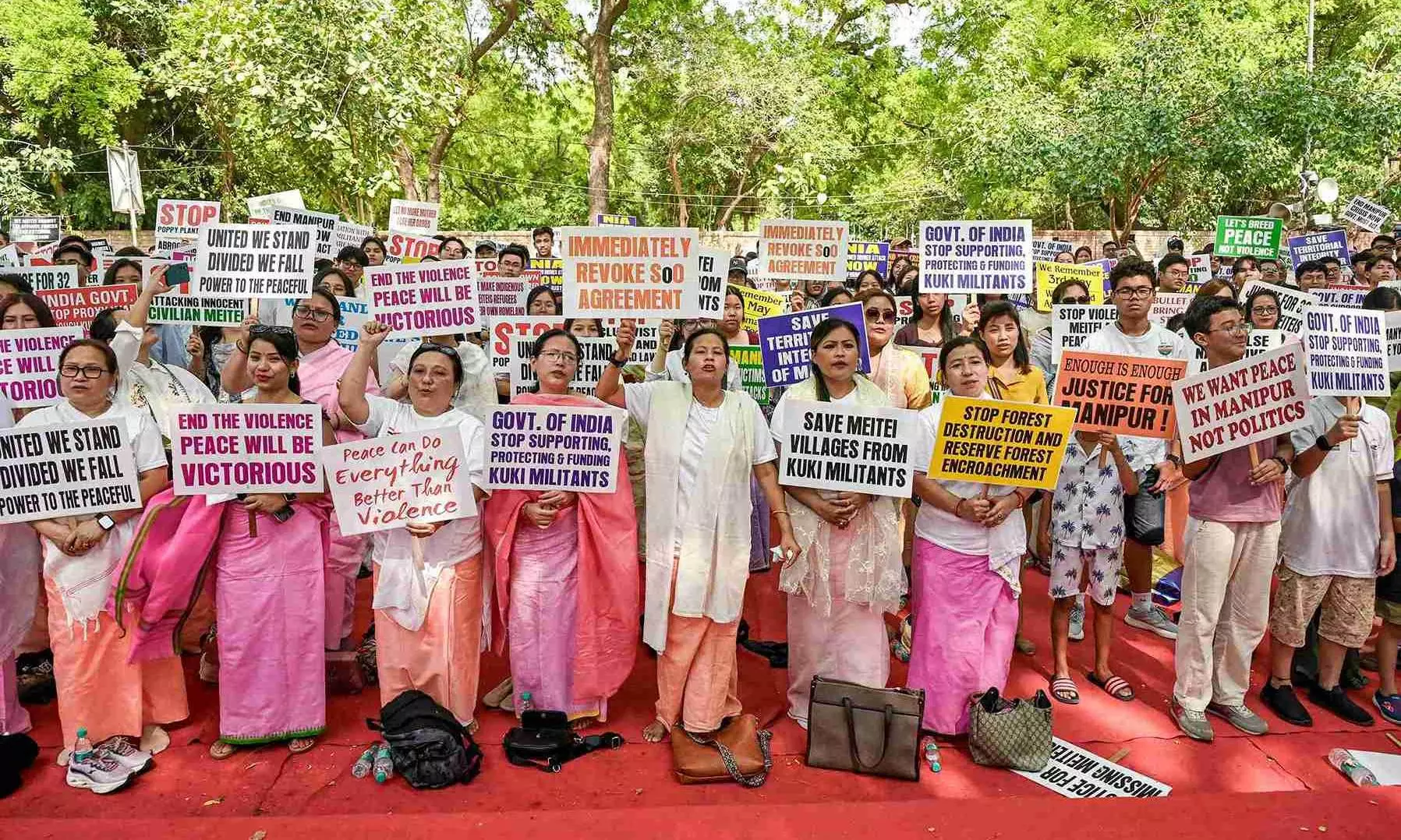
As Manipur’s ethnic violence entered its fourth year on Sunday (May 3), the deep fault lines of the prolonged conflict were once again visible in the national capital, where Meitei civil society groups staged a protest at Jantar Mantar demanding immediate intervention from the Centre, while a Kuki militant organisation renewed its demand for separate administration for Kuki-Zo communities.
Three years after the violence began on May 3, 2023, representatives of Meitei student bodies, women’s groups and civil society organisations from Manipur, Assam and Tripura gathered in New Delhi, accusing the Union government of failing to restore peace, justice and constitutional order in the troubled state.
Protestors condemn violence
The demonstration brought together members of the Delhi Meetei Co-Ordinating Committee (DMCC), Manipur Students’ Association Delhi (MSAD), Manipur Innovative Youth Organisation Delhi (MAIYOND), Ningols United Progressive Initiative (NUPI), Delhi Manipuri Society (DEMAS), Meitei Heritage Society and several other organisations.
Also read: How Manipur unrest is flaring up again after deaths of children, Naga civilians
Holding placards and raising slogans, the protesters alleged that the violence began with coordinated attacks on Meitei villages and claimed that justice for victims remained elusive even after three years.
Meitei groups demand justice
DMCC convenor Dr Seram Rojesh said the pain of displacement and loss continued to haunt thousands of affected families. “We have come here to say clearly that people cannot be left to suffer endlessly. Thousands are still in relief camps, families remain broken, and many are still waiting for justice,” he said.
Rojesh alleged that civilians were forced into self-defence when institutions meant to ensure protection failed during the outbreak of violence. “Our demand is simple — restore law and order fully, dismantle militant violence, and ensure justice for every victim,” he said.
Meitei Heritage Society representative Elizabeth Khumallamban said the prolonged unrest had deeply shaken public trust. “When constitutional rights feel uncertain, fear only grows stronger. The government must act in a way that restores faith among ordinary people,” she said.
Also read: Night rallies continue in Manipur over death of 2 children in bomb attack
MSAD president Lanchenbi Urungpurel said Manipur’s social fabric had suffered severe damage. “Manipur has lived through diversity for generations. Peace can return only when truth, justice and security are given equal importance,” she said.
Youth voices
MAIYOND president Gunchenba Yengkhom said Manipur’s territorial and social integrity remained central to the aspirations of many youths. “Our generation cannot stay silent when our homeland is in crisis. We stand for its protection and dignity,” he said.
NUPI president Ranjana Longjam said prolonged silence over the suffering of displaced families was unacceptable. “Justice delayed for years becomes a wound for society. Development means little without dignity and safety,” she said.
Also read: Manipur protests swell: Thousands defy curfew
Retired Colonel Geerija Devi of DEMAS also highlighted the fears of ordinary citizens caught in the violence. “When people begin to feel abandoned, insecurity becomes a daily reality. Citizens need protection, not prolonged uncertainty,” she said.
Many speakers focused on the continuing plight of internally displaced persons living in relief camps and demanded rehabilitation, accountability for missing persons and stronger intervention to restore normal life.
Demand for separate administration
At the same time, the Kuki Liberation Army-Letkholun (KLA-L), in a separate statement, reiterated its political demand for a separate administrative structure under the Constitution for the Kuki-Zo people.
KLA-L spokesperson Naoppleon Kuki said the last three years had fundamentally altered relations between the communities. “The events of the past three years have shown that the Kuki-Zo people and the Meitei community can no longer exist under one administrative arrangement,” he said.
The organisation demanded a Union Territory-style administrative framework with legislative powers, arguing that separate governance was essential for security and dignity. “We need a politically recognised boundary and the authority to shape our own future. Without that, peace will remain difficult,” the statement said.
Also read: People displaced by Manipur's ethnic violence demonstrate, seeking to return home
The KLA-L also launched sharp criticism of certain political representatives, claiming they did not reflect the broader aspirations of the affected Kuki communities.
In its statement, the organisation further made serious allegations against Meitei groups and political figures and questioned the Centre’s handling of the crisis.
Trust deficit
The sharply opposing positions from Meitei civil society groups and Kuki militant voices once again highlighted the depth of mistrust that continues to define Manipur’s crisis.
Since violence broke out on May 3, 2023, more than 260 people have reportedly lost their lives, while around 60,000 remain displaced. Despite repeated peace appeals and security measures, the conflict continues to cast a long shadow over Manipur, with both sides pressing vastly different visions for justice, security and the state’s political future.