








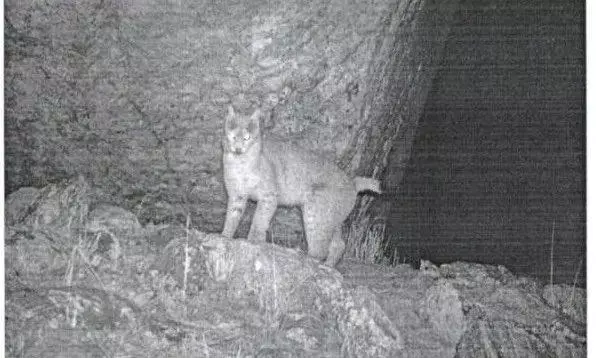
This was only the second confirmed photographic record of the species in the entire Eastern Himalayas. Photo: X/@ParveenKaswan
Sikkim records sighting of rare Eurasian lynx in Eastern Himalayas
The rare wild cat was captured by a camera trap in January 2026 at an altitude of 5,250 metres on the Tso Lhamo plateau in Mangan district

Gangtok/New Delhi, Jul 1 (PTI) The rare Eurasian lynx, a medium-sized wild cat species, has been photographed for the first time in Sikkim, the state's forest and environment department said on Wednesday, terming it a landmark in wildlife conservation.
This was only the second confirmed photographic record of the species in the entire Eastern Himalayas.
The first-ever photographic record of the Eurasian lynx in the region was from Arunachal Pradesh last year.
The rare wild cat was captured by a camera trap in January 2026 at an altitude of 5,250 metres on the Tso Lhamo plateau in Mangan district.
The Eurasian lynx is a medium-sized cat distinguished by its characteristic ear tufts and short tail, and it is well-adapted to cold, high-altitude environments.
According to an official statement, the photo was captured during a long-term snow leopard and rangeland monitoring programme jointly conducted by the state's forest and environment department and WWF-India.
The initiative tracks snow leopard populations and associated high-altitude wildlife while assessing the ecological health of trans-Himalayan rangelands.
Chief Wildlife Warden D Manjunatha described the discovery as a major milestone for wildlife conservation in the state.
"The photographic confirmation of the Eurasian lynx in the Tso Lhamo plateau is a proud moment for Sikkim. It highlights the ecological significance of our high-altitude rangelands and reinforces our commitment to protecting these fragile ecosystems," he said.
Rishi Kumar Sharma, head of the Himalayas programme at WWF-India, said that following the 2025 photograph in Arunachal Pradesh, the Sikkim record confirms that the Eurasian lynx has a broader presence in the eastern Himalayas than was previously understood.
"What we are documenting at Tso Lhamo is not a single species occurrence; it is a high-altitude ecosystem of exceptional conservation value. Sustaining long-term, systematic monitoring across these landscapes is essential if we are to understand and protect what is here," Sharma said in a statement. PTI