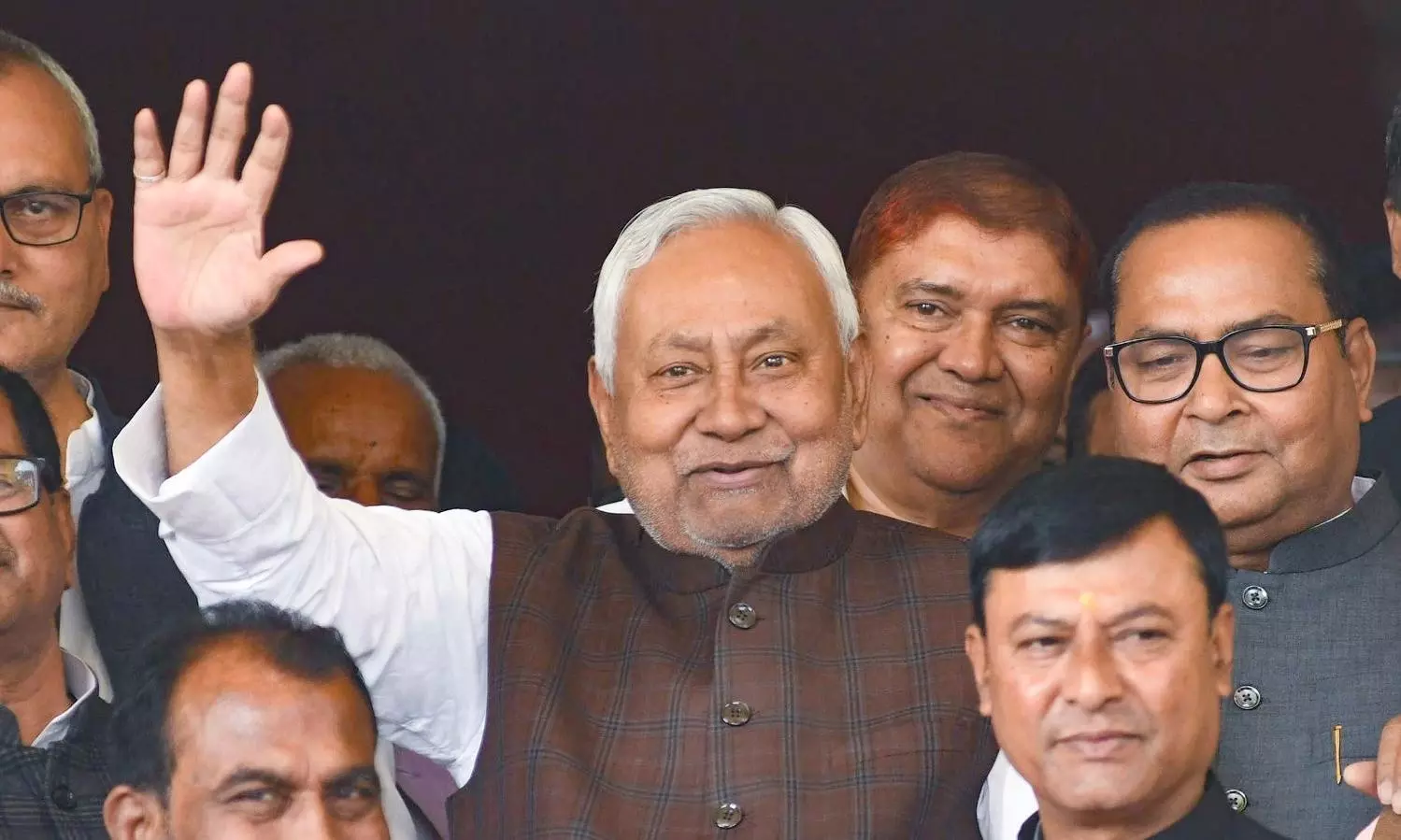
As Bihar's liquor ban turns 10, Nitish faces pressure from allies, rivals
Rampant hooch tragedies, Rs 30,000-crore loss in revenue to state coffers, thriving liquor mafia put a question mark on Nitish's prized insistence on dry state

A decade ago, Bihar Chief Minister Nitish Kumar came up with a ban on the sale and consumption of liquor across the state. However, months after he won his record 10th term in office, the Janata Dal (United) supremo has been facing pressure from inside the ruling National Democratic Alliance (NDA), as its effectiveness has been questioned.
This is not the first time that Nitish has faced such questions, both from his ally BJP and the Opposition parties, particularly following hooch tragedies and the alleged rise of the liquor mafia in the state.
Also read: Patna HC: Bihar officials love liquor ban, to them it means big money
In his current tenure, the allies’ voice is getting louder. Also, concerns have grown stronger inside the Assembly and on the streets over whether the prohibition, locally called sharab bandi or daru bandi, has paid off.
Demand for ban review
The demand became louder and clearer in the recent Budget Session, where a united voice emerged from the government’s own bench, adding to the discomfort of the Chief Minister, who has otherwise downplayed similar concerns rising from the Opposition ranks over one of his pet policies.
Of late, the JD(U)’s rallies in the NDA, including the BJP, the Hindustani Awam League (Secular) or HAMS, the Lok Janshakti Party (Ram Vilas) or LJP (R-V) and the Rashtriya Lok Morcha (RLM) have not only sought to review a complete liquor ban but also spoken in favour of removing it on grounds of loss of revenues and challenges of implementation.
Hic! Bihar's liquor ban is losing its buzz
♦ Nitish Kumar imposed statewide prohibition in April 2016
♦ NDA allies now demanding urgent review or complete rollback
♦ Bihar has lost Rs 30,000 crore in excise revenue
♦ Liquor mafia running Rs 25,000-30,000 crore parallel black economy
♦ Dry drug use among youth has spiked alarmingly
♦ Women still back the ban, despite poor enforcement
The Opposition, despite its reduced presence, has maintained a strong stance against the liquor ban, calling it effective only on paper and claiming that it is available on demand, whether from home or a hotel.
Can Nitish, known for mastering the skill of political management, find a way out to ensure that the ban can be maintained, particularly when the administration is reportedly facing fiscal challenges to implement welfare schemes, particularly those focused on women, one of the JD(U) supremo’s key constituencies?
No review, says Nitish's lieutenant
His government, however, is trying to put up a strong face. Vijay Kumar Chaudhary, a cabinet minister and a close confidante of the CM, said in the Assembly on February 26 that a total liquor ban would continue since it is in the best interest of society and said all state legislators should support the idea.
Also read: Ground report | Why most women in Bihar want liquor ban to continue
“Drinking or consumption of liquor is a crime in the state as per the Bihar Prohibition and Excise Act, 2016, and the government is ensuring to control and stop consumption. All MLAs and MLCs should cooperate for it,” he told The Federal.
But there were differing voices in the ruling alliance. Vinay Bihari, a BJP legislator, questioned where the ban was, claiming it was being sold and people were consuming it. The leader, who is also a Bhojpuri singer, told this website that when they visit any marriage ceremony, they get to see hundreds of people drinking.
“It is because liquor is easily available; everyone knows where to get it. Liquor selling is rampant,” he said. Bihari, in fact, protested against the claim of a total liquor ban by singing at an event recently.
“A review of the liquor ban law is a must now. It should be done as soon as possible for people’s interest,” he added.
Top BJP leaders of the state, including two deputy chief ministers, Samrat Choudhary and Vijay Kumar Sinha, however, have maintained silence on the matter.
Former state minister and JD(U) leader Neeraj Kumar also said in response to Bihari that the prohibition would not be removed. “Those advocating to end the liquor ban should first submit an affidavit from their wives, daughters and other family members that they are in favour of lifting the ban,” he told The Federal.
Non-BJP allies seek review
It is not only the BJP from which such voices have emerged. In February, RLM MLA Madhav Anand also sought a review of the prohibition.
“Let’s wait for some time. Nitish Kumar will review the liquor ban as it is the people’s demand. It is high time to review it to know how it worked and what it exactly achieved. No doubt, the decision to ban liquor was a landmark, but now its implementation is not fully satisfactory,” Anand told The Federal, expressing his hope about the CM’s action.
Also read: Gujarat’s GIFT City: Liquor permit, a pragmatic move to break shackles of old laws
He received support from HAM(S) and LJP(R-V) leaders Jitan Ram Manjhi and Chirag Paswan, respectively. Both of them are Union ministers.
The poor punished
Manjhi, who has also been the chief minister in 2014-15, has also been vocal against the liquor ban. Echoing Bihari’s remarks, he said that while home delivery of illegal liquor is rampant, it is only the poorest sections who are punished for violating the law and that the ban is affecting revenues. Paswan also spoke in favour of a review.
An analyst from the state feels that the BJP is using a ploy to create pressure on Nitish, making it evident that it is no longer ready to play a second-fiddle role to the CM, particularly after finishing as the largest party in last year’s Assembly elections.
He said that with other allies of the NDA also backing the voice, the BJP intends to pressure the CM to review the policy to either relax it like in Gujarat or end it completely, so that the state exchequer is not compromised and governance doesn’t take a hit.
Coffers bleeding
One cannot contest the fact that the liquor ban has indeed left the state coffers bleeding.
As per a research study data, before the ban came into effect, Bihar’s revenue from excise duty was Rs 3.142 crore (annual revenue of 2015-16), which was a major source of the administration’s income.
In the last 10 years, since the policy came into force, the state has lost at least Rs 30,000 crore in revenue.
But others are making hay, feel those who want a review.
“Taking advantage of the lacklustre implementation of the liquor ban, a powerful liquor mafia has emerged that has been running a parallel black money economy of Rs 25,000 to 30,000 crore of illegal liquor business. There is a powerful nexus of police, politicians, and others behind it that enjoys clout in the power corridors as well,” said political activist Satya Narayan Madan.
Also read: Why liquor ban failed to sober up Bihar
While the critics have alleged that the state has been incurring an annual loss of Rs 20,000-40,000 crore because of the ban, the government has also been spending between Rs 800 and Rs 1,000 crore annually to ensure the ban is in place. Moreover, the state’s key manpower, including the police and administrative officials, are also being made to run around to see that the implementation is being done properly.
Anti-people ban?
Recently, Prashant Kishor, whose Jan Suraaj Party made its electoral debut in the Bihar elections last year, claimed that the state government’s moneybag is empty and it borrowed funds to execute its cash-transfer scheme for women and others ahead of the last elections. He said the NDA government is under pressure now to raise revenue by terminating the liquor ban through the backdoor. Kishor also agreed that the current ban is not in the interest of the people.
It was Kishor, a former election strategist, who had announced that he would end or lift the liquor ban (prohibition) if his party came to power in the 2025 Bihar Assembly polls.
The Opposition has also spoken the language uttered by the JD(U)’s allies in government by questioning the effectiveness of the liquor ban. They have also questioned the liquor mafia freely smuggling alcohol and its delivery at home, becoming a lucrative business in both urban and rural areas of the state. Even police officers have been accused of selling liquor from police stations and their official residences, serving a big blow to the administration.
People, courts not convinced
While Nitish’s government imposed the state-wide prohibition in April 2016, the common people are not very convinced about its success on the ground.
According to the state government’s own data, about 10 lakh first information reports were registered in connection to implementation of total prohibition laws; 16 lakh people were arrested (between April 2016 and December 2025) and 4.5 crore litres of illicit liquor and 1.6 lakh vehicles have been seized. These figures suggest that the implementation has not been easy for the authorities.
Also read: Gujarat eases liquor rules for outsiders, foreign nationals at GIFT City
Additionally, there has also been an alarming rise in the use of “sukha nasha” (dry drugs) among youths and children as the liquor ban remained in place. Police have admitted that Bihar has witnessed an unbelievable use of dry drugs such as ganja, brown sugar, doda, intoxicant pills, thinners and glues.
“As illicit liquor has become four to five times more costly, a large number of middle-aged men, youths and children have found easy access to use cheap dry drugs as an alternative,” they said. While 518 cases were registered in 2016 under the Narcotic Drugs and Psychotropic Substances Act, 1985, the numbers went up to 2,411 by 2024. Opium and cough syrup have also been seized by the police regularly.
The arrests over implementing the ban have also put pressure on the courts and jails. The Patna High Court recently expressed concerns over the burgeoning illicit liquor trade, leading to a deluge of cases in the lower courts as well as the high court. In the recent past, it has also criticised the provisions of the Act.
Women want the ban
However, despite the political tug-of-war, administrative challenges and judicial debates, Bihar’s women have remained vocal supporters of the liquor ban. Even though they are aware that liquor has been available across the state despite it being dry, the women feel that an official ban deters the men from shunning alcoholism to some degree and puts a check on liquor-related crime. It also allows families to save money.
But as one Aarti Devi, a resident of Kurkuri Mushar Toli under Phulwarisharif block of Patna district, told The Federal, the authorities have not implemented the policy perfectly well, and they are not amused..
“The government has failed to enforce the ban as a nexus of police, liquor mafia and local politicians manages everything. We are fed up with the liquor ban on paper, not a real one,” she said.
Shanti Devi, a resident of Ranipur village in the same district, strongly supports the ban and rejects the demand to lift it. She said Nitish has repeatedly claimed that the ban was imposed in the state on the women’s demand.
Liquor mafia at work before Holi?
With Holi celebrations not far, Bihar is set to witness another surge in demand for liquor, and the mafia will make the most of it. It has been reported that they have become active in the run-up to the festival and are smuggling and hoarding alcohol so that they can be used to cater to the high demand as people indulge in non-vegetarian food and liquor during such celebrations.
The state government has instructed the police to seize and recover prohibited liquor and increase surveillance at border areas to check smuggling activities.
The availability of the Indian-made foreign liquor at higher prices, their entry into Bihar illegally from the neighbouring states of Jharkhand, West Bengal, Uttar Pradesh and other distant states and even from across international borders such as Nepal, growth of the country-made liquor into a cottage industry across the state’s villages, and most importantly, repeated hooch tragedies claiming hundreds of lives over the years, only add ammunition to the viewpoint that Nitish Kumar has failed to give wings to a policy about which he has often felt proud in the last 10 years.