








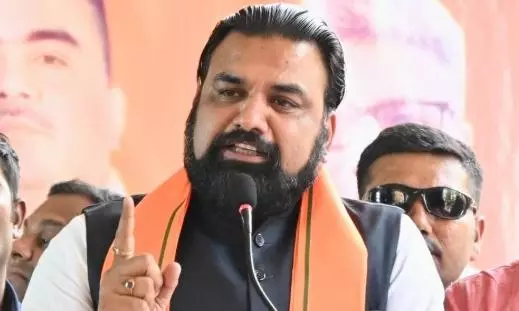
Samrat Choudhary has become the first BJP CM in Bihar. Image: X/Samrat Choudhary
The rise of Samrat Choudhary, from RJD roots to BJP’s first Bihar CM
Once shaped by Mandal-era politics, Samrat Choudhary now embodies the BJP’s OBC pivot as he takes charge in a post-Nitish Bihar

Bihar is witnessing a decisive political transition. With Nitish Kumar stepping down after a long tenure, Samrat Choudhary has been chosen to lead the state—marking a defining moment for the BJP in Bihar.
The shift is not merely administrative. It signals a deeper realignment in the state’s political structure, with the BJP moving from coalition dependency to direct leadership.
A political legacy rooted early
Born on November 16, 1968, in Lakhanpur village in Bihar’s Munger district, Samrat Choudhary was shaped by politics from an early age. He comes from a well-entrenched political family; his father, Shakuni Choudhary, was a seven-time MLA and also served as a Member of Parliament, while his mother, Parvati Devi, represented Tarapur as an MLA.
Also Read: LIVE | Samrat Choudhary picked new Bihar CM after Nitish's resignation
Educated initially in Munger, Choudhary later pursued higher studies at Madurai Kamaraj University. His early years in public life were marked by activism, including a stint in jail during a political movement in 1995, an episode often cited by supporters as part of his formative political struggle.
From Lalu camp to saffron rise
Choudhary’s journey mirrors Bihar’s own political churn. He began his career under Lalu Prasad and served in the government led by Rabri Devi, firmly rooted in Mandal-era social justice politics.
He began his political journey in the 1990s under the influence of Lalu, embedding himself in the social justice politics that defined the era. His early rise was swift. On May 19, 1999, he was appointed Agriculture Minister in the government led by Rabri Devi, a decision that drew attention due to his relatively young age.
In 2000, he secured his first electoral victory as an MLA from Parbatta, laying the foundation for a long legislative career. A decade later, in 2010, he returned to the Assembly for a second term and was appointed Chief Whip of the Opposition, strengthening his role within the state’s political framework.
Turning point
The turning point came in 2014, when Choudhary broke away from the RJD, leading a split and aligning with the government headed by Jitan Ram Manjhi. As Minister for Urban Development and Housing, he marked a decisive shift away from his earlier political affiliations, setting the stage for his eventual rise within the BJP.
Over time, however, he transitioned to the BJP, formally joining in 2017. What followed was a steady rise through the ranks—state vice president, legislative council member, leader of opposition, and eventually Deputy Chief Minister.
His evolution from RJD loyalist to BJP’s central figure reflects a broader ideological shift that has defined Bihar politics over the past decade.
The OBC face of new bjp
At the heart of Choudhary’s elevation lies caste arithmetic. Belonging to the Kushwaha (Koeri) community, he represents a crucial OBC bloc that has historically shaped electoral outcomes in Bihar.
Also Read: Stalin issues a ‘final warning from Tamil Nadu’ to Modi on delimitation
For the BJP, projecting Choudhary is both strategic and symbolic, an attempt to consolidate non-Yadav OBC support while breaking into the traditional “Luv-Kush” axis associated with Nitish Kumar.
His rise also signals the party’s long-term recalibration in the Hindi heartland, where leadership is increasingly being anchored in OBC representation.
A combative and assertive style
Unlike the administrative restraint often associated with Nitish Kumar, Choudhary has cultivated a more aggressive political persona. As Home Minister, he pushed for a tougher law-and-order approach, drawing comparisons with Yogi Adityanath.
His tenure has been marked by strong rhetoric, organisational discipline, and a willingness to directly confront opponents, traits that have aligned him closely with the BJP’s central leadership under Narendra Modi and Amit Shah.
Choudhary’s appointment represents more than an individual rise, it marks the BJP’s transition into a dominant force in Bihar. After years of playing junior partner, the party is now shaping the state’s leadership on its own terms.