








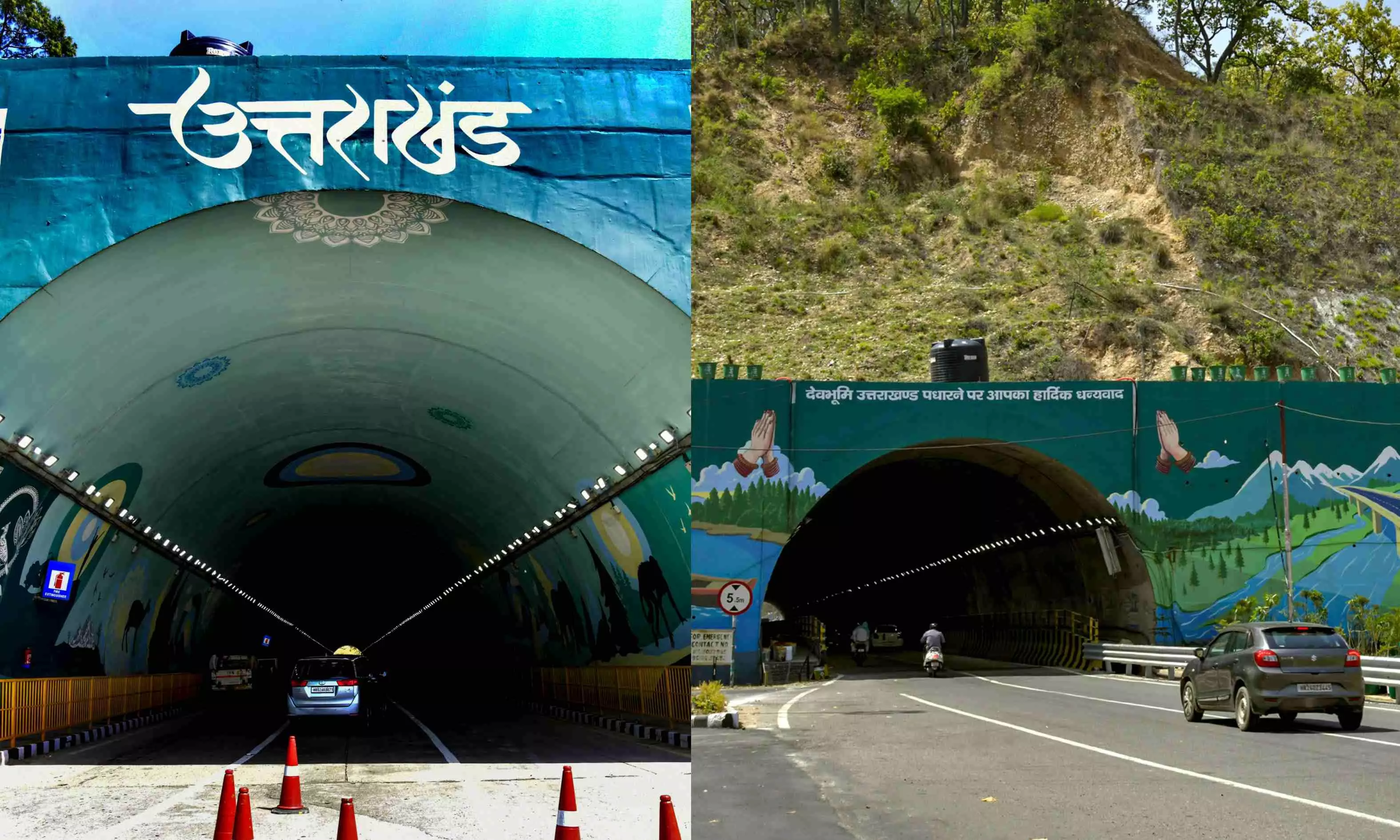
The Delhi-Dehradun Express Highway will reduce the six-hour commute to about two and a half hours. Photo: PTI
Delhi-Dehradun Expressway opens with 12km wildlife corridor; here are key highlights
PM Modi inaugurates the 213-km long corridor featuring a 12-km elevated wildlife passage through Rajaji Tiger Reserve; cuts travel time to two and a half hours

The Delhi-Dehradun Expressway, inaugurated by Prime Minister Narendra Modi on April 14, has been hailed as a landmark example of balancing infrastructure growth with ecological responsibility. Uttarakhand's Forest Minister Subodh Uniyal described the expressway's 12-kilometre elevated wildlife corridor as Asia's longest, saying it would act as a protective shield for wildlife and help reduce human-wildlife conflict.
The final 20-kilometre stretch of the expressway passes through the dense forests of Uttar Pradesh's Shivalik Forest Division, Uttarakhand's Rajaji Tiger Reserve, and the Dehradun Forest Division. To safeguard these habitats, sound barriers and light barriers were installed during construction to minimise the impact of noise and artificial light on animals.
Also Read: Nitish Kumar likely to step down as Bihar CM today, BJP set to form first govt
Six underpasses
The elevated wildlife corridor includes six animal underpasses, eight animal passes, and two 200-metre-long elephant underpasses, all designed to ensure the uninterrupted movement of wildlife. A 370-metre tunnel near the Daat Kali temple further reduces the expressway's footprint through sensitive forest zones.
PM Modi also visited Saharanpur in Uttar Pradesh to review the wildlife corridor on the elevated section before performing a pooja at the Jai Maa Daat Kali Temple near Dehradun.
Travel time cut by hours
Beyond its environmental credentials, the expressway delivers a dramatic improvement in connectivity. The journey between Delhi and Dehradun, which currently takes over six hours, will now take around two and a half hours. The 213-km corridor passes through Delhi, Uttar Pradesh, and Uttarakhand.
The project was launched in February 2021, when Union Road Transport and Highways Minister Nitin Gadkari laid the foundation stone. PM Modi laid a second foundation stone in December of the same year. Built at a total cost of ₹11,868.6 crore, the expressway was originally slated for completion by December 2024.
Also Read: Noida protests: Police say ‘outsiders’ tried to incite unrest; several detained
Four phases, 100-plus underpasses
Construction was carried out in four phases. Phase 1 covers a 32-km, 12-lane stretch from Akshardham Temple in Delhi to the Eastern Peripheral Expressway near Baghpat. Phase 2 extends 118 km to the Saharanpur Bypass with six lanes, seven interchanges, and 60 underpasses. Phase 3 spans 40 km from the Saharanpur Bypass to Ganeshpur. Phase 4 covers the final 20 km to Dehradun, with twin tunnels and elevated sections built specifically for wildlife movement. Across all phases, the expressway features more than 100 underpasses and five railway overbridges.
A 32-km section from Delhi's Akshardham through Mandola Vihar in Ghaziabad to Khekra in Baghpat was completed by mid-2025 and opened to the public in December 2025, giving commuters an early preview of the corridor.
Smart systems
The expressway is equipped with an Advanced Traffic Management System (ATMS) to enhance safety and improve traffic flow. It also connects with key routes including the Delhi-Mumbai Expressway, the Eastern Peripheral Expressway, and roads leading to Haridwar and Roorkee.