








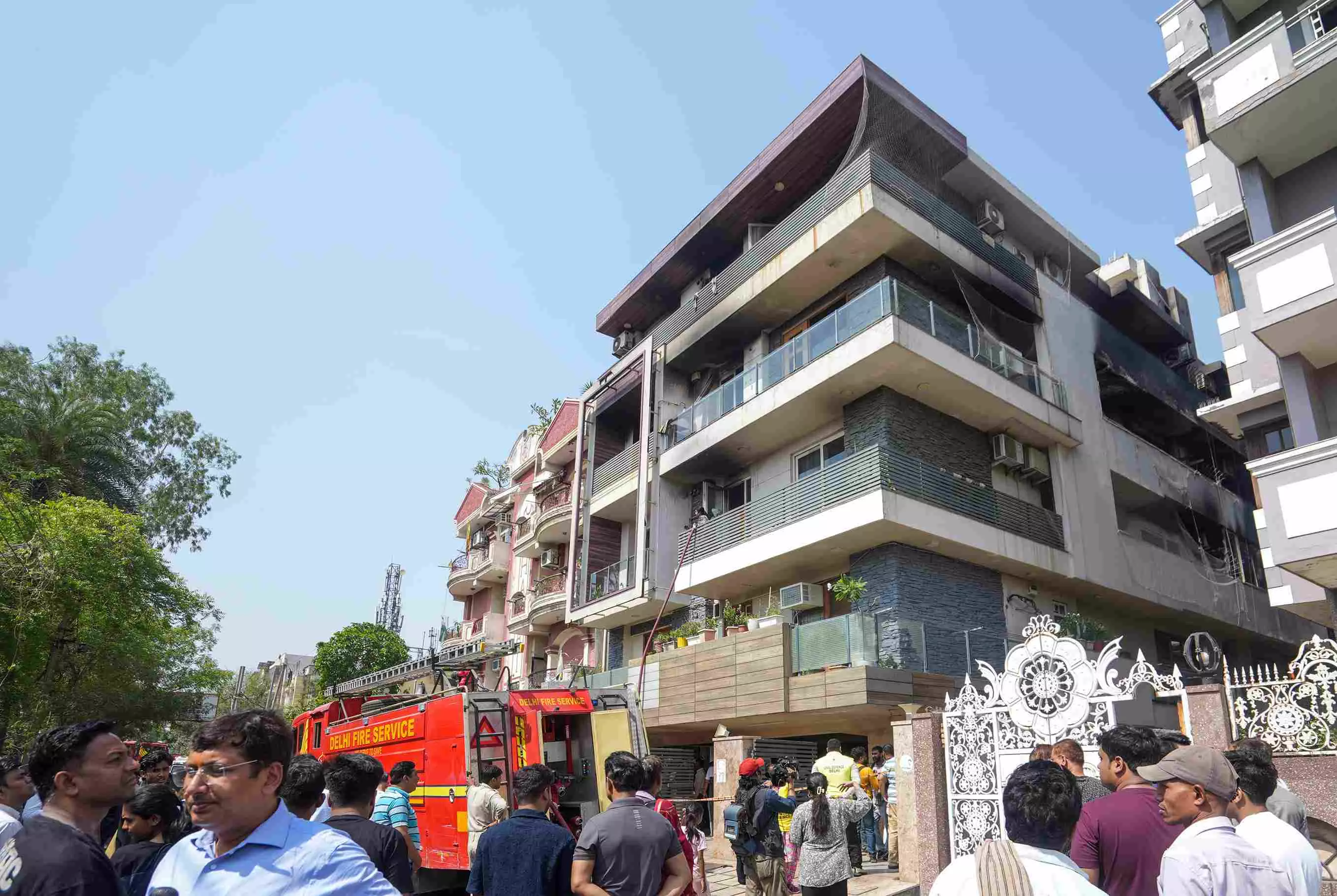
People gather outside a four-storey residential building where a fire killed at least nine people, at Vivek Vihar area, in New Delhi, Sunday, May 3, 2026. Photo: PTI
Delhi fire: How iron window grills, a locked terrace trapped residents, including a toddler
A devastating blaze turns a Delhi residential building into a death trap, claiming lives of two families as rescuers struggle with the complex building layout

Big iron window grills, digital locks, and a locked terrace, which are meant to be security features in a building, turned fatal for nine residents of Delhi’s Vivek Vihar in the early hours of Sunday (May 3).
For the nine residents, which included a toddler (one and a half years old), who suffocated and died as the fire spread rapidly through the residential building, the four-storey building's complex layout also turned into a deathly trap.
Fatal structure
Firstly, the residential building, with eight flats on a 800-yard plot, had only a single central staircase and no emergency exits.
Secondly, each floor was divided into two units—one facing the front and the other the rear. When the fire started at the back of the building, this layout proved fatal for those in the rear flats.
Deputy Commissioner of Police (Shahdara) Rajendra Prasad Meena told the media that the flats located at both the front and rear of the building made access difficult for firefighters.
Moreover, the building's internal design made a rescue operation impossible. The entire building had only one central staircase. As soon as the fire broke out, smoke and flames first rose up this staircase.
Furthermore, the investigation also revealed that people had placed large flowerpots and planters near the stairs and on the fire escapes. In an attempt to enhance the aesthetics, the path became so narrow that people tripped and fell in the dark and smoke.
Also read: Delhi fire: Nine killed as blaze engulfs residential building in Vivek Vihar
Evacuation became an impossibility. Moreover, the heavy iron grills installed on the rear windows prevented residents from jumping to safety or being reached by rescuers, said the police.
The most shocking part was the failure of the electronic central lock. While many buildings nowadays install smart locks for security reasons, in the Vivek Vihar incident, this very technology became the cause of death. As soon as the power to the building was cut off due to the fire or a short circuit occurred, the system of these doors stopped working.
Locked terrace door
Meanwhile, the internal entrances to these flats were quickly engulfed in flames and thick smoke, cutting off access to the front of the building. In a desperate final attempt to survive, several residents braved the heat and raced upward towards the terrace. But what was tragic is that the terrace door was locked.
Stranded in the stairwell with no ventilation and soaring temperatures, a family of three were overcome by smoke inhalation and suffocated before help could reach them. The investigation team is now investigating who possessed the key to this door and whether keeping it locked was part of the building's rules.
Fire department official Mukesh Verma’s statement clearly indicates that if the rooftop access had been open, the number of casualties would likely have been much lower.
People gather after a fire in a four-storey residential building killed at least nine people, at Vivek Vihar area, in New Delhi, Sunday, May 3, 2026. Photo: PTI
According to eyewitnesses, the scene at 3.30 am was one of absolute terror, after the fire broke out. Families in the neighbourhood described a harrowing atmosphere, filled with the desperate cries of adults and children trapped behind the smoke. The situation was so dire that two children were seen attempting to jump from the front of the building to escape the encroaching flames, said reports.
After the fire was completely doused around 8 am, the authorities learnt that the fire had claimed nine lives from two families, including a toddler.
Charred bodies found
Search operations were conducted and the charred bodies were found.
The victims recovered from the second floor belonged to a single family: Arvind Jain (60), his wife Anita Jain (58), their son Nishant Jain (35), daughter-in-law Anchal Jain (33), and their grandchild Akash Jain, who was just one and half years old.
On the third floor, another family was devastated by the blaze. The deceased were identified as Nitin Jain (50), his wife Shailey Jain (48), and their 25-year-old son, Samyak Jain. Their bodies were found huddled together near the terrace door, which was found to be locked.
On the first floor, Shikha Jain (45) was found dead, while her husband, Naveen Jain (48), survived with injuries and is currently receiving treatment
DCP Meena confirmed that nine bodies were recovered and added, “Further enquiry and proceedings at the spot are in progress.”
Lens on AC
While the police are still conducting a formal investigation to determine the exact origin of the fire, a resident of the area told ANI that a powerful air-conditioner (AC) blast is believed to have triggered the horrific incident.
But the question remains: how did a fire from one machine engulf the entire building? A major part of the investigation is revolving around AC gas. It’s common for people to choose local mechanics instead of authorized service centres to save a few bucks.
Experts say local mechanics often fill low-quality gas that isn't fireproof. If the AC had a technical fault and the gas was local, it may have acted as fuel. The investigation team is now investigating the mechanic and his service history to determine whether this was a manufacturing defect or negligence in servicing.
AC technician Deepak Meena says cheap or counterfeit gas available in the market often contains hydrocarbons or petroleum products, which are highly flammable. If this gas leaks and comes into contact with even a small spark in the compressor or wiring, it can cause a fire or a major explosion. It puts excessive pressure on the compressor, causing it to overheat and explode. Using substandard gas can lead to moisture in the system, acid formation, and debris accumulation in the pipes, which can burn out the compressor.
Initial alarms and rescue efforts
The first person to spot the danger was a delivery agent who arrived at the building late at night. According to his statement to the police, the fire began as sparks emanating from an external air-conditioning outlet. By the time the severity of the situation became clear, the flames had already escalated beyond control.
Local residents noted that over 10 fire tenders arrived at the scene. They saw the fire brigade rescuing approximately 20 people through the front balconies, while some residents from the rear flats managed to find paths out on their own. However, local residents felt "one or two families" were still trapped inside the structure.
Delhi Chief Minister Rekha Gupta described the incident as “extremely tragic” and condoled the death of the people in the fire.
The Vivek Vihar fire is a warning to thousands of flat owners across Delhi, as well as other parts of India. The police charge sheet may include the names of the AC mechanic, the builder, and perhaps even some residents. But the biggest question is: Who should be blamed for this tragedy? Legally, residential buildings below 15 meters do not require a fire NOC, which builders take advantage of by not installing fire systems. But shouldn’t the residents themselves be more responsible?