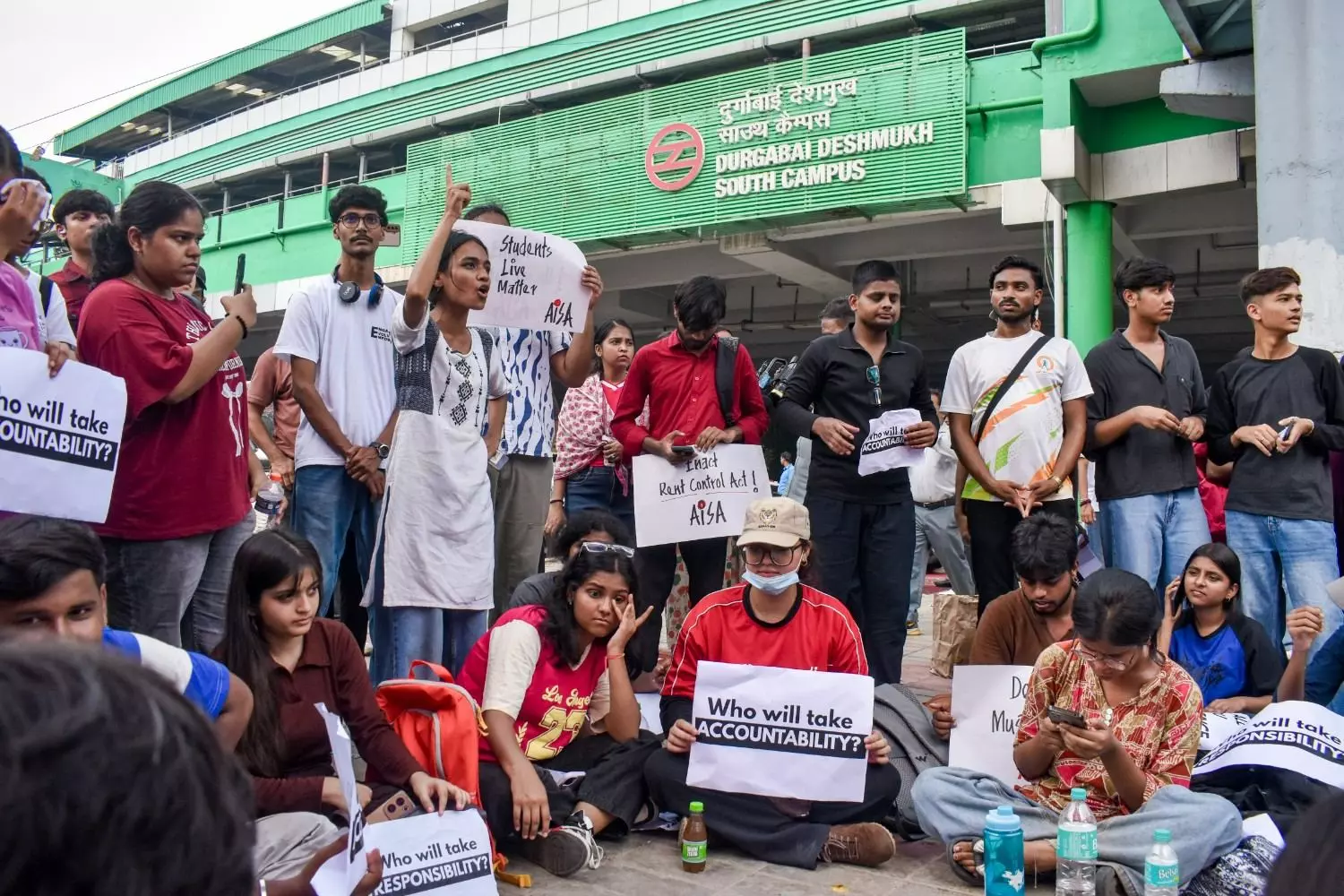
Students gather to stage a protest demanding safety audits of PGs and university-regulated hostel accommodations outside Durgabai Deshmukh South Campus metro station, a day after a five-storey building housing a boys' hostel collapsed in Satya Niketan, in New Delhi, Monday, September 7. PTI
Ground Report | Satya Niketan tragedy: Life in Delhi's PGs, one collapse away from disaster
The incident has renewed focus on regulating PG accommodations in Delhi’s student hubs. Questions remain over how a building declared “dangerous” could be used to house students

The collapse of a building in Delhi’s Satya Niketan, near Delhi University’s South Campus, has raised questions over the safety and regulation of paying guest (PG) accommodations used by thousands of students in the national capital.
The building, which reportedly housed a boys’ PG with around 75 beds and had a chemist shop on the ground floor, collapsed on Sunday (September 6), killing seven people and prompting the rescue of nine others.
The 40- to 50-year-old building had earlier been declared “dangerous”. Despite this, a PG was operating there. The circumstances under which students were allowed to stay on the premises, and whether the required permissions and safety clearances were in place, are now under scrutiny.
Excavation work under building
When The Federal Desh reporter visited the site, students living in the area said excavation for a basement had been under way beneath the building for several days before the collapse. A Maitreyi College student living opposite the premises said a new boys’ PG had recently begun operating there and that many students were staying in it.
Also read: Satya Niketan building collapse: Owner arrested in Rajasthan
The account has raised questions about whether the excavation was authorised and whether structural safety assessments were carried out before the work began.
Delhi Chief Minister Rekha Gupta visited the site after the incident, while the Delhi and Central governments took cognisance of the collapse. However, students and residents have questioned the monitoring mechanisms that allowed a reportedly unsafe building to continue being used for accommodation.
High rents, poor living conditions
Students in Satya Niketan also pointed to the high cost and poor quality of accommodation in the locality. Ankit, a student, said shared rooms could cost Rs 15,000-Rs 16,000 a month, with some rooms being too small to comfortably accommodate two beds, a table and personal belongings.
Rohit, a former student of Atma Ram Sanatan Dharma College, said finding accommodation without a broker was difficult. Students may have to pay Rs 40,000-Rs 45,000 upfront towards advance rent, security deposits and other charges, often without clear information about the building’s approvals or fire-safety arrangements.
Also read: Satya Niketan building collapse: Latest student hub tragedy where safety went for a toss
A student of Aryabhatta College said three girls paid around Rs 26,000 a month for a room and alleged that the food served at the PG had affected her health. Students have also reported problems involving water seepage and electrical safety, including instances of electric current being felt in taps and other appliances.
Questions over regulation
The incident has renewed focus on regulating PG accommodations in Delhi’s student hubs. Questions remain over how a building declared “dangerous” could be used to house students, whether additional construction and basement excavation were authorised, and whether fire and structural safety inspections were conducted.
For students who travel from across the country to Delhi for higher education, the availability of safe and affordable accommodation remains a critical concern. The Satya Niketan collapse has underscored the need for effective monitoring and enforcement of safety norms in areas with a high concentration of student housing.
(This article was originally published in The Federal Desh)