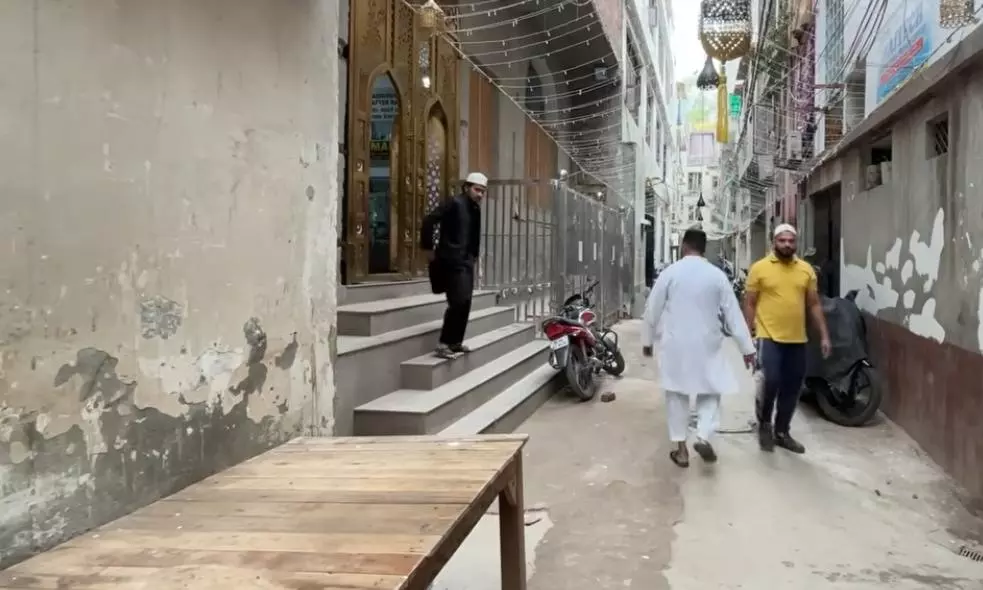
Fear and rumours grip Delhi's Hastsal neighbourhood ahead of Eid
As social media threats spark panic, residents say fear and misinformation drove over half the Muslim families to leave the once-peaceful area near Uttam Nagar

“What are we supposed to do — just wait and watch?” This is the question Muslim residents of Hastsal JJ Colony in Delhi are asking after a social media post threatening bloodshed during Eid sent shockwaves through the neighbourhood, prompting more than 50 per cent of Muslim families to temporarily leave.
“What happened to Tarun [a youth killed on Holi day] was wrong. Those who attacked him deserve to be punished. But what is the fault of ordinary Muslims in all this?” asked a resident. That, more or less, is how most of the neighbourhood is putting it.
The Federal Desh team visited the colony to find out whether the exodus was real and what was driving it.
Fear on camera, fury off it
Was social media alone responsible, or had Muslim families always left the area around Eid? Most of those willing to speak were women — and almost none wanted to be on camera.
“You are seeing the result of years of hatred sown against our community,” one of the residents said. “If we speak up, we are called anti-national. Our words are twisted. We are viewed with suspicion. Who do we even go to? Today, national media is portraying us as villains. Our neighbourhood is being defamed.”
Also read: Group of eminent Muslims urges Amit Shah to act on Uttam Nagar Eid threats
When pressed on who exactly was responsible, the response was sharp: “Don’t act so naive. You know who.”
The residents pointed out that Hastsal has been a mixed Hindu-Muslim neighbourhood for 50 years, with no history of trouble. One incident, they said, had turned them into enemies in everyone’s eyes.
After nearly two hours of persuasion, a few residents agreed to speak on camera. Riyaz, Rehan, and Shubham (names changed) explained the situation in detail.
'Khoon ki Holi'
“Around 50 per cent of the Muslim community have left the area, and that khoon ki Holi (blood-soaked Holi) post on social media is directly responsible,” Riyaz told The Federal Desh. “If you look at this colony, you won’t find a better example of communal harmony anywhere. In any given lane of 20 houses, half are Hindu and half are Muslim. People help each other.”
So who exactly was leaving?
Rehan had an answer. “Most of those who have left are from Bihar and UP — mostly daily wage workers. They were the most frightened. But even families who have lived here for 50 years have left. The social media post got inside people’s heads.”
Shubham, for his part, kept returning to the root cause.
Also read: Uttam Nagar Holi clash: 7 held; neighbours with old dispute involved, say Delhi police
“What happened on March 4 should not have happened,” he said. “This colony has always had its arguments, but people sorted things out among themselves. Right now, though, the atmosphere is tense.”
Asked whether local peace committees were urging people to stay, Shubham was blunt.
“That responsibility lies with the administration. The same administration that looks so active today, barricading our neighbourhood, should have acted much earlier against those spreading hatred on social media. If they had, we wouldn’t be in this situation.”
'Why weren’t the hate-mongers stopped?'
Adil Ali, president of the Uttam Nagar Jama Masjid, echoed the frustration. “Why did it come to this, with police having to mount a security operation in the first place?” he asked. “Why isn’t the police acting against those who posted hate content?”
He confirmed that more than 50 per cent of Muslim residents had left the area. Efforts to persuade people to stay were ongoing, he said, but fear was not easy to overcome.
Also read: In rare harmony, Belagavi Muslim couple raises Hindu orphans, holds Lingayat wedding
“The speeches made by those spreading hatred — in the name of supporting the victim’s family — only frightened people further. Most of those who left are daily wage earners. They felt the situation was unsafe and returned to their villages," said Ali.
What happened on March 4
On Holi day, a Hindu child allegedly threw a water balloon at a Muslim woman, leading to a brawl. Tarun, 26, was allegedly assaulted by members of the accused’s family, and he died.
Residents say the water balloon was merely the spark — the two families had been at odds for years. But others seized on the incident to give it a communal colour. The social media posts that followed did the rest, spreading fear through a community that, by most accounts, had lived peacefully here for half a century.This article was originally published in The Federal Desh.