



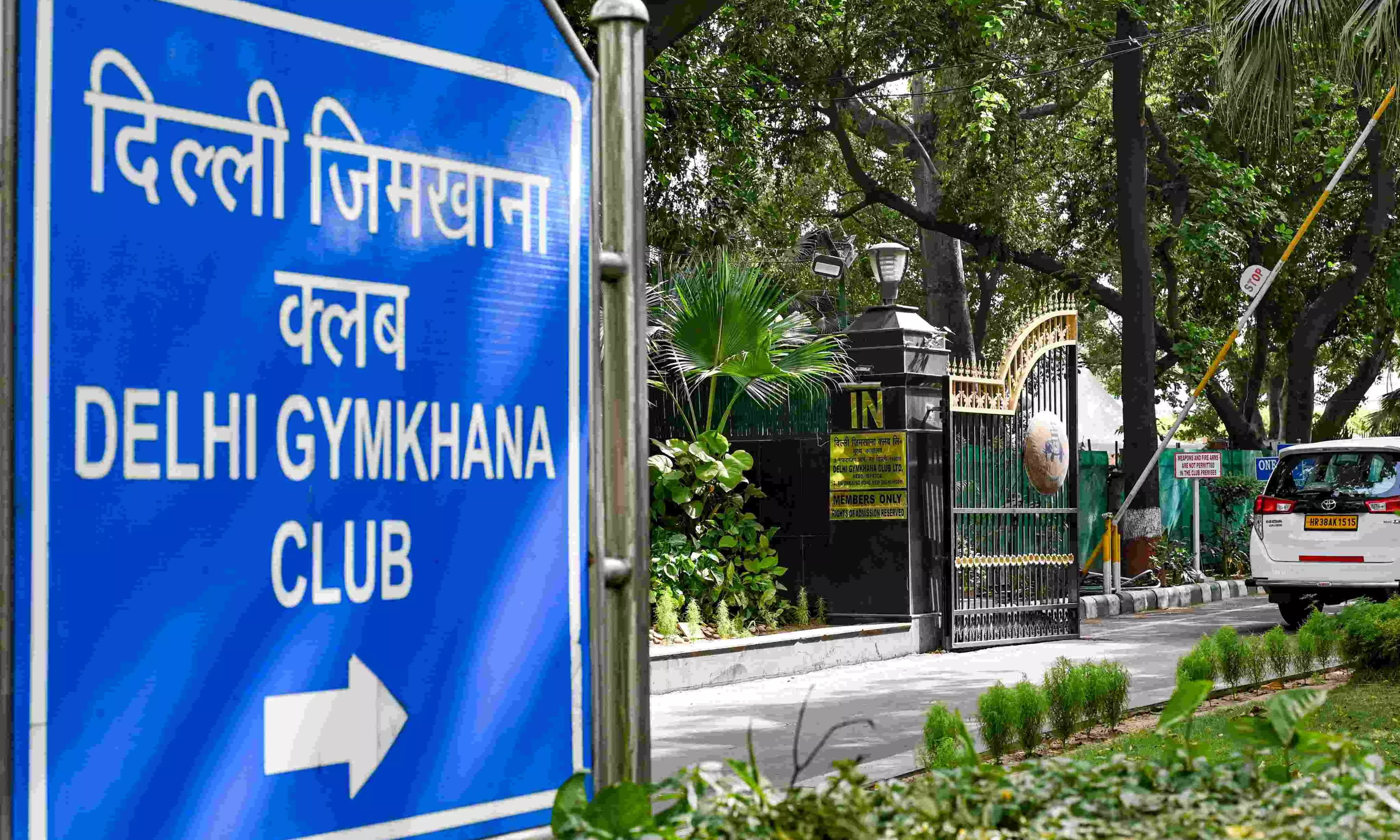
Imperial days to eviction: All you need to know about Delhi's Gymkhana Club
The Centre cited defence and security needs to reclaim the Lutyens' Delhi plot, throwing the 112-year-old club's future into deep uncertainty

For over a century, the Delhi Gymkhana Club has been the quiet address where the elite and who's who of India exercised their powers and socialised. That iconic structure now faces its most direct challenge yet.
The Centre has ordered the club to hand over its sprawling 27.3-acre premises at 2, Safdarjung Road, by June 5, setting off a debate that stretches from the club's mahogany-panelled halls to television studios and social media timelines.
The government's order
The Land and Development Office (L&DO), under the Ministry of Housing and Urban Affairs, issued its notice on May 22, invoking Clause 4 of the original lease deed to terminate the arrangement and order immediate re-entry of the premises. The order states that the land falls in a "highly sensitive and strategic zone" and is "critically required" for strengthening and securing defence infrastructure, as well as for urgent institutional, governance and public security purposes.
Also Read: Where have Modi’s rivals gone? The slow erosion of India’s Opposition
Under the order, the entire plot — along with all buildings, standing structures, lawns and fittings — will vest absolutely with the President of India through the L&DO upon re-entry. Possession is to be handed over peacefully on June 5. "In the event of non-compliance, possession shall be taken in accordance with law," the notice warned.
Why the land is needed
The premises sit adjacent to the prime minister's residence on Lok Kalyan Marg, within a high-security administrative zone that houses several key central government and defence establishments.
A senior official in the housing ministry noted that most land in Lutyens' Delhi allotted on lease is owned by the Government of India, which retains the power to reclaim it citing security or national interest. The L&DO said the land was also needed for public-interest projects integrated with the resumption of adjoining government lands.
The move comes against the backdrop of the recent removal of slums near Race Course Road. In March this year, the Delhi High Court had stayed eviction notices issued to the Delhi Race Club and the Jaipur Polo Ground, holding that the ministry could not take "forcible possession" of iconic premises.
A landmark building
The club's current home is a majestic white building designed by architect Robert Tor Russell, who also shaped two other defining features of New Delhi, the Connaught Place complex and the Commander-in-Chief's house, now known as Teen Murti Bhawan.
Constructed in the early 1930s, the building was contracted to Sir Teja Singh Malik, one of the two major contractors of New Delhi at the time. Russell, who remained involved in the club's management as a general committee member until the 1930s, was keen that the design complement the bungalows rising in the neighbourhood.
The result was what the club's own records describe as a "spartan yet majestic building" set amid green lawns, featuring a famed ballroom with a wooden floor, a swimming pool, tennis courts and a billiards table.
A piece of history adorns the pool: in the early 1930s, Lady Willingdon, wife of the then Viceroy, gifted Rs 21,000 for its construction. Inscribed tablets — 'Lady Willingdon Swimming Bath' and 'The Willingdon Squash Courts' — were put up in recognition before the Viceroy and Lady Willingdon visited for their farewell on March 16, 1936.
Born in colonial Delhi
The club's origins are inseparable from New Delhi's own birth as India's capital. After the announcement at the 1911 Delhi Durbar that the capital would shift from Calcutta, New Delhi was built between 1912 and 1931 under the principal architecture of Sir Edwin Landseer Lutyens and Sir Herbert Baker, and formally inaugurated by Viceroy Lord Irwin in February 1931.
In that same arc of history, the Imperial Delhi Gymkhana Club was founded on July 3, 1913 — initially in the Civil Lines area — to serve colonial administrators and military officers. Its first president was Sir Spencer Harcourt Butler, a prominent British administrator who later served as the first governor of the then United Provinces of Agra and Oudh in the 1920s. The club moved to its present Safdarjung Road address on July 3, 1913. After Independence in 1947, the word 'Imperial' was dropped from its name, but the colonial-era charm, and the exclusivity, remained firmly intact.
Elite by design
Membership of the Delhi Gymkhana Club has long been considered a status symbol. Its waiting list is notoriously long, and its rolls have included former prime ministers, senior government and defence officials, members of the judiciary and prominent figures from corporate India. The club celebrated its centenary in 2013.
In February 2016, it made a rare concession to the outside world, hosting its first literature festival and opening its gates to non-members with prior registration — a moment that was notable precisely because such openness was the exception, not the rule.
Members plan to push back
The club met on an urgent basis on May 23 and announced it would write to the L&DO seeking clarity on several issues, while also requesting an urgent appointment with housing ministry officials. "The immediate priority of the club is to ensure that its operations continue without dislocation," it said in a communication to members.
Also Read: Why India's tough economic reality can't be ignored anymore | Talking Sense With Srini
However, the club's ability to mount a legal challenge is constrained. Since 2022, when the National Company Law Tribunal permitted the Centre to take over management citing financial irregularities and company law violations, the club has been run by a government-appointed committee.
Madras Gymkhana Club president Capt S Seshadri said that it was a sad thing to happen to an institution of such stature.
"I am not going to say it's fair or not fair. It's beyond my capacity to say that. But I feel sad," he said.
A member, speaking anonymously, said individual members may have to file their own applications in court. "How can we expect the current management to challenge the order?" the member said.
However, the push back might not turn as effective as the members opine that since the club is run by a committee appointed by the government, there will not be a challenge to the order from them.
A member, on condition of anonymity,"How can we expect the current club management to challenge the order since it is currently being run by the government-appointed committee? Members will have to file an application on their own to challenge the government's order."
Criticism and colonial echoes
The order has sparked sharp reactions. AAP leader Saurabh Bharadwaj drew a pointed political arc: "Till now, it was the poor who were being affected, so the rich were not too bothered. Then came the turn of shopkeepers. Now it is the turn of senior officers and professionals who visit clubs. Everyone's turn will come eventually."
Also Read: Lid comes off Rs 200-crore ‘land scam’ in Punjab with realtor Ajay Sehgal’s arrest
Some on social media have described the club as a vestige of the colonial era, while others argue it represents a heritage that should be acknowledged without bias. One club member questioned the security rationale, noting that the Indira Gandhi Memorial on the same road is visited by thousands daily.
600 jobs at stake
Beyond the members, the order has cast uncertainty over nearly 600 employees. On May 23 evening, staff said they had received no formal briefing. A gardener who has tended the tennis lawns for 17 years said he heard of the development only recently.
"There has been no formal meeting with employees so far. Most of us are still waiting for clarity on what happens to our jobs after June 5," another staff member said. A club official acknowledged the ground reality: "An immediate shutdown without transition is not practically feasible."
With agency inputs