








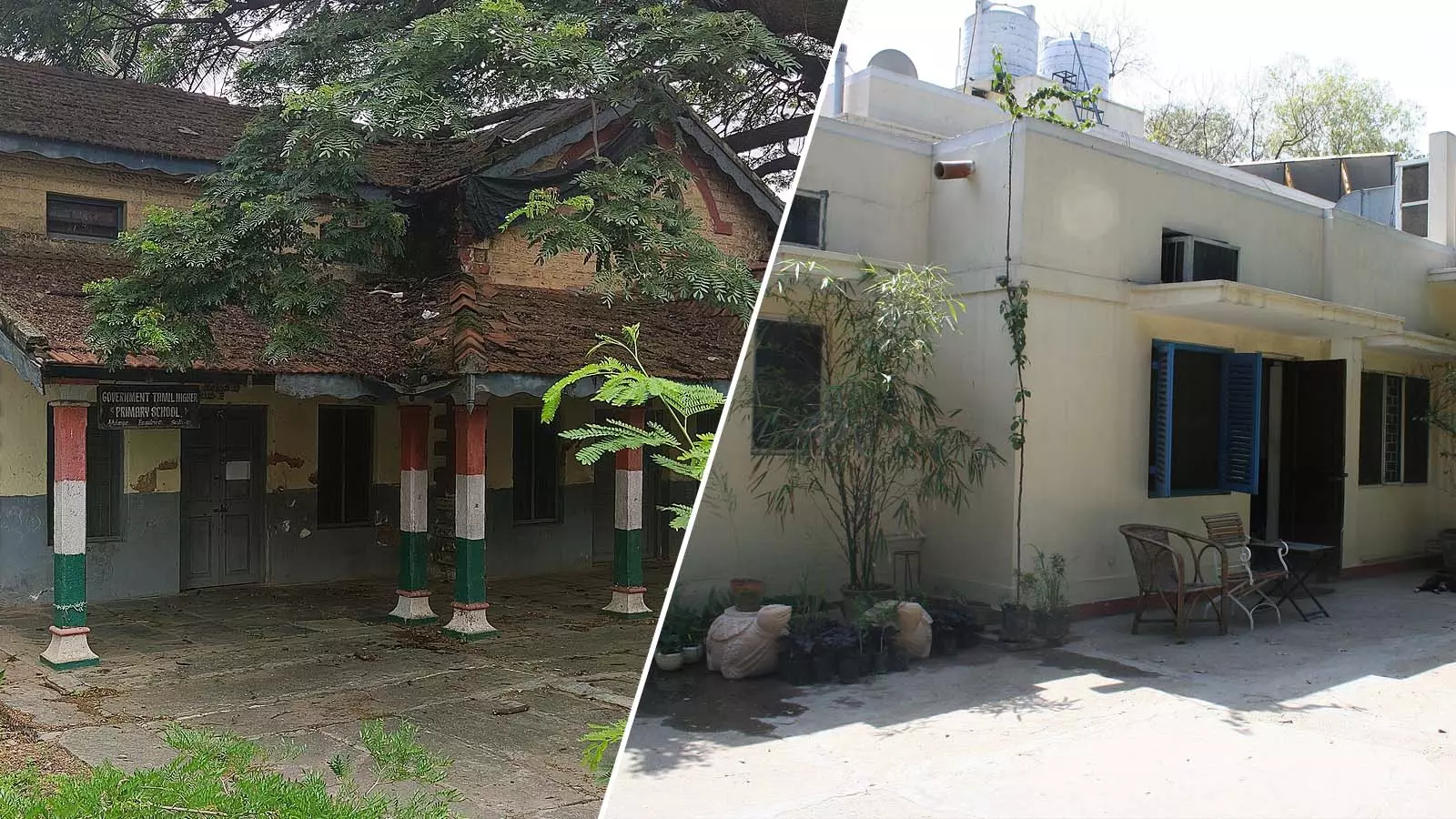
Reacting to the report on the government’s spending on Lutyens’ bungalows, the Cockroach Janata Party (CJP) said Rs 92 crore could build 10 new world-class government schools and urged the Centre to prioritise fixing schools over maintaining lavish homes.
Rs 547 cr spent on Lutyens bungalows in 12 years; CJP says ‘fix schools’ instead
The annual expenditure on the renovation, furnishing and repair of the official residences of Union ministers touched a record high of Rs 92.35 crore in 2025-26

A day after media reports based on an RTI query revealed that the government had spent over Rs 500 crore in the past 12 years to upkeep Delhi's century-old iconic Lutyens bungalows, the Cockroach Janata Party (CJP) slammed the government, saying money should be used to fix the schools and not lavish bungalows.
According to information obtained by PTI through an RTI query, the government spent Rs 547.68 crore on such works between 2014-15 and 2025-26 through the Central Public Works Department (CPWD), which executes the repairs, renovation and maintenance works.
CJP targets Centre
The annual expenditure on the renovation, furnishing and repair of the official residences of Union ministers touched a record high of Rs 92.35 crore in 2025-26, more than three times the Rs 27.47 crore in 2014-15.
Also read: Delhi Gymkhana Club debate: 'Should MPs' bungalows also go?' | AI With Sanket
Accusing the Centre of misplaced priorities, the Cockroach Janta Party (CJP) has said the record Rs 92.35 crore bill spent for the upkeep of Union ministers' official residences last financial year could have paid for 10 new government schools.
"Stop fixing your lavish homes, and fix the schools!" CJP said in an X post. "Rs 92 crore = 10 new world-class government schools. The money is available, the intent to use it for government schools is missing," the CJP post read.
Its latest campaign 'School Thik Karo' has focused on the state of government schools.
Why maintenance costs have risen
The data shows that the annual bill for 2025-26 was the highest since 2014, officials said, attributing it to various factors, including inflation as well as the wear and tear costs of the ageing structures set in expansive grounds in the heart of the capital.
CPWD officials have, over the years, pointed to maintenance challenges such as seepage, termite infestation, ageing electrical systems, plumbing problems and other repairs. In the past, there have also been plans, though never officially announced, to raze and rebuild some of the bungalows. "These are mostly 80-90-100-year-old bungalows. Some, though not all, had even become structurally unsafe and needed to be upgraded," an official said.
The history of Lutyens bungalows
Built as part of the development of New Delhi as the imperial capital, the bungalow zone was developed between 1912 and 1930 and later adapted for use by senior government functionaries after Independence. Besides ministers, the bungalows are also occupied by members of Parliament, senior judges and top military officers among others.
Also read: BJP targets Arvind Kejriwal over ‘Sheesh Mahal 2’ bungalow allegations
Historian and author Swapna Liddle said, "These bungalows reflected the same pattern seen in residences that the British built in Civil Lines in most Indian cities to house their officials: a big compound, with ancillary buildings for the staff apart from the main building.”
Spending rises sharply
From 2014 to 2019, the ministers spent an average of Rs 26.78 crore per year on repairs and upgradation. The average annual spending doubled to nearly Rs 50 crore from 2019 to 2024. In 2024-25, the spend was Rs 71.98 crore and last year it was Rs 92.35 crore, according to the RTI reply.
While the information was sought, the CPWD did not furnish data on expenditure incurred during this period on the residences of Lok Sabha and Rajya Sabha MPs who are not ministers, or on the offices of Union ministers and ministers of state.
The Union council of ministers over the years has comprised around 70 to 72 Cabinet ministers and ministers of state. At Rs 92.35 crore in the last financial year, the cost of repairs and renovation works out to an average of Rs 1.2 crore per minister, though actual expenditure varies from residence to residence.
The year-wise expenditure stood at Rs 27.47 crore in 2014-15, Rs 29.57 crore in 2015-16, Rs 30.10 crore in 2016-17, Rs 23.34 crore in 2017-18, Rs 23.42 crore in 2018-19, Rs 26.37 crore in 2019-20, Rs 53.87 crore in 2020-21, Rs 40.84 crore in 2021-22, Rs 73.86 crore in 2022-23, Rs 54.52 crore in 2023-24, Rs 71.98 crore in 2024-25 and Rs 92.35 crore in 2025-26, shows the RTI response.
What the repairs involve
A staff member of a Cabinet minister told PTI on condition of anonymity that the most frequent demands for repair and renovation mostly concern electrical items such as fans, LED lights and plumbing work every few months, and replacing floor tiles every few years.
According to an RTI response in September 2009, between 2004 and 2009, a period of five years, the government spent a cumulative Rs 93.50 crore on maintenance and renovation of bungalows allotted to Members of Parliament and Union ministers.
Kejriwal’s ‘Sheesh Mahal’ row
AAP leader and former Delhi minister Somnath Bharti, meanwhile, sought to contrast the expenditure with the controversy over the construction and renovation of the official residence occupied by Arvind Kejriwal as chief minister.
Also read: Kejriwal vacates CM residence, shifts to colleague's Lutyens' Delhi bungalow
"Why doesn't the Godi media debate this 92 crore splurge on repair of houses of ministers in Modi govt who left no stone unturned to criticise Kejriwal govt for constructing a CM house?" Bharti wrote on X.
The BJP had made the expenditure on Kejriwal's former Civil Lines official residence a major political issue, repeatedly accusing the previous AAP government of extravagance and referring to the property as a "sheesh mahal".
(With agency inputs)