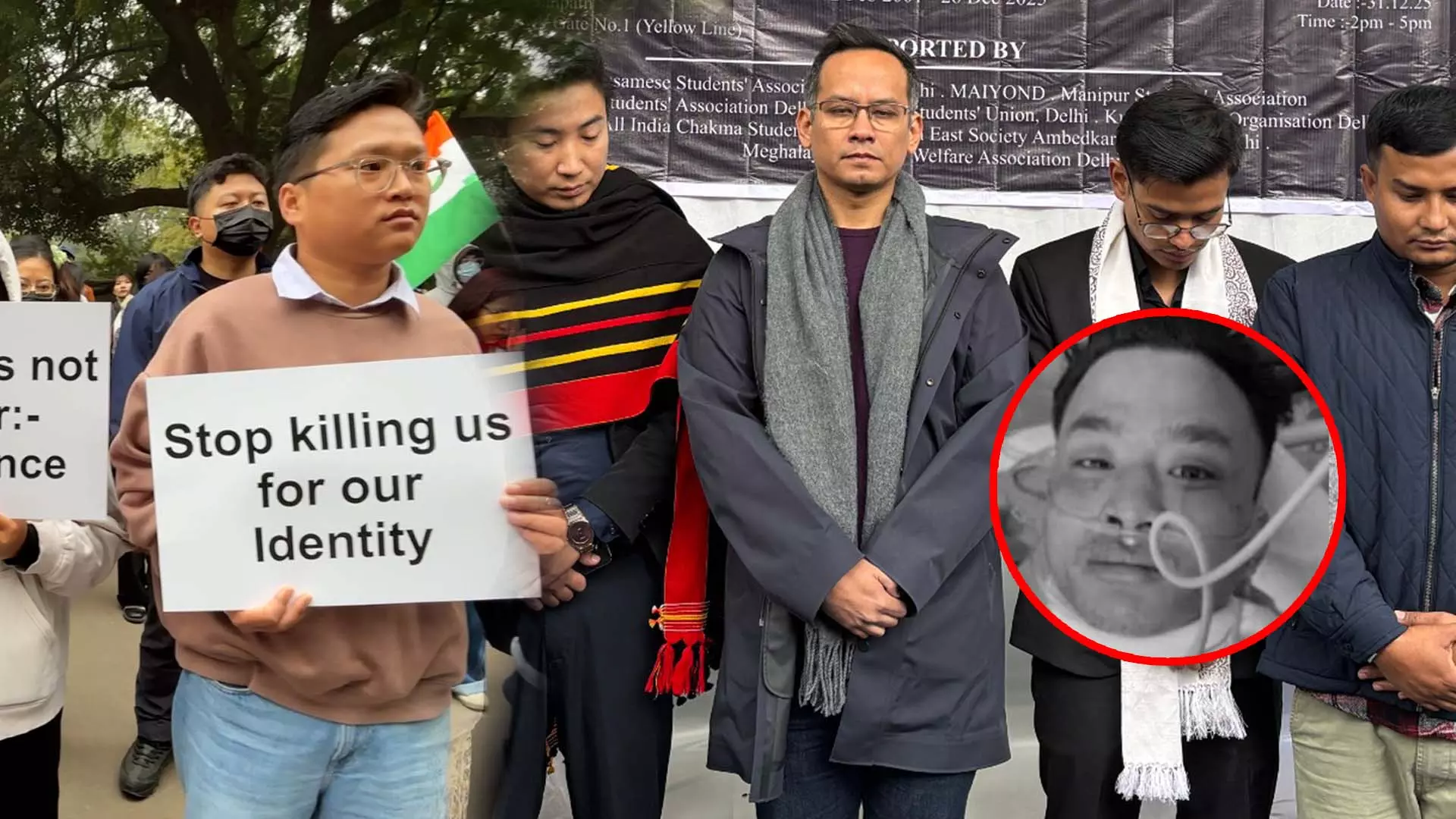
Justice for Anjel Chakma: North East groups protest against racism in Delhi
From racial slurs to legal gaps, protesters demand accountability and a CBI probe into Anjel Chakma’s killing, citing systemic discrimination

People from several North-Eastern states gathered at Jantar Mantar in New Delhi to demand justice for Anjel Chakma, a student from Tripura who was killed in Dehradun earlier this month. Protesters alleged that the killing was racially motivated and reflected a deeper pattern of discrimination faced by people from the region.
Raising slogans such as “We are not Chinese, we are Indian”, and holding placards demanding the enactment of an anti-racial law, the protesters said the incident was not an isolated crime. They accused authorities of downplaying the racial dimension of the case and demanded a transfer of the investigation to the CBI.
The gathering also became a platform for North-Eastern students and residents to speak about everyday racism, stereotyping, and the lack of legal protection against racial abuse.
Accounts of racism
Dixsona Chakma spoke about routine discrimination faced by students from the North East, saying ignorance about the region fuels prejudice. She recalled being questioned about her identity and nationality simply because of her appearance, pointing to a persistent lack of awareness beyond Assam.
Dipti Chakma highlighted how racial slurs have become normalised, even in the national capital. “We want justice. Even here in Delhi, people call us ‘Chinki’ and ‘Nepali’. This is not acceptable to us anymore,” she said. “We have been here for 25 years, but when we step out, we don’t feel comfortable. In schools, hospitals, everywhere, they ask if we are Chinese.”
Ranjini Chakma said many such incidents never get reported or formally registered. Questioning the police narrative, she said she did not trust the claims made by the Uttarakhand police. “Enough is enough. This will not be tolerated,” she said, adding that the truth must come out and accountability must be fixed.
Solidarity voices
While the protest was led largely by people from the North East, voices of solidarity also came from outside the region. Former Delhi University Students’ Union (DUSU) president Ronak Khatri joined the gathering and said racism against North-Eastern students was a long-standing issue.
“Our demand is not just because this incident happened in Dehradun,” Khatri said. “Racism is an old problem. North-Eastern students are humiliated by being called ‘Chinese’ or ‘momo’ across campuses.” He reiterated the demand for a CBI probe, saying the community does not trust the Uttarakhand police.
Khatri also pointed to the failure of institutional mechanisms. “Every college has a grievance cell, but they are inactive,” he said, urging the Education Ministry to set up dedicated committees in colleges with North-Eastern students, including principals, to ensure complaints are acted upon.
Political backing
Congress MP from Assam, Gaurav Gogoi, also attended the protest and expressed solidarity with Chakma’s family. He stressed the need for specific laws to deal with racial slurs and demanded that the investigation be fast-tracked.
“We stand here in grief and in solidarity with the family of Anjel Chakma,” Gogoi said. He argued that racial abuse should attract punishment similar to caste-based slurs and said he would raise the issue in the next session of Parliament.
Gogoi added that without clear legal provisions, cases involving racial abuse often fall through the gaps in the system.
Core demands
Pointing Thokchom, president of the North-East Students’ Society DU (NESSDU), said the protest reflected fear and anger within the community. Referring to earlier cases of racial violence, she warned that the absence of strong laws puts every North-Eastern student at risk.
“Today it is Anjel Chakma. Tomorrow it could be me or anyone from the North East,” she said, calling on the government to enact a law that protects North-Eastern people and students living across India.
Two key demands emerged clearly from the protest: the immediate transfer of the case to the CBI and the enactment of a comprehensive anti-racial law to address racially motivated abuse and violence.
The content above has been transcribed from video using a fine-tuned AI model. To ensure accuracy, quality, and editorial integrity, we employ a Human-In-The-Loop (HITL) process. While AI assists in creating the initial draft, our experienced editorial team carefully reviews, edits, and refines the content before publication. At The Federal, we combine the efficiency of AI with the expertise of human editors to deliver reliable and insightful journalism.