



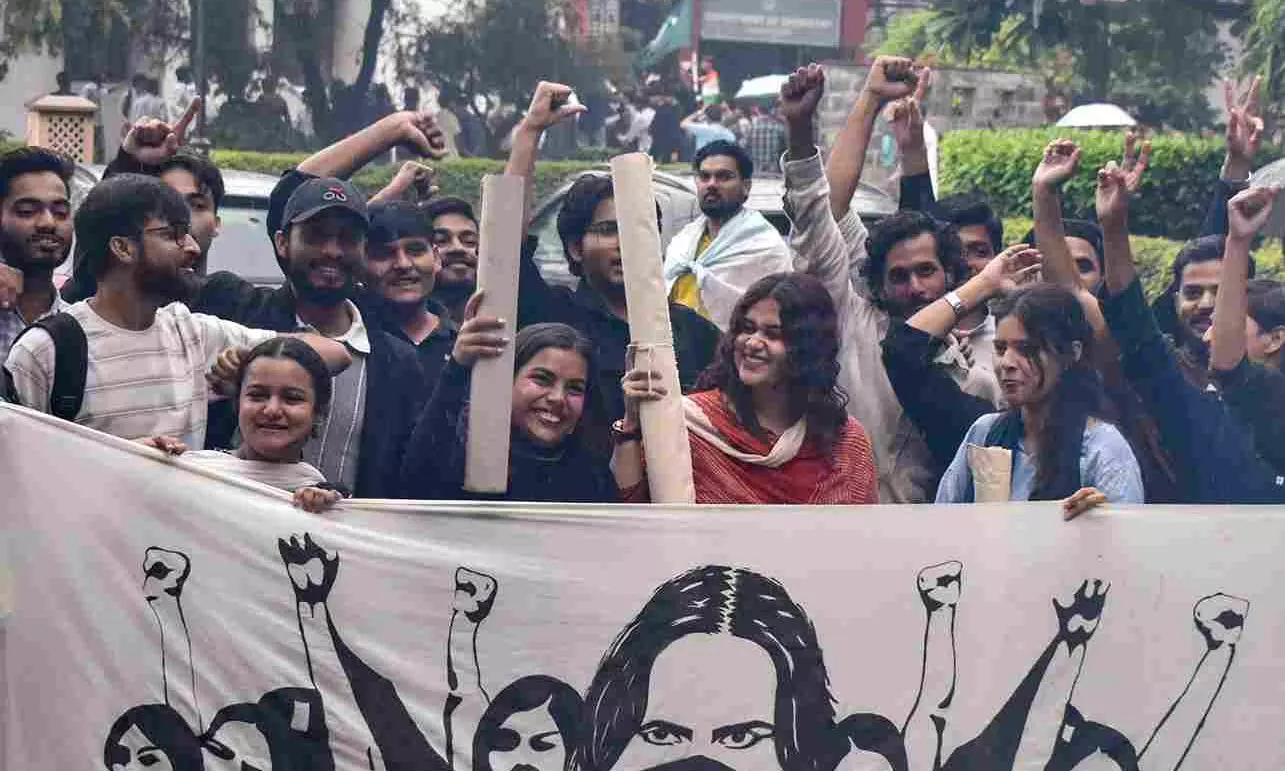
‘Protest over, movement not’: Jamia students wary despite union assurance
After securing a written assurance on union revival, Jamia students remain watchful as the constitution, election timeline and withdrawal of disciplinary action remain unresolved

“The protest has ended, but the movement has not.” That is the message from Jamia Millia Islamia students after the university, on the night of its 106th foundation day, gave them something it had withheld for 20 years: a written commitment to restore the student union, dissolved in 2006 following violence and clashes on campus.
But the commitment is only a first step. The union’s powers and scope will depend on a constitution yet to be drafted, and students say they will resume the agitation if the administration backs down.
The leaders are already looking at what comes next, even as regular classes are scheduled to resume on Monday.
Also read | Jamia approves students' union constitution; sets May 15 deadline, asks protesters to end stir
“This is not a small thing,” said Mantasha Irfan, a second-year MA Conflict and Peace Studies student with AISA. “This is the first time in 20 years that the administration has given us in writing that there will be a student union. The paper carries official stamps. We are believing them,” she said.
But students are also quick to point out that a written commitment is not the same as an actual union. “Till the union is notified, this victory will not be complete. Till elections happen, this victory will not be complete,” said Neville Thomas, a sociology PhD scholar who was part of the delegation that negotiated with the administration.
What came before the final deal
According to Thomas, on Monday, the administration proposed that the student union’s constitution would be drafted by December 20. It then added a fresh step: elections would be notified 15 days after the constitution was approved. It offered no clear date for the elections.
The students held out because they felt the offer was too vague. Two hunger strikers were ready to relent, but the others continued their fast in the hope of securing a concrete timeline. It took four more days of delegations to the Vice-Chancellor, administrative staff and teachers before the notification arrived on the university’s 106th foundation day.
The administration has set May 15, 2027, as the deadline to finalise the JMISU Constitution in consultation with faculty representatives. The next academic session begins on July 15 or 16, and elections are to be held within six weeks of that date, placing them in August 2027 under the Lyngdoh Committee guidelines.
The Lyngdoh Committee report, dated May 23, 2006, and headed by former Chief Election Commissioner JM Lyngdoh, contains recommendations on electoral reforms for student union elections in universities and colleges.
The wait for elections has a reason. The Lyngdoh Committee requires student elections to follow the admission cycle. Irfan said students have no objection to that criterion for now.
Legal relief
The most urgent task for the students was to get out of legal trouble. Five students faced preventive security proceedings following complaints filed against them by the university administration. They were produced before the Special Executive Magistrate. Three were sent to judicial custody three days ago, of whom two were released by court order yesterday. Arbaz Mewati, a student who remained in custody because of discrepancies in his bail application, was also released on Friday (October 30).
Two NSUI leaders, Mohammad Faizan and Zeeshan Khan, were detained on Wednesday and sent to Tihar jail under a preventive report. NSUI’s Dhruv Chauhan, a final-year law student, said the matter was being heard by the Special Executive Magistrate and that he hoped both would get bail soon.
Also read | Jamia Millia Islamia shifts classes online amid student protests
The students interpreted the written assurance as a commitment by the administration to take no disciplinary action against “students”. They believed the legal cases should therefore be withdrawn as well. But Thomas noted that two of the five were alumni. “If they are not released, we will take steps further,” he said.
Abuzar Gour of the SFI, a master’s student in tourism, spent two days on hunger strike and was in hospital today along with Rehan Khan and Ebin Basil, who had been on an indefinite hunger strike since October 12. Gour said Khan was discharged today, but Basil remained hospitalised.
Students for wider withdrawal of disciplinary action
Students allege that nearly 200 of them received show-cause notices. Those living in the boys’ hostel were asked to vacate their rooms, while students in the girls’ hostel received notices. The notices allege that students took emergency leave on false grounds before joining the protest. Several students were also suspended and barred from campus.
The administration has agreed to revoke all campus suspensions, rustications and other disciplinary actions. Students now plan to press the university to include the withdrawal of show-cause notices and hostel eviction orders in that commitment, and to restore hostel rooms to students facing action despite what they describe as a lack of evidence against them.
The university’s spokesperson said, “The process will take time. It can’t happen in five hours,” adding that the notification had been issued only the previous night. Complaints of vandalism, she said, were a separate matter for the police.
Questions the settlement still doesn’t answer
The constitution committee has five members from the administration, and students have been told they will be represented on it, Thomas said. The structure and method of representation are still under discussion. How much say students get in drafting their own union’s rules will shape everything that follows.
Students also say they failed to secure their demand for the resignation of the chief proctor and the chief security adviser. They agreed instead to an inquiry into their conduct. Students allege that the two were responsible for the attacks on students on October 17 and 24, and Thomas said they would “hold the administration further accountable”. The spokesperson dismissed allegations that food and water supplies had been cut off and that security officers had used violence, saying there was “no truth” in them.
Also read | Why are Jamia Millia students on an indefinite hunger strike?
The administration has repeatedly cited disruption as the reason a student union could not be restored. In a press release, it said “outsiders” had occupied and locked the Political Science and Economics departments from October 24, forcing them to conduct classes online. It has also lodged FIRs over Congress MPs Imran Pratapgarhi and Imran Masood entering the campus. Asked how the university would ensure that a union functions peacefully, the spokesperson placed the responsibility on students. “Ensuring is not enough, it all has to come from their side. They have to ensure nothing happens which will disrupt the campus peace,” she said.
“For now, the protest has ended. But the movement has not. We will continue to keep a close watch, and if necessary we will start another protest immediately,” Thomas said. Irfan echoed that resolve, saying that if the administration backs down, “we are capable of building the movement again.”