








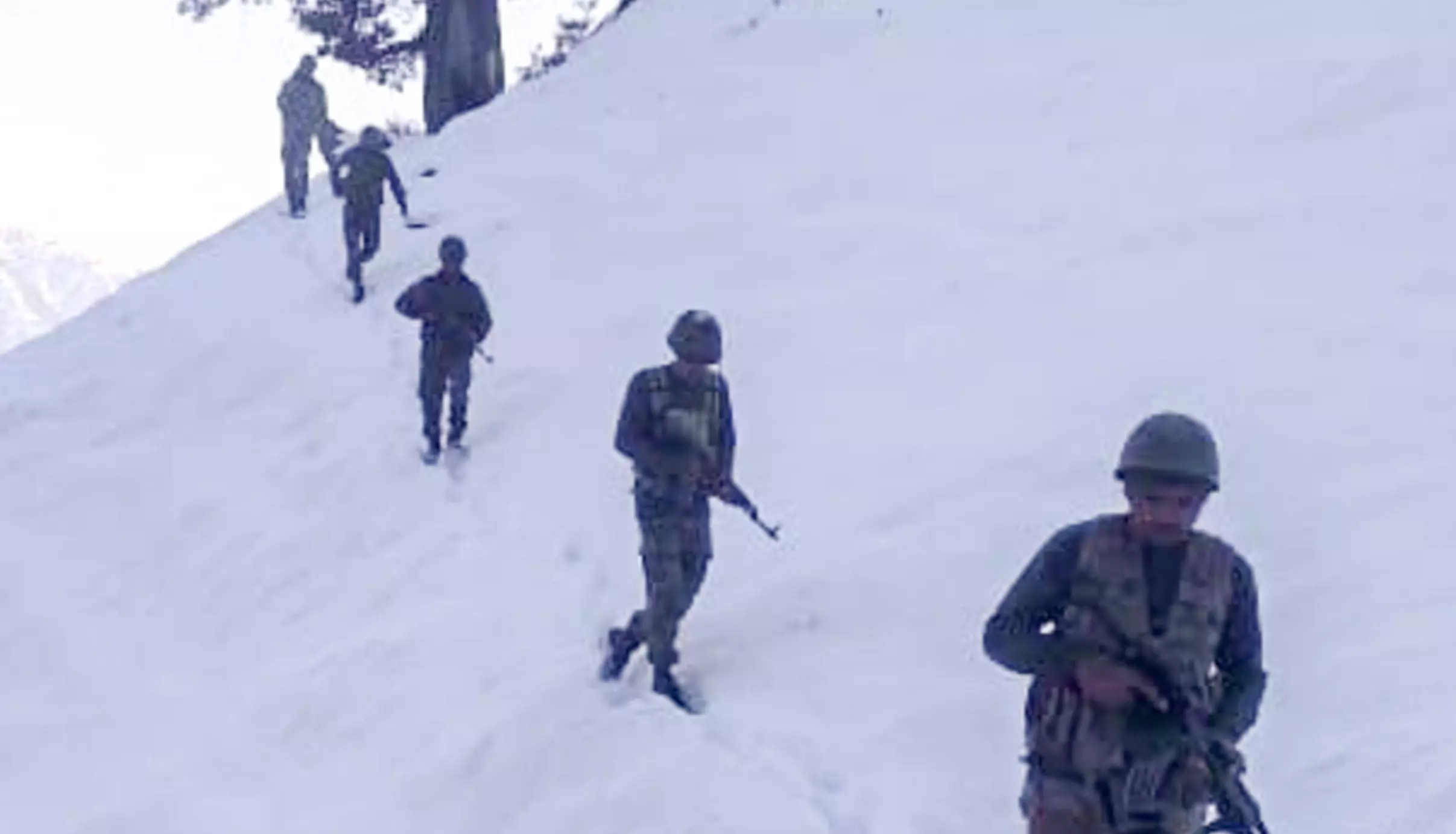
Army intensifies winter operations in J&K to flush out Pakistani terrorists. Photo: PTI
Army intensifies counter-terror ops as 30–35 Pak terrorists active in Jammu region
Security forces abandon the traditional winter lull, expanding counter-terror operations into snowbound high-altitude areas during 'Chillai Kalan'

Indian intelligence agencies have assessed that there are “approximately 30-35 Pakistani terrorists” currently operating in the Jammu region, prompting the Indian Army to intensify counter-terrorism operations across Kishtwar and Doda districts in Jammu and Kashmir, defence sources said on Saturday.
Winter lull gives way to decisive shift
Traditionally, the onset of the 40-day ‘Chillai Kalan’, the harshest phase of winter in the Kashmir Valley from December 21 to January 31, ushers in a ‘temporary lull’ in terrorist activities as communication routes close and heavy snowfall isolates mountain regions.
Also Read: Bad weather forces 11 flight cancellations at Srinagar airport
This winter, however, has marked a “decisive shift” in the operational approach of the Army and other security forces, a source in the defence establishment said.
Terror groups pushed into higher reaches
According to intelligence inputs gathered over the past few months, Pakistani terrorist groups, finding themselves cornered by sustained counter-terror operations, have shifted deeper into higher and middle-mountain reaches that are now devoid of habitation.
These terrorists are believed to be seeking temporary winter hideouts to evade detection and avoid direct confrontation with security forces. Reports indicate that remnants of terror groups are attempting to coerce or threaten local villagers for shelter and food supplies, even though their support among locals and overground workers has sharply declined.
Also Read: Pahalgam terror attack: NIA files chargesheet against Pak-based handler, 6 others
The drying up of local support and continuous security vigilance in lower altitudes have forced the terrorists into isolation, further restricting their ability to regroup or plan coordinated attacks, sources said.
Operations expanded despite extreme weather
Undeterred by freezing temperatures, treacherous terrain and heavy snowfall, Army units have expanded their operational reach into higher and snowbound areas to pursue and “neutralise Pakistani terrorists attempting to exploit the harsh season for concealment”.
The intensified operations continue across Kishtwar and Doda districts, defence sources said.
Intelligence-led precision operations
Intelligence from multiple agencies is synthesised to draw “precise situational pictures” of terrorist movement and hideout patterns. Once verified, coordinated joint operations are planned and launched to minimise overlaps and ensure maximum impact.
The synergy between ground units and intelligence frameworks has enhanced response times, enabling security forces to act the moment actionable information surfaces. The principal focus of the Army and other forces this winter is twofold: eliminating remaining terrorist pockets and ensuring that terrorists remain confined to inhospitable higher reaches.
Also Read: When being a ‘Kashmiri’ is forced to override all other identities, a community feels targeted
This containment strategy prevents infiltration into populated areas and disrupts logistics and communication channels, significantly reducing operational capability.
Surveillance-sweep-surveillance doctrine
Security forces have launched concurrent operations across valleys, mid-altitude regions and high ridges to maintain overlapping control and deny movement corridors.
Each clearance operation is followed by sustained monitoring, forming a “surveillance-sweep-surveillance” cycle that underpins the Army’s “new winter doctrine”. Specially trained winter warfare sub-units have been deployed across key sectors, skilled in high-altitude survival, snow navigation, avalanche response and snow combat.
Also Read: Bangladesh: Two suspects in Hadi murder fled to India, say Dhaka police
Modern technology has emerged as a force multiplier, with drones, ground sensors and surveillance radars used to detect movement, track heat signatures and identify possible routes.
(With agency inputs)