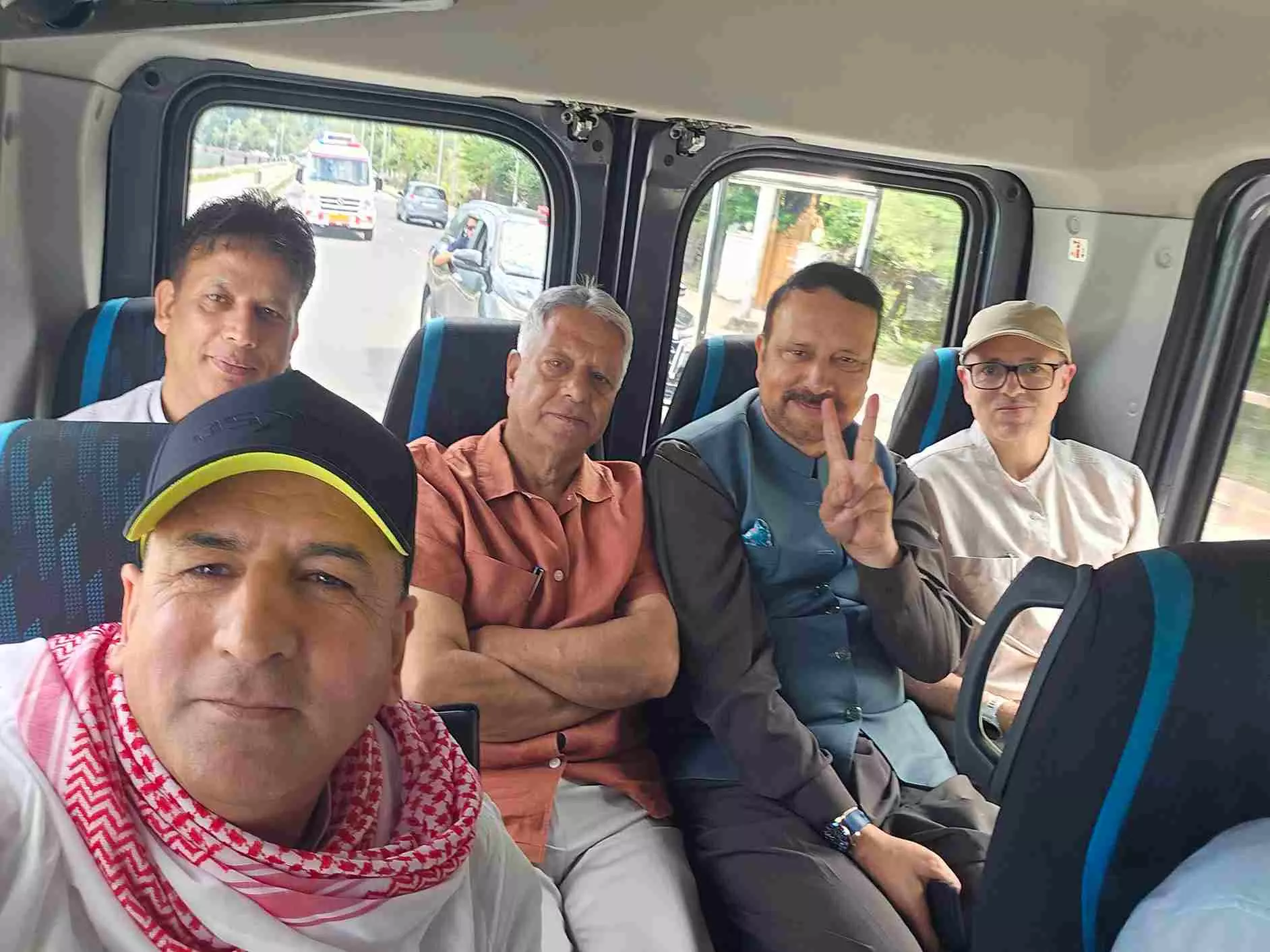
Rattled by a bruising by-election loss and rising internal rebellion, the Jammu&Kashmir Chief Minister Omar Abdullah has decided to take the long-standing demand for the restoration of J&K’s statehood to the gates of Parliament.
According to experts, the move appears to be a calculated counter-offensive designed to unify his fractured ranks, appease his critics, and shift the narrative back to the National Conference's core fight for J&K statehood.
The Delhi protest
After a day-long secretive huddle helmed by Omar Abdullah on the outskirts of Srinagar at Dachigam National Park, the National Conference (NC) finalised plans on Wednesday (June 3) to hold a massive protest on the opening day of the Parliament’s monsoon session in the capital.
The protest in Delhi, which is bound to capture eyeballs, is to demand the restoration of J&K's full statehood will be the NC’s most assertive move yet on the issue, said reports.
After J&K lost its statehood and special constitutional status under Article 370 on August 5, 2019, the issue has evolved into an intense political flashpoint.
Not only did it strip off J&K of its special status but the state was carved into two Union Territories, along with Ladakh. This was done with the promise to restore statehood at an "appropriate stage" with no definitive timeline given.
Since then, regional parties like the NC and the People’s Democratic Party (PDP) are competing with each other promising to fight to restore Article 370. However, realising reversing Article 370 may be impossible under the current central regime, statehood has become the new, realistic baseline for political consensus.
The huddle
Briefing journalists after the huddle at Dachigam National Park, Zadibal MLA and NC chief spokesperson Tanvir Sadiq announced the party's decision to shift its statehood campaign to the national capital.
Sadiq explained that while the meeting covered development issues and the growing drug and alcohol menace, the central focus remained on J&K's special status.
There was a lot of secrecy attached to this meeting. NC legislators initially gathered at Omar Abdullah’s Gupkar Road residence before being driven in a convoy. The final destination was kept tightly under wraps, many believed they were going to a Mughal garden, until they arrived at Dachigam, a secluded park famous for the endangered Kashmir stag (hangul).
Opposition leaders quickly mocked the event. Peoples Conference chairman Sajad Lone called the secluded venue symbolic of an "aloof, secluded, isolated" government. PDP's Iltija Mufti cracked a joke, remarking that in Kashmir, "MLAs are more endangered than hangul" and should have their own designated wildlife park
Abdullah later clarified on X (formerly Twitter) that the remote venue was planned in advance to escape standard political settings.
The meeting reviewed the government's performance over its past 18 months and mapped out future strategies. The NC also decided to propose a bill seeking a ban on liquor in J&K.
NC under fire
Political circles had been anxious about this meeting since Abdullah hinted in May that he wanted to speak out more openly on key issues, stating, "Trust me, I want to burst like a cloudburst."
Primarily, the failure to secure statehood had become a massive liability for the ruling NC.
There has been relentless pressure on NC by Opposition parties like the PDP and J&K People's Conference, who have accused the ruling NC of diluting its stance.
However, the heat is also coming from within. Srinagar NC MP Aga Ruhullah Mehdi has openly clashed with party leadership over statehood and J&K's controversial reservation policy, which now exceeds 50 per cent. Mehdi, who recently went as far as joining the student protests outside the Chief Minister’s residence, was notably absent from Wednesday's huddle, though it remains unclear if he was even invited.
By-poll defeat
What's more, to add to its troubles, NC recently faced a political setback in the recent by-poll. The sharpest blow came with the party's embarrassing defeat in the Budgam by-election, a seat Chief Minister Omar Abdullah had won in 2024 before vacating it, only for the rival PDP to capture it.
Political analysts directly link this loss to the widening rift between the Chief Minister and Srinagar MP Aga Ruhullah Mehdi, whose personal political stronghold happens to be Budgam.
Cornered by this electoral defeat, internal rebellion, and relentless opposition attacks, Abdullah called the emergency meeting of NC lawmakers and allied Independents under the guise of discussing "matters of collective importance."
Tensions brew with Congress
Tensions are also brewing with the NC's election ally, the Congress party. Despite fighting the 2024 Assembly elections together, Congress chose to stay out of the cabinet, offering only outside support until statehood is fully restored.
Since then, multiple Congress leaders have publicly chided the NC for a lackluster push on the statehood front. Notably, no Congress lawmakers were invited to Wednesday's strategy session.
Saving a sinking ship?
With rumours circulating that a faction of NC MLAs are profoundly unhappy with the administration's functioning, the BJP has eagerly seized on the chatter, declaring the government unstable.
Leader of the Opposition Sunil Sharma went so far as to mock the Dachigam huddle as Omar Abdullah’s frantic attempt "to save a sinking ship." NC leaders have swiftly dismissed these claims, insisting the Chief Minister enjoys absolute backing.
Currently, Abdullah commands a comfortable majority in the 90-member Jammu and Kashmir Assembly. The ruling coalition has 53 seats (41 NC legislators, 6 Congress MLAs (providing outside support), 5 Independents (one of whom holds a cabinet minister berth), and 1 CPM MLA. While the Opposition led by the BJP has 29 seats, PDP four, JK People's Conference has one, AAP one, and there are two unaligned Independents.
While an abrupt withdrawal of support by Congress and the Independents would severely rattle the government's stability, such a rebellion remains unlikely for now.
Now all eyes are now on the NC's upcoming New Delhi protest. Whether it sparks a fierce, sustained confrontation with the Modi government or remains a merely symbolic gesture will likely dictate the next chapter of Jammu and Kashmir’s volatile politics.