








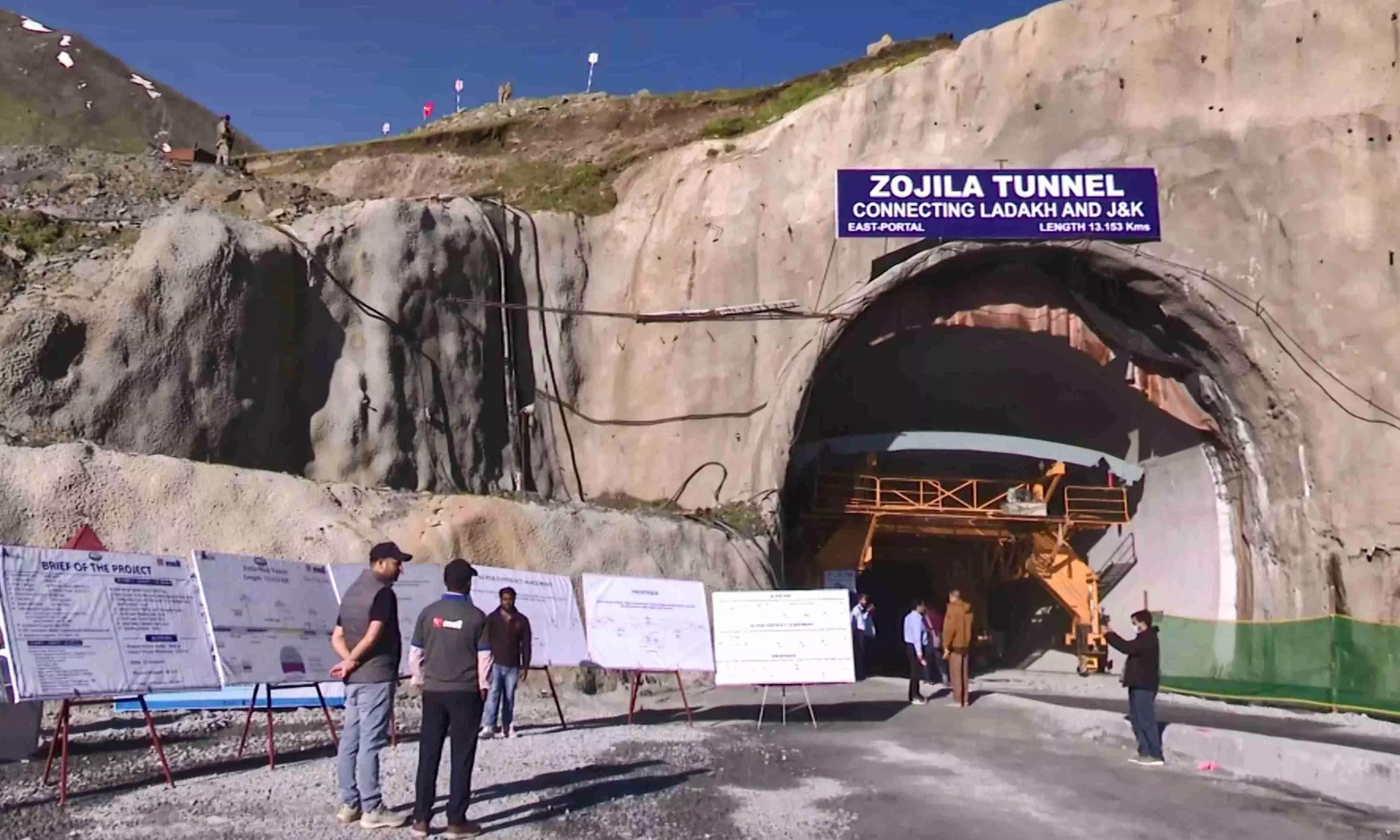
Union Minister Nitin Gadkari triggered the final blast marking the breakthrough of the Zojila Tunnel near its east portal at Minimarg, bringing the strategically important all-weather connectivity project between Kashmir and Ladakh closer to completion, in Ladakh on Tuesday (June 9). Photo: PTI
Zojila tunnel: Why is it a game changer for Kashmir and Ladakh?
Set to become Asia's longest bi-directional single-tube high-altitude road tunnel, it will provide year-round road connectivity between J-K and Ladakh, reduce travel time

The ambitious initiative to achieve year-round connectivity of the Kashmir Valley with Ladakh took a giant leap after engineers completed the final blast connecting the main tube of the Zojila Tunnel project. The breakthrough, achieved six months ahead of schedule, marks a major milestone in one of the country's most challenging infrastructure projects.
Here is a closer look at what the tunnel is, why it matters, and how it will transform connectivity in the region.
What is the Zojila tunnel?
The Zojila Tunnel is a 13.153-km-long, two-lane, bi-directional road tunnel being constructed beneath the Zojila Pass on the Srinagar-Leh National Highway (NH-1).
The tunnel connects Baltal near Sonmarg in Jammu and Kashmir with Minimarg near Drass in Ladakh.
Also read: India's longest rail tunnel inaugurated in Jammu
Built at an altitude of 11,578 feet (3,528 metres), it is set to become Asia's longest bi-directional single-tube high-altitude road tunnel. The entire project spans 31 kilometres, including 18 kilometres of approach roads, bridges and avalanche-protection structures.
What are its key milestones?
The National Highways & Infrastructure Development Corporation Limited (NHIDCL) announced the successful breakthrough of the main tunnel following the final blast near the eastern portal at Minimarg in Ladakh.
This means excavation from both ends of the tunnel has been successfully executed, marking one of the most critical engineering milestones in tunnel construction.
Why was the tunnel needed?
Currently, the Zojila Pass remains one of the most difficult mountain crossings in India.
Every winter, heavy snowfall, avalanches and extreme weather conditions force the closure of the pass for three to four months, effectively cutting off Ladakh from the Kashmir Valley by road.
Also read: Kashmir: Why Udhampur-Srinagar-Baramulla Rail Link is an engineering marvel?
The tunnel is designed to eliminate seasonal isolation by providing uninterrupted, all-weather connectivity throughout the year.
How much travel time will it save?
A journey that currently takes around 3.5 hours through steep mountain roads and difficult weather conditions will be reduced to approximately 15 minutes once the tunnel becomes operational.
How is the tunnel being built?
The project is being executed by Megha Engineering and Infrastructure Limited using the New Austrian Tunnelling Method (NATM), a globally recognised technique suited for challenging geological conditions.
Engineers have had to work with fragile Himalayan rock formations, harsh weather, high altitude conditions and difficult terrain to execute the project, making it one of India's most complex infrastructure undertakings.
What is its strategic importance?
The tunnel is situated on the crucial Srinagar-Leh highway, which serves as the primary land route connecting Ladakh with the rest of India.
Also read: Four years of protests and Centre’s apathy: Why Ladakh exploded
Ladakh's proximity to both Pakistan and China makes uninterrupted road connectivity a major strategic requirement for India.
The project will also allow year-round movement of military personnel, equipment, supplies and heavy machinery to forward areas without depending extensively on air transport during winter months.
How will it help logistically?
The biggest benefit of the tunnel will be uninterrupted connectivity throughout the year. For decades, heavy snowfall has cut off road access to Ladakh during winter. The tunnel will ensure that residents, tourists and businesses remain connected regardless of weather conditions.
The tunnel will significantly improve logistical support to the Indian Armed Forces.
Troops, heavy artillery, fuel, construction materials and essential supplies can be transported throughout the year to sensitive border areas near both the Line of Control (LoC) and the Line of Actual Control (LAC).
With tourism being one of Ladakh's most important economic sectors, the year-round access could help extend the tourist season beyond the summer months, making destinations such as Sonmarg, Drass, Kargil and Leh more accessible and generating additional employment opportunities.
Also read: How Ladakh’s traditional kitchens keep its food culture, and mountain spirit, alive
Reliable road connectivity will also lower transportation costs and improve the movement of goods between Kashmir and Ladakh. This will benefit the local businesses, farmers, transport operators and traders are expected to benefit from reduced disruptions and improved market access.
Also, the tunnel will allow faster movement of ambulances, rescue teams and essential services during emergencies.
When will the tunnel open?
According to project officials, the tunnel is expected to be completed and opened to traffic by February 2028.
Once operational, it will permanently alter connectivity between Kashmir and Ladakh, ensuring that one of India's most strategically important regions remains connected throughout the year.