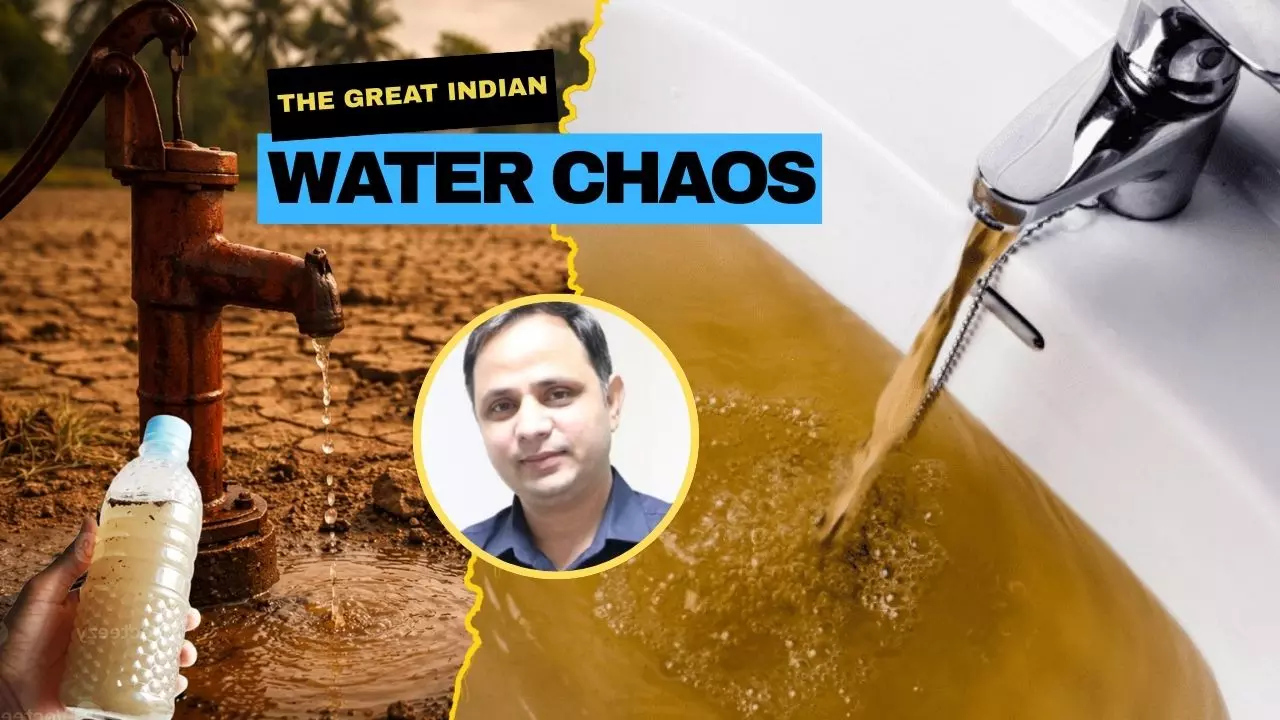
How a newspaper campaign exposed Indore water contamination issue
Based on info gathered from conversations with Dainik Bhaskar's Indore editor Amit Mandloi, The Federal Desh decodes when and how the crisis broke out

Indore, the city that built a national reputation for cleanliness, has been jolted by a disturbing revelation originating from the Bhagirathpura locality — one that has shaken the system to its core.
This was not merely a case of illnesses caused by contaminated water. It was the deadly outcome of a deep “communication gap” between the municipal corporation, elected representatives and the bureaucracy — one for which innocent children and ordinary citizens paid with their lives.
Also read: Indore water contamination case: MP HC summons Chief Secretary
Usually, complaints about filth in neighbourhoods or dirty water entering homes are tucked away in a small corner of newspapers. By doing so, newspapers believe they have discharged their social responsibility. Sometimes the problem gets resolved; often it does not.
Truly the Fourth Pillar
But the Indore incident is different. It was journalism — and a sustained newspaper campaign — that ensured this tragedy travelled from a single settlement in Indore to the national spotlight.
When the issue first surfaced, it appeared to be just another routine complaint that reached Dainik Bhaskar, Madhya Pradesh’s leading daily. But something rang alarm bells for the newspaper’s Indore editor, Amit Mandloi, who sent reporters into the field. What initially seemed like an ordinary issue soon unfolded into a horrific tragedy.
Based on information gathered from conversations with Amit Mandloi, The Federal Desh put together the sequence of events — what exactly happened, when and how it unfolded, what the administration and government did, and whether those measures are enough.
First horrifying news
The chain of events began on December 27, when reports emerged from Bhagirathpura of a large number of people suffering from vomiting and diarrhoea. Within hours, local hospitals — Verma, Triveni, LB and others—were overwhelmed with patients.
The situation was such that there was barely any space to stand inside the hospital premises. When the first day’s data was compiled, more than 150 people were found to be ill.
Also read: Kerala’s water woes: Worsening quality, lack of retention strategies
When the Dainik Bhaskar team reached the spot, it became clear that this was no seasonal illness. This was poison — contaminated water — seeping directly into people’s lives.
Investigation reveals the truth
As the investigation progressed, shocking facts came to light. In a city celebrated as the cleanest in the country, a public toilet near a police outpost in Bhagirathpura was not connected to any drainage pipeline. "For the past eight years, waste from the toilet had been seeping into a pit beneath the ground," recounted Mandloi. "Ironically, the city’s main water supply line passed through the very same spot."
It is believed that a minor leakage allowed sewage to mix with drinking water, turning taps into conduits of death that reached people’s homes.
The most heartbreaking aspect of the tragedy was the death of five-month-old Avyaan. His mother would mix a little water with milk before feeding him, believing it would help the baby digest it better. She had no idea that the water she believed to be life-giving would take away the life of her child.
The news of Avyaan’s death left not just Indore but the entire state shaken.
Political drama
As the death toll rose — first to 11, then 15, and eventually 17 — the administration was forced out of its slumber. It was only after the newspaper backed its investigation with data and post-mortem reports that the government sprang into action.
Also read: Indore water contamination: Guillain-Barré syndrome-like symptoms in woman?
A round of political blame game followed. Elected representatives claimed they had been pushing for tenders since August, but officials had failed to issue work orders.
Eventually, under mounting pressure, action was taken against five to six senior officials. The municipal commissioner was removed, and officials in charge of the water department — many of whom had occupied their posts for years — were suspended.
Old pipelines and risk to life
The newspaper’s investigation also revealed that complaints of dirty water have been reported from nearly 70 of Indore’s 85 wards. In large parts of the city, pipelines are 25 to 30 years old.
"Ideally, sewage and water pipelines should run in different directions. In Indore, however, they have been laid parallel to each other. Even a minor leak in such a system poses a direct threat to human life," said Mandloi.
The administration has now deployed more than 200 teams on the ground. Door-to-door surveys are underway, yet dozens of patients remain hospitalised. The government has announced compensation of Rs 2 lakh per victim — but can any amount truly compensate for a life lost?
Also read: Indore water contamination: Authorities yet to pinpoint source as probe expands
The High Court has taken a particularly strict view of the matter. More than 1,100 people fell ill.
This incident is a stark reminder that being “clean” on paper and in rankings is not enough. Unless the ageing pipelines buried underground and the crumbling system are fixed, the fear of another Bhagirathpura-like tragedy will continue to loom.
(This article was originally published in The Federal Desh)