








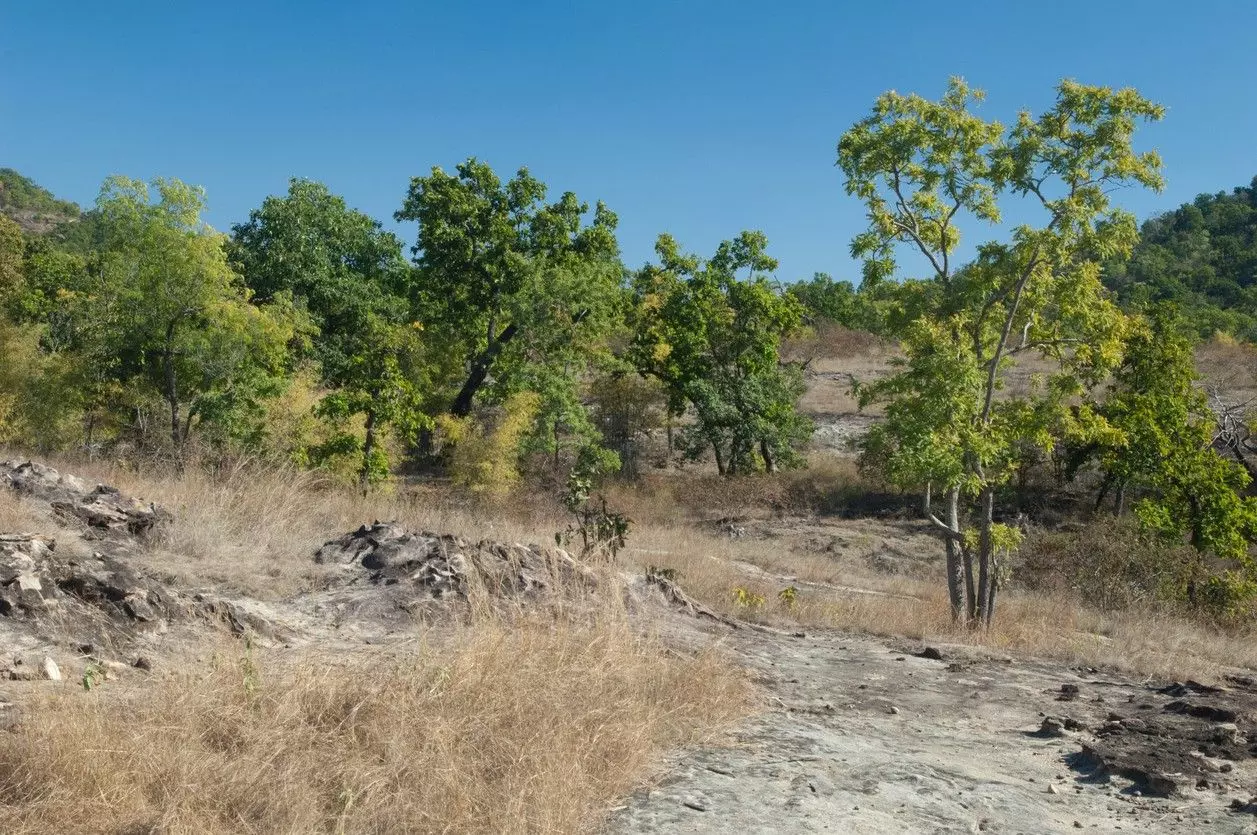
Rampant deforestation in Madhya Pradesh due to mining activities may pose serious ecological, environmental and tribal rights challenges. Representative Photo: iStock
How India’s ‘greenest state’ is sacrificing massive forest land to mining
As MP leads the nation in deforestation for infrastructure and corporate mining, fears of irreparable ecological damage and disrupted wildlife corridors loom

Even as India reels under brutal heatwaves — with experts pointing to deforestation as a key driver of worsening climate conditions — something deeply troubling is unfolding in Madhya Pradesh.
The state holds India's largest forest cover, a vast green expanse of over 85,000 square kilometres. Yet over the past five years, it has lost a staggering 60,000 acres of that forest to infrastructure and mining projects. If reports are to be believed, it is the highest rate of forest loss in the entire country.
Also read: Lens on Assam forest garbage dumping as elephant dies after eating plastic
Between 2014 and 2024, India approved the diversion of 1.73 lakh hectares of forest land for development projects. Mining and hydropower alone consumed over 80,000 hectares, with roads, power transmission lines, and defence projects claiming much of the rest. MP has consistently ranked among the worst-hit states throughout this period.
Madhya Pradesh's vanishing green top
♦ In 2021, MP's forest cover area was 77,492 sq km. In 2023, it was 77,073 sq km
♦ Top 3 districts with most forest cover area in MP: Umaria 55%, Balaghat 53%, Sheopur 52%
♦ Recorded the maximum decrease in the forest cover outside the Recorded Forest Area (344.77 sq km)
♦ The maximum decrease in forest and tree cover was recorded in MP (a decrease of 612.41 sq km)
Source: India State of Forest Report 2023
In 2024-25, more than 3,200 hectares of forest land were diverted in the state. In 2023-24, more than 9,000 hectares were diverted, while in 2022-23 and 2021-22, it was 3,492 and 6,352 hectares, respectively.
According to the India State of Forest Reports 2023, MP's forest cover area in 2021 was 77,492 square kilometres, which was reduced to 77,073 square kilometres in 2023.
The report also said that the maximum decrease in forest and tree cover in India was recorded in the central state (612.41 square kilometres), which is roughly the size of Indore city.
One of the major reasons for this large-scale deforestation in MP is mining, including for gold and coal.
The New Indian Express reported recently that the central government has okayed the diversion of 150 hectares in the state to mine gold.
The report added that a private enterprise intends to extract 130 kilograms of gold each year in the state’s Singrauli district. This area is situated within India’s Mahakoshal mineral belt, recognised for its deposits of gold, sulphides, nickel, platinum group elements (PGE), and other related minerals.
The environmental appraisal committee (EAC) of the Ministry of Environment, Forest and Climate Change (MoEFCC) has thoroughly reviewed and assessed the proposal, ultimately recommending the approval of the mining project on forest land.
In its endorsement, the EAC permitted Kundan Gold Mines Private Limited to mine a maximum of 1.12 metric tonnes per annum across 149.30 hectares of forest land in the Gurhar Pahar Gold Block, located in Singrauli’s Chitrangi tehsil. This operation will involve the extraction of 130 kg of raw, unrefined gold directly from the mine, with the remaining 990 kg classified as waste.
Also read: Arunachal Pradesh town loses a sixth of its forest to urban sprawl
The company had submitted a mining proposal in August 2024, asserting that the mining lease area encompasses 143.80 hectares of forest land and 5.50 hectares of government barren land, the report added.
Subsequently, it was found that the entire area is designated as forest land. They resubmitted their application in August last year, affirming that the complete lease area is classified as forest land. The EAC, following an evaluation of the project, endorsed the proposal’s approval.
MP to become India's mineral hub: CM
In September 2025, MP Chief Minister Mohan Yadav announced that, in accordance with Prime Minister Shri Narendra Modi’s vision for a self-reliant and developed India, the state had achieved a significant milestone in the mining industry. Yadav said MP was set to become India’s mineral hub.
The Hindustan Times reported in March that the forest advisory committee (FAC), which also comes under the MoEFCC, has given its in-principle approval for the diversion of forest land to accommodate various significant mining and infrastructure projects. This includes the allocation of more than 1,000 hectares for a coal block and approximately 470 hectares for a coal mine, both in the central state.
As per the minutes from the FAC meeting conducted on February 27, which were accessed by the news outlet, the committee has recommended in-principle approval for the diversion of nearly 470 hectares of reserve forest for the proposed underground Gondbahera Ujheni East coal mine, in favour of M/s Mahan Energen Limited, a subsidiary of Adani Power, in Singrauli district.
The mineral landscape exploration plan in MP has also seen the Supreme Court being moved and protests in the state Assembly and on the streets.
On May 21, the Supreme Court quashed a plea against the environment ministry's final approval to Adani Group company Stratatech Mineral Resources for diverting nearly 1,400 hectares of forest land in Singrauli, for the Dhirauli coal mining block, the Economic Times reported. It also rejected the petition against the state government's go-ahead to the firm for the undertaking.
Environment activist Ajay Dubey had urged the apex court to declare the forest area as an eco-sensitive zone, citing the elephants' route and a biodiverse forest, the report added. According to him, the animals' corridor goes through the Dhirauli block area, which has been allocated to Mahan Energen.
Also read: Deforestation and climate change force tropical mountain birds to higher altitudes: Study
The FAC has also provided preliminary approval for the diversion of more than 1,063 hectares of forest land from a total lease area of 1,200 hectares for the proposed Marwatola-VII coal block in Umaria and Shahdol districts, the HT report added. This block will be operated partially as an open-cast mine and partially as an underground mine by M/s Rama Cement Industries Private Limited, located in the Ghanghuti forest range of MP.
Political protest
Last December, MP’s Assembly saw protests as members of the Opposition Congress in the Bharatiya Janata Party-ruled state walked out to protest the destruction of around six lakh trees for the Dhirauli project. Congress MLA and national president of the Adivasi Congress, Vikrant Bhuria, alleged that tribal people were being “deprived of their rights to give benefits to capitalists and coal mining”. Heated exchange was also seen between the treasury and opposition benches, The Hindu reported.
Taking a dig at Adani and Prime Minister Narendra Modi, senior Congress leader Jairam Ramesh said in September on X, “In Dhirauli, Madhya Pradesh, Modani has begun cutting trees on government and forest land for its coal mine – without Stage-II forest clearance and in blatant violation of FRA, 2006 & PESA, 1996. Villagers, mostly Scheduled Tribe communities and even a Particularly Vulnerable Tribal Group (PVTG), are rightly protesting.”
MP's Minister of State for Forest Dilip Ahirwar said cutting of trees was happening as per rules of the Centre and state, and the same number of trees was being planted at various spots.
Ex-IFS questions funding transparency
Former IFS officer Sudesh Waghmare was quoted by an ETV Bharat report as saying that merely planting trees alone would not make up for the loss. Saying that centuries-old trees are felled after forest land diversion, he cautioned that the new trees also need to survive and grow.
Speaking about funding, he said those for forest land designated for development are provided through CAMPA (Compensatory Afforestation Fund Management and Planning Authority) funds, which should be allocated for forest management.
Also read: As scientists warn of imminent desertification, can a green wall shield North Karnataka?
“However, in many cases, CAMPA funds have been used for building construction. This has been previously raised in the CAG report,” he told the news outlet.
Environmental costs
Madhya Pradesh is also seeing threatening heatwaves and dry spells. One new study has said that the state is confronting a climate crisis, and any delay in action to thwart it could pose a serious challenge to water, farming and life in the rural areas.
Many districts in northern and eastern MP are experiencing less rain during the monsoon season and high temperatures throughout the year.
Heat-related deaths in the state are touching alarming rates.
The study also showed that both precipitation and temperature patterns in MP have changed in recent decades. Less rainfall means the agriculture is taking a toll, while higher temperatures mean the water is drying fast.
Seeking strong action against the climatic disasters, experts have advised the farmers to plant trees alongside fields to hold moisture, besides other methods such as collecting rainwater.
They said deforestation is a major threat in the tribal and rural areas as destroying trees changes the land cover and raises surface heat. He said when forest cover shrinks, more heat gets trapped, and this could increase droughts and heatwaves in those regions.
Wildlife threatened
Deforestation in MP, known as India’s “Tiger State” for its major big cat reserves and their population, has severely impacted the state's wildlife reserves.
One of the major critical damages is corridor fragmentation. Between 1990 and 2015, vital corridors in the Kanha-Pench landscape were either converted into marginal farms or degraded to the point of impeding connectivity between the two tiger reserves, resulting in instances of human-animal conflict.
The HT report said the proposed Marwatola-VII coal block area’s boundary adjoins the Bandhavgarh-Achanakmar wildlife corridor, which provides habitat for tigers, leopards, sloth bears, and cheetal.
The corridor linking Tadoba, Pench, and Kanha, which connects MP with neighbouring Maharashtra, has been specifically recognised as being at risk due to mining operations. Even sand mining in the region’s Chambal River has threatened its aquatic life.
While gold mining in MP is still in early or auction stages in many areas, the pattern already established by coal and other mining in the state — massive forest loss, tribal displacement, and regulatory violations — raises serious concerns about what expanded gold mining could mean for MP’s massive forest land. The challenge is to balance the economic value of gold reserves with the ecological and human cost of forest diversion.