








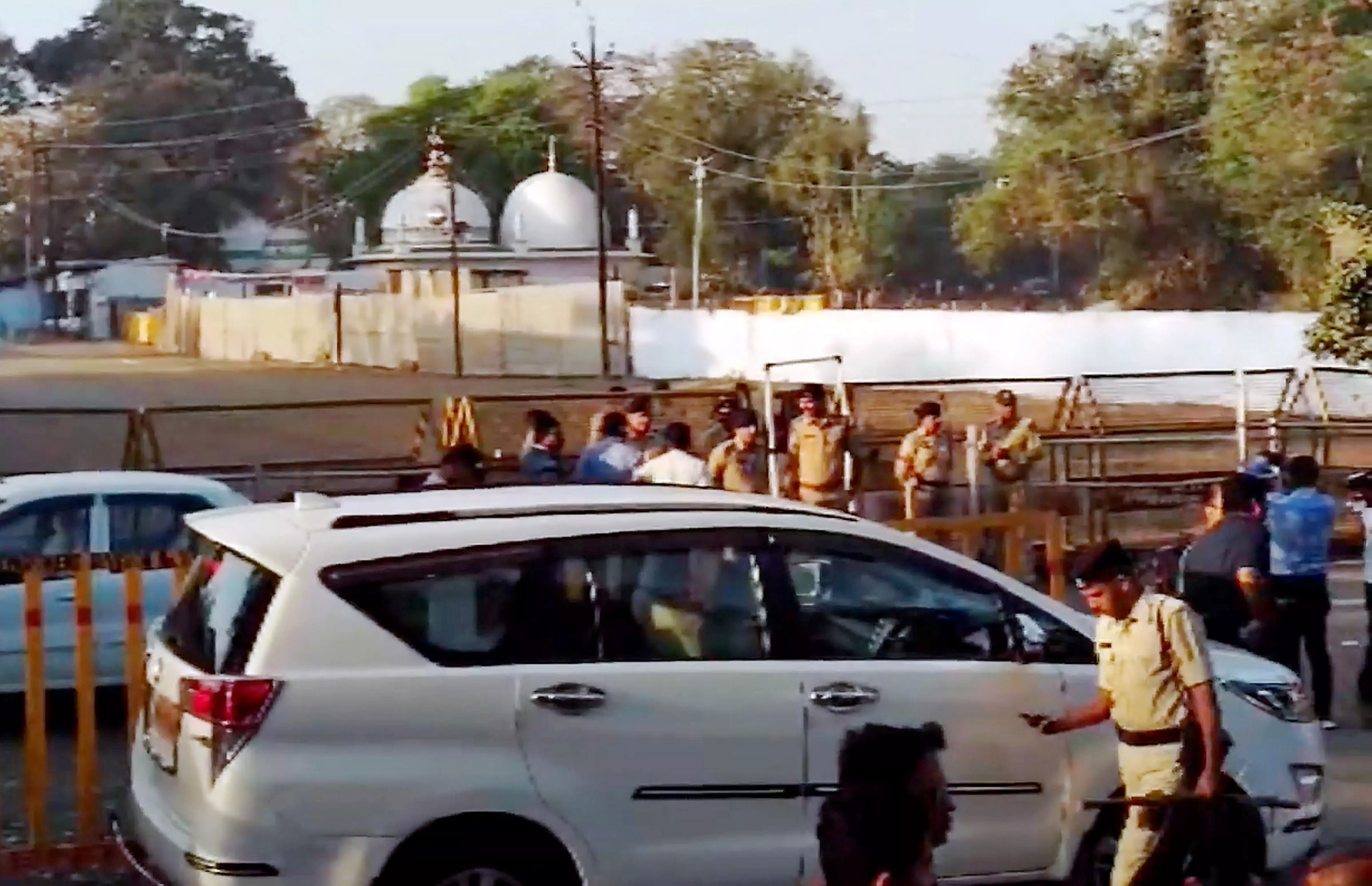
Supreme Court allows Hindu and Muslim prayers at Bhojshala complex
Apex court permits Hindu prayers on Basant Panchami falling on Friday and allows Muslims to offer namaz the same day at the Bhojshala–Kamal Maula Mosque complex

The Supreme Court has allowed Hindus and Muslims to offer prayers at the disputed Bhojshala–Kamal Maula Mosque complex in Madhya Pradesh’s Dhar district, even as the larger legal battle over the site remains unresolved.
In its order passed on Thursday (January 22), the apex court permitted Hindus to offer prayers from sunrise to sunset on Basant Panchami, which falls on Friday, January 23, while allowing Muslims to offer namaz between 1 pm and 3 pm on the same day.
Also Read: What's Bhojshala complex dispute and what ASI survey report has to say on it
The court also directed that a list of members from the Muslim community who would be coming to offer namaz be submitted to the district administration in advance.
Order amid past clashes
Hearing an application filed by Hindu Front for Justice seeking permission to allow day-long rituals on Basant Panchami, a bench comprising Chief Justice of India Surya Kant and Justices Joymalya Bagchi and Vipul M Pancholi issued the direction.The bench also appealed to both communities to maintain mutual respect and cooperate with the state and district administration to ensure law and order. The district administration has been directed to make necessary security arrangements at the ASI-protected site.
Under an arrangement in place for the past 23 years, the ASI allows Hindus to worship at Bhojshala on Tuesdays, while Muslims are permitted to offer prayers on Fridays. A similar situation had arisen in 2016, when Basant Panchami fell on a Friday, leading to protests and clashes in Dhar over prayer timings at the disputed site.
Inside Bhojshala legal battle
Declared a protected monument in 1951, the 11th-century Bhojshala complex is claimed by Hindus as a temple dedicated to Goddess Saraswati (Vagdevi), while the Muslim community refers to it as the Kamal Maula Mosque.
After initial protests from the Muslim community, the Archaeological Survey of India (ASI) conducted a scientific survey to determine the history of the structure. The report has already been submitted but remains unopened.
Now, the Supreme Court has referred the original Bhojshala–Kamal Maula Mosque dispute back to the Madhya Pradesh High Court, directing its division bench to hear the matter expeditiously within two weeks, while ordering that the sealed ASI survey report be opened in open court and shared with both parties, who will have two weeks to file objections.
Also Read: SC agrees to consider listing plea against scientific survey of 'Bhojshala'
The apex court also reiterated that the status quo at the disputed site must be maintained. It further clarified that the court-ordered scientific survey was meant only to ascertain the site’s original character and directed that no physical excavation or action on the report be permitted until a judicial resolution is reached.
Similar disputes across India
The Bhojshala dispute is among several contested religious sites across India. The most prominent was the Babri Masjid–Ram Janmabhoomi case in Ayodhya, which was settled by a Supreme Court verdict in 2019, paving the way for the construction of the Ram temple, inaugurated in January 2024.
A similar dispute exists over Gyanvapi mosque and Kashi Vishwanath temple in Varanasi, Uttar Pradesh. Although the broader Gyanvapi–Kashi Vishwanath dispute remains unresolved, Hindu prayers are now permitted in the mosque’s cellar. In April 2024, the Supreme Court refused to stop these prayers, ordering that the status quo be maintained despite legal challenges.
In Tamil Nadu, the Thiruparankundram hill in Madurai has also witnessed tensions involving the Subramaniya Swamy temple and a dargah located on the hill. The main flashpoint was a request by Hindu devotees to light the Karthigai Deepam (holy lamp) on a specific stone pillar (Deepathoon) at the hilltop. The Dargah representatives and the Tamil Nadu government opposed this, claiming that the ritual could disturb communal harmony.
The Madras High Court, however, recently ruled in favour of the Hindu devotees and allowed the lighting of the lamp at the hilltop near the dargah premises.