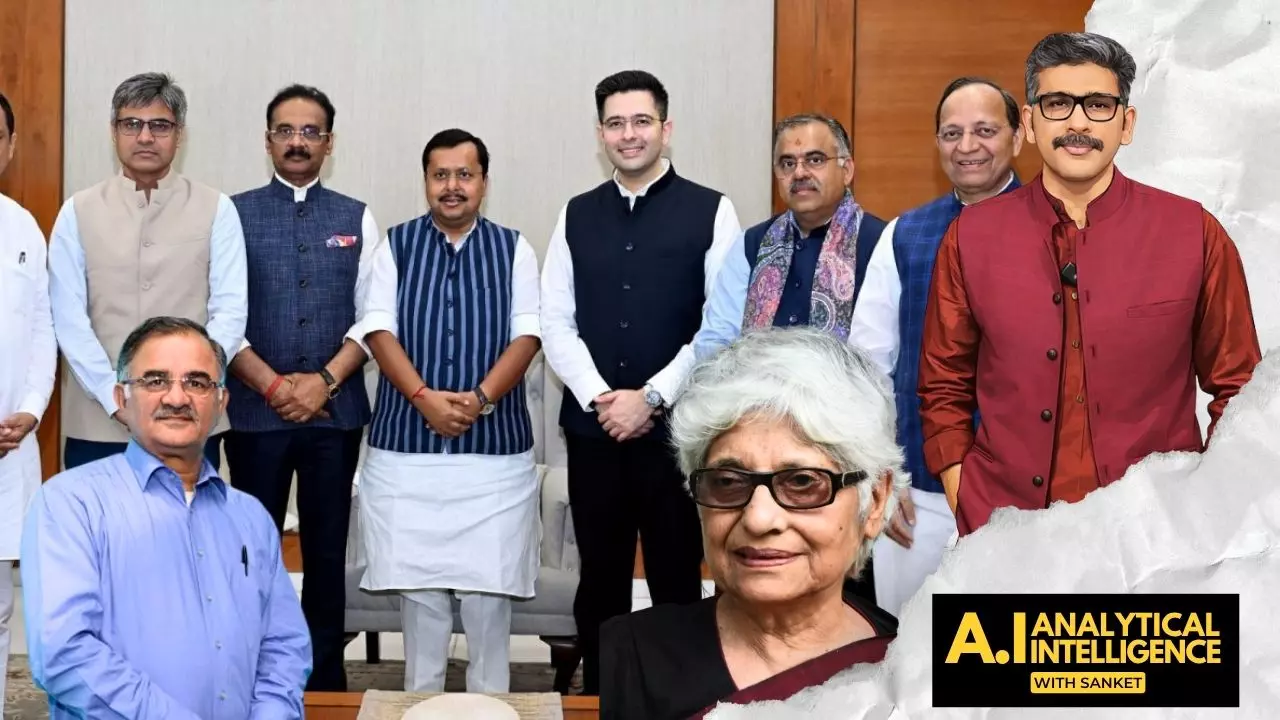
The panelists agreed that AAP's MPs switch episode likely signals more than an isolated Rajya Sabha realignment.
Punjab power play: Raghav Chadha's BJP switch sparks anti-defection debate | AI with Sanket
Senior journalists Neerja Chaudhuri and Javed Ansari say the bigger story is BJP’s possible long-term political strategy in Punjab, than the legal battle

Raghav Chadha’s dramatic exit from the Aam Aadmi Party (AAP), along with six other Rajya Sabha MPs, has triggered a larger constitutional and political debate, with a senior journalist arguing that “the whole anti-defection act needs to be revisited.”
Also read: AAP moves to disqualify 7 MPs who defected to BJP, calls it betrayal of people's mandates
While legal experts may battle over the constitutional validity of the move, a senior journalist suggested the more immediate concern is the BJP’s broader political strategy, particularly in Punjab.
The Federal spoke to senior journalists Neerja Chaudhuri and Javed M Ansari, who analysed both the constitutional implications of Chadha’s defection and the political consequences for AAP, BJP, and Punjab’s electoral future.
Legal grey zone
Chaudhuri noted that while AAP is likely to seek the disqualification of the defecting MPs, anti-defection disputes have historically taken years to resolve.
She pointed out that the anti-defection law was framed for an earlier political era dominated by wholesale party-hopping and may no longer adequately address modern merger strategies.
Also read: Chadha, others’ exit was a disaster waiting to happen for AAP
“The whole anti-defection act needs to be revisited,” she said, suggesting that constitutional reform may be necessary as political defections evolve.
Punjab strategy
For Chaudhuri, the bigger immediate story is political, not legal. She argued that the Rajya Sabha defections may be only the first step in a larger BJP strategy aimed at Punjab.
She suggested that the BJP’s move may indicate a strategic recalibration in a state where it has historically struggled for independent dominance after its break from the Shiromani Akali Dal.
According to her, the BJP may now be considering Punjab a more serious electoral battleground than before.
Optics vs reality
Javed Ansari described the defections as “bad optics” for AAP but remained sceptical about their immediate ground-level political impact in Punjab.
He argued that while the BJP may gain short-term perception benefits, leaders like Raghav Chadha and Harbhajan Singh may not necessarily possess the grassroots influence needed to significantly alter Punjab’s political equations.
Also read: Vikramjit Sahney says he warned Kejriwal about MPs' defection: Report
Ansari also sharply questioned AAP national convenor Arvind Kejriwal’s Rajya Sabha candidate selection, saying many appointees were not deeply rooted political workers.
Kejriwal’s choices
Ansari suggested that, apart from Chadha and a few others, many AAP Rajya Sabha nominees were selected for reasons beyond organisational political strength.
“This is also a poor reflection on Kejriwal’s choice of candidates,” he said.
The defections, he argued, expose vulnerabilities not only in AAP’s parliamentary arithmetic but also in its leadership’s candidate vetting process.
BJP’s turncoat model
Both journalists acknowledged BJP’s growing pattern of inducting opposition leaders under pressure, often amid allegations involving investigative agencies.
Also read: Punjab: Why lone Assembly bypoll has turned into high-stakes AAP-Oppn battle
Ansari noted that while BJP’s strategy of absorbing defectors may continue regardless of criticism, its electoral returns from such turncoats have often been underwhelming.
He referenced the poor performance of BJP turncoats in the 2024 elections, where many underperformed electorally despite high-profile inductions.
Diminishing returns?
The discussion also raised concerns within BJP’s own ecosystem about whether aggressive expansion through defections is politically sustainable.
Ansari suggested that despite concerns over diminishing electoral returns, the BJP’s current leadership remains focused on power acquisition above all else.
He argued that for BJP, strategic political acquisitions may matter more than ideological consistency or cadre discomfort.
Can Punjab be toppled?
A major question raised during the discussion was whether the BJP could use Chadha’s rebellion as part of a broader operation to destabilise Bhagwant Mann’s government in Punjab.
Also read: A year ahead of Assembly polls, Punjab AAP govt slashes power charges
While both analysts remained cautious, Chaudhuri suggested that defections could create conditions for instability, even if a full-scale legislative rebellion appears difficult.
She also floated the possibility that President’s Rule could emerge if instability deepens, though much would depend on numbers and political incentives.
Raghav’s utility
Ansari was unconvinced that Chadha himself would emerge as BJP’s central face in Punjab.
He argued Chadha’s value to BJP lies more in weakening AAP and contributing to strategic disruption rather than directly leading Punjab politically.
Also read: Why Chadha-led exodus presents an existential crisis for AAP and Kejriwal
For BJP, Chadha may represent one component of a broader operation rather than the final leadership solution.
Bigger than one defection
Both panellists agreed that this episode likely signals more than an isolated Rajya Sabha realignment.
For AAP, it is a morale and perception crisis. For the BJP, it could represent the opening move in a larger political expansion into Punjab.
As the constitutional battle unfolds, the larger political question remains whether this defection marks a turning point in Punjab’s power equations.The content above has been transcribed from video using a fine-tuned AI model. To ensure accuracy, quality, and editorial integrity, we employ a Human-In-The-Loop (HITL) process. While AI assists in creating the initial draft, our experienced editorial team carefully reviews, edits, and refines the content before publication. At The Federal, we combine the efficiency of AI with the expertise of human editors to deliver reliable and insightful journalism.