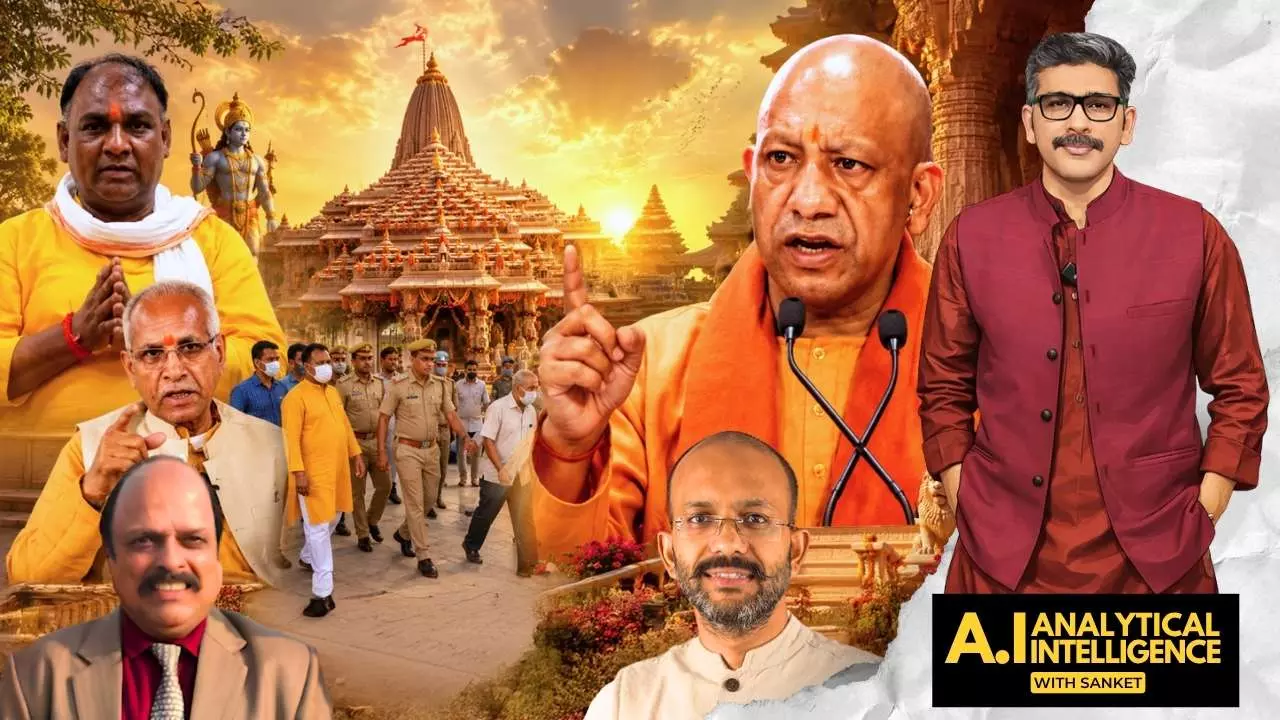
Ram temple donation scam: Real crackdown or bid to shield real kingpins?
Senior journalist Sharat Pradhan alleges the SIT probe is engineered to protect the big fish, while political analyst Shantanu Gupta defends the trust’s intent

Selective probe
The investigation is a calculated exercise to shield top leadership while using low-level staff as scapegoats, Pradhan claimed.
Also read: Ram temple theft: With RSS-BJP cornered, will Congress seize the moment?
He argued that a crime of this scale, occurring within an institution of unparalleled national sentiment, could not have been executed without the compliance or involvement of individuals high up in the administrative hierarchy.
Shielding leadership
The probe's integrity has come under intense scrutiny following the arrest of eight individuals, including an auto-rickshaw driver named Tinu Yadav, who claimed to have amassed crores in property through his daily wages. Speaking on the nature of the investigation, Sharat Pradhan stated that the Special Investigation Team (SIT) appears to be operating on an engineered mandate to divert public attention.
Pradhan remarked that the haste with which the smaller players were arrested indicates a pre-emptive exercise to protect the real kingpins. He noted that the ongoing strategy is straight and simple: passing the buck to individuals whom authorities in Delhi wish to protect while allowing Lucknow to prosecute minor actors. This shifting of blame ensures that the focus remains entirely on who to fix and who to save, rather than unearthing the absolute truth behind the pilfered funds.
The controversy deepens with the public defence of key temple trust figures. Pradhan questioned the logic presented by representatives of the Rashtriya Swayamsevak Sangh (RSS) who defended Champat Rai on the grounds of his bachelorhood and lack of family ties. He termed such arguments illogical and regressive, challenging the premise that financial corruption is exclusive to married individuals.
Accountability questioned
The role of Nripendra Misra, a 1967-batch IAS officer and head of the temple construction committee, has also drawn sharp criticism regarding institutional accountability. Despite Misra’s long-standing reputation as an upright bureaucrat over four decades, his shifting statements immediately after the scam came to light have raised red flags.
Also read: Blame politics, not the system, for Ayodhya temple donation theft
Pradhan pointed out that Misra initially attempted to distance himself from the controversy by asserting that his jurisdiction was strictly confined to the construction committee, independent of the primary temple trust. However, within 36 hours, Misra issued a suo motu certificate of integrity vouching explicitly for Champat Rai. Pradhan argued that this uncalled-for clearance, issued before any formal inquiry could be concluded, strongly suggests an institutional effort to suppress deeper administrative liabilities.
The origin of the exposure, according to Pradhan, traces back to Mahipal Singh, a committed RSS volunteer from Kota who served as an accountant for the trust without a salary. Singh reportedly discovered that closed-circuit television (CCTV) footage was being systematically deleted and flagged the irregularities directly to Rai. According to Singh’s account, he was immediately sent home on leave and subsequently terminated. It was only after Singh detailed these events in an interview with independent journalist Abhishek Upadhyay that political figures like Pawan Pandey and Akhilesh Yadav brought the matter into the public domain.
Defensive arguments
In response to these allegations, Gupta strongly defended the integrity of the trust's leadership and dismissed the escalating scam figures as political fabrications. Gupta argued that the multi-crore figures repeated on television channels lacked empirical basis, originating from speculative statements by opposition leaders rather than verified forensic audits.
Gupta maintained that the motive behind a crime remains a fundamental tenet of jurisprudence. He asserted that it is highly improbable for an 80-year-old individual like Champat Rai, who has dedicated his entire life to the Ram Janmabhoomi movement alongside leaders like Ashok Singhal and Mahant Avaidyanath, to engage in personal financial embezzlement at this stage of his life.
"There is no reason to believe that at that age he will get a group of people to embezzle a temple which he has put his life behind," Gupta stated.
Also read: Ram Mandir row: Why Champat Rai’s exit may trigger a big political battle
While acknowledging that Rai may have lacked the specific administrative and technical skill set required to manage a modern, multi-crore temple economy, Gupta rejected any insinuations of criminal intent. He countered that the trust acted swiftly by demanding an investigation, which led to Uttar Pradesh Chief Minister Yogi Adityanath constituting a high-level SIT comprising senior IAS and IPS officers within four hours of receiving the request.
Forensic standards
The debate concluded with sharp disagreements over the appropriate investigative agency required to restore institutional trust among millions of donors. Pradhan emphasised that given the clear indications of money laundering, the case should have been immediately handed over to the Enforcement Directorate or the Central Bureau of Investigation (CBI) rather than a localised SIT operating under state bureaucracy.
Also read: Why was Ajay Rai stopped from visiting Ayodhya’s Ram Temple? | Capital Beat
Gupta, however, reiterated faith in the track record of the Uttar Pradesh administration, noting that its stringent legal and law-and-order actions have consistently withstood judicial scrutiny in magisterial courts. As allegations continue to mount, the demand for an independent, flawless forensic audit remains central to preserving the sanctity of the temple's rising donation-based economy.(The content above has been transcribed from video using a fine-tuned AI model. To ensure accuracy, quality, and editorial integrity, we employ a Human-In-The-Loop (HITL) process. While AI assists in creating the initial draft, our experienced editorial team carefully reviews, edits, and refines the content before publication. At The Federal, we combine the efficiency of AI with the expertise of human editors to deliver reliable and insightful journalism.)