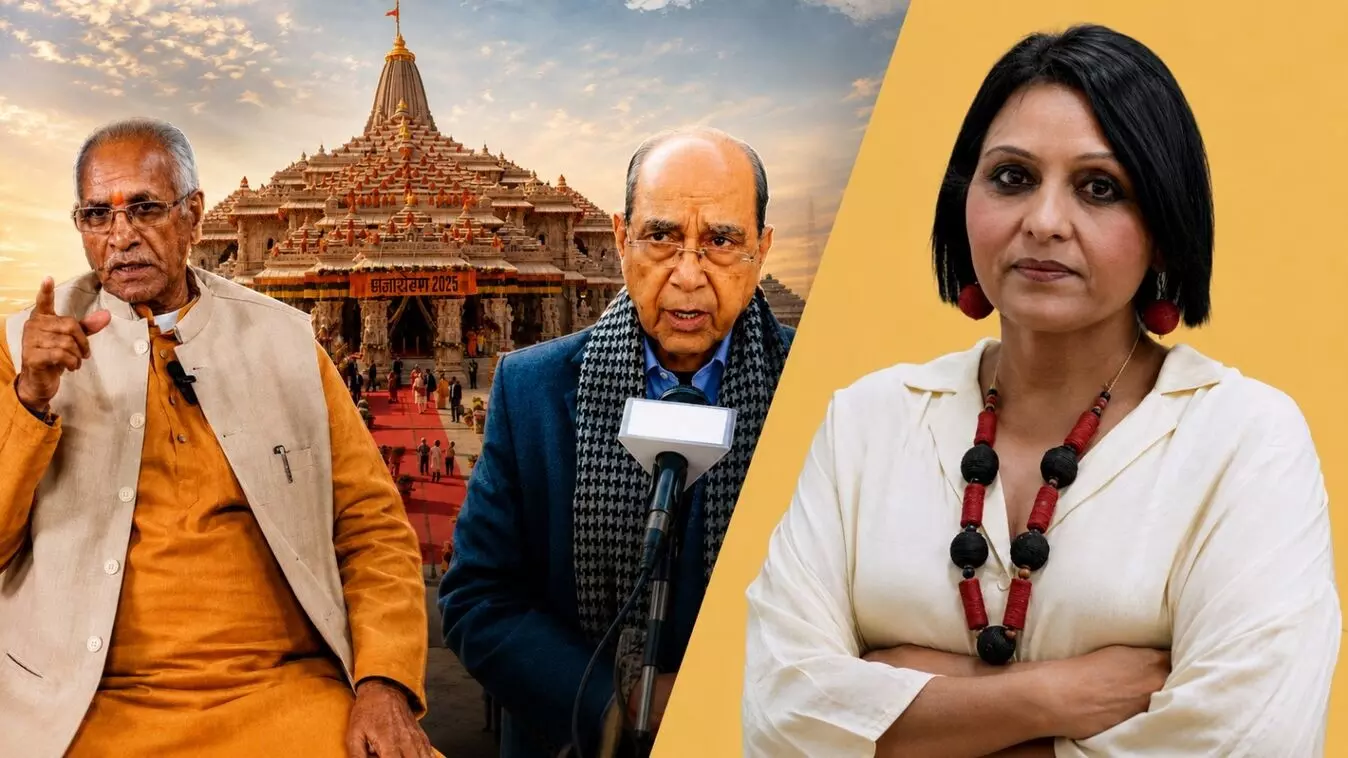
Ayodhya donation theft: What explains Champat Rai’s open letter defending Mishra?
Power struggle? Shifting the blame? A subtle warning? Sealing his position for the CEO job? What explains Rai’s open letter ahead of key temple trust meeting?

Champat Rai’s open letter defending the role of the Ram Temple construction committee has triggered fresh political speculation ahead of a crucial Shri Ram Janmabhoomi Teerth Kshetra Trust meeting scheduled for September 3.
Rai, who stepped down as the general secretary of the Trust amid allegations related to donation collection irregularities, wrote that all key decisions regarding temple construction were approved by the committee headed by former bureaucrat Nripendra Mishra.
Why the timing?
According to the letter, the committee’s authority was absolute and no work was carried out without its approval. Rai also credited Mishra for ensuring the temple project moved forward despite challenges during the Covid-19 pandemic.
The letter praised Mishra’s role in resolving technical and logistical hurdles, while simultaneously emphasizing that major decisions rested with the construction committee.
So, why did Rai choose this particular moment to release the letter? Senior journalist Shahira Naim, speaking on The Federal’s Capital Beat programme, described it as a “curious” intervention that came just before a major Trust meeting where a CEO is expected to be appointed.
What is Rai’s intention?
According to her, the letter appears to be an attempt by Rai to distance himself from responsibility while highlighting that decisions were taken under Mishra’s authority.
Also read: Champat Rai gets clean chit in Ram Temple donation embezzlement case: Report
Naim argued that the document reads as both a defence of Mishra and a subtle effort by Rai to establish that the ultimate responsibility for decisions rested elsewhere. She suggested that the letter could also be interpreted as an effort by Rai to rebuild his position within the Trust structure.
Naim also viewed the developments as part of a broader power struggle involving the Prime Minister’s Office and Uttar Pradesh Chief Minister Yogi Adityanath. She argued that Yogi had historically remained outside the Trust’s formal structure despite being the chief minister of the state where the temple is located.
According to Naim, the controversy appears less about administrative decisions and more about competing centres of influence within the broader political ecosystem surrounding the Ram Temple project.
Modi versus RSS?
Another senior journalist Sharat Pradhan examined the claims circulating in political circles that the dispute could reflect tensions between individuals perceived to be close to Prime Minister Narendra Modi and those associated with the Rashtriya Swayamsevak Sangh (RSS).
Also read: Ram Temple Trust rift deepens as Champat Rai's note exposes VHP-PMO divide
He argued that the nine-page letter largely defends Mishra rather than attacks him. He noted that Mishra had publicly defended Rai earlier and suggested that the letter appeared designed to reinforce Mishra’s role in the project while simultaneously protecting Rai.
According to Pradhan, Rai’s primary objective may be to protect the RSS from a political fallout arising from the controversy.
He also pointed out that the Trust was constituted after a vetting process involving the highest levels of leadership, making it difficult to separate individual decisions from broader institutional responsibility.
Eye on CEO’s position?
Pradhan said reports suggested that thousands of applications had been received for the position and that Rai’s name was among those shortlisted. He argued that this could explain the timing of the open letter.
Also read: Ayodhya Ram Temple donation case: Probe complete, chargesheet by Sept-end, say police
According to Pradhan, the letter may be intended to reinforce Rai’s credentials by highlighting his contribution to the temple project and portraying his record as unblemished. He suggested that appointing Rai as CEO could help maintain continuity within the Trust while also containing the political fallout from the controversy.
A warning from Rai?
Political analyst Siddharth Sharma viewed the issue through the lens of political management. He argued that the controversy had become entrenched in public discourse and that political actors were increasingly trying to avoid responsibility.
According to Sharma, Rai’s letter could be interpreted as a warning that if blame is assigned to him alone, others may also be drawn into the controversy. He pointed to Mishra’s public dismissal of the letter as evidence of a defensive posture.
Sharma contended that the BJP is facing not merely a political challenge but a credibility challenge as questions surrounding the Trust continue to attract attention.
The panel agreed that the September 3 meeting will be closely watched for signs of how the Trust intends to move forward.