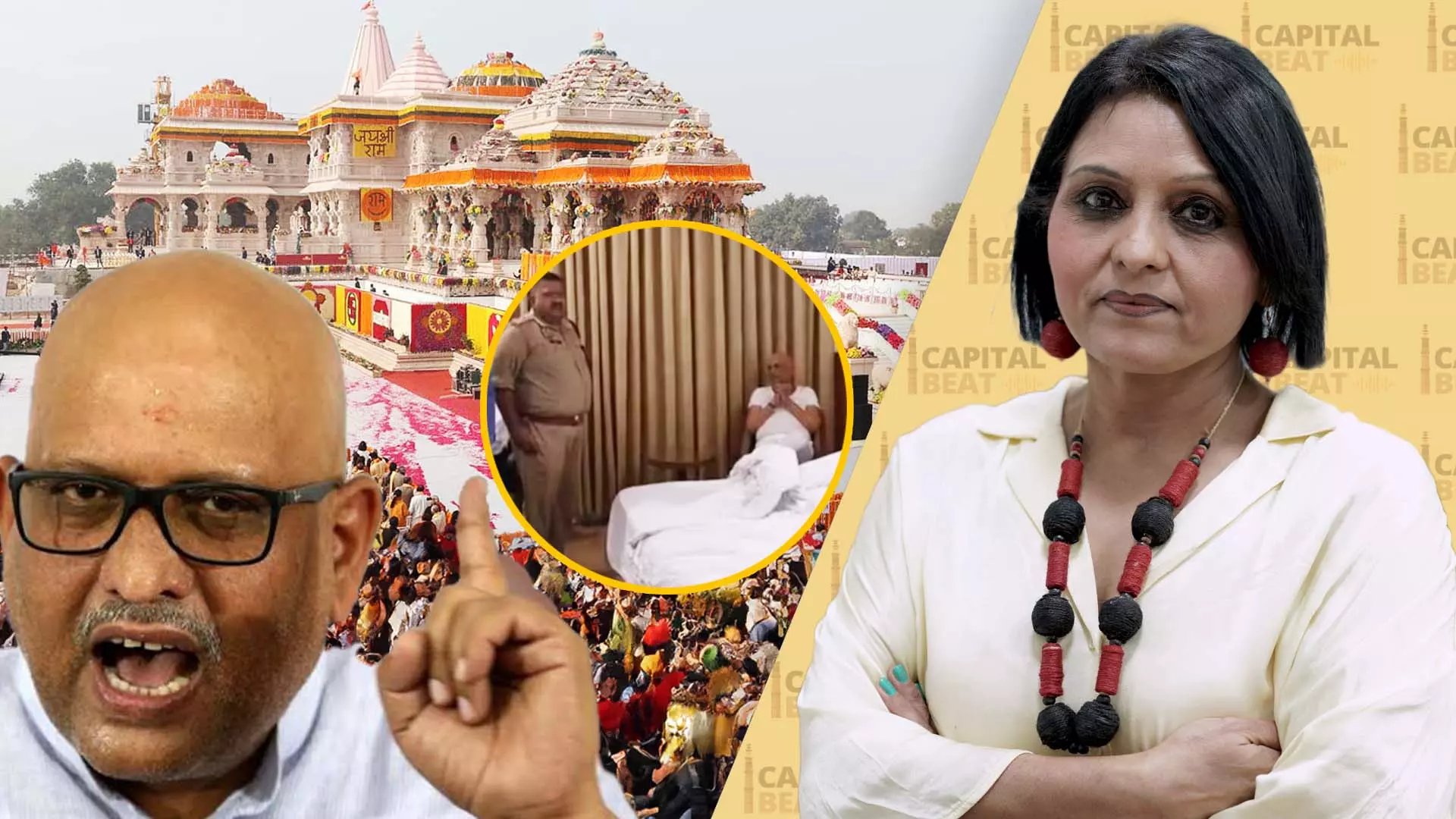
Why was Ajay Rai stopped from visiting Ayodhya’s Ram Temple? | Capital Beat
Panellists analyse the police action against Ajay Rai, alleged Ram Temple trust corruption and the Opposition's strategy to keep the issue alive

In this episode of Capital Beat, political commentator Sunita Aron, senior journalist Shahira Naim and SP spokesperson Sarvesh Tripathy discuss the alleged house arrest and detention of Uttar Pradesh Congress chief Ajay Rai and a high-level party delegation. The political flashpoint unfolded after Uttar Pradesh police stopped the delegation, which included former MP Ujjwal Raman Singh, from visiting the Ram Temple in Ayodhya to offer prayers and look into allegations of a large-scale donation, land and offering scam involving the temple trust.
The Congress stated that the state administration deployed police forces to intercept the political leaders shortly after they checked into their hotel on the previous evening. The delegation was subsequently relocated against their will to a university guest house, where they were effectively confined. This restrictive action triggered intense political debate, especially given previous assertions during the 2024 temple consecration ceremony when the ruling party claimed that Opposition leaders lacked respect for Lord Ram due to their choice to not attend the event.
Also read | Will Ayodhya Ram temple donation row impact 2027 UP Assembly elections?
Broadcast visuals from the university guest house showed police personnel stationed inside the room with Ajay Rai, while Opposition supporters and party leaders staged a protest dharna at the main gates. In tandem with these developments, Ajay Rai’s wife recorded and released a short video on social media platforms, publicly declaring that the Congress leader's life was in danger due to the sudden, unprovoked, and forced nature of the police custody, which occurred right after they arrived to meet local people and plan their temple visit.
Allegations of corruption
Speaking from confinement, Ajay Rai levelled severe accusations against the BJP and the RSS, claiming that the ruling establishment is attempting to cover up systemic corruption in Ayodhya. Rai asserted that the government panicked at the arrival of the Opposition delegation because a direct visit would expose illicit activities involving temple funds, land deals, and what he characterised as the theft of public donations and offerings meant for the deity.
Rai demanded an immediate shift in the ongoing police investigation, criticising the fact that lower-level employees had been sent directly to judicial custody without undergoing thorough police remand or interrogation to uncover the larger conspiracy. He insisted that accountability must be fixed on high-ranking trust officials and former bureaucrats, specifically naming temple construction committee chairman and former Principal Secretary to the Prime Minister Nripendra Misra, trust member Anil Mishra, as well as officials like Gopal Rao and Govind Dev Giri.
The UP Congress chief further demanded the immediate dissolution of the existing temple trust management to restore public faith. He proposed that the administration of the Ram Temple be handed over to a reconstituted body consisting of individuals nominated directly by the Shankaracharyas, emphasising that the trust must include local residents of Ayodhya who have traditionally served the temple across generations and possess a legitimate spiritual connection to the site.
Administrative overreaction
Sunita Aron provided historical context to the state's actions, comparing the current situation to the political friction of the 1990s. Aron observed, "Today, I don't think there was any reason for the government to stop them, or even for the Congress to go there. Whether Ajay Rai or any other person wanted to go for darshan, you can't question that. If a group wants to go for darshan, you can't ask why they are going."
She categorised the deployment of police forces as an administrative overreaction to an issue that remains highly sensitive among the public. Aron stated, "I personally feel the government overreacted to it because of the issue that is raging right now in everybody's mind but it was not required... It would have been better if the government had allowed them to go, have the darshan."
Also read | Ayodhya Ram temple theft probe turns spotlight on Mishra family’s ‘wealth surge’
Highlighting the immense scale of the controversy, Aron pointed out that the temple's construction relied on widespread public mobilisation, making the allegations a matter of global concern for devotees. She noted, "The reach of this scam is equally huge. It's not confined to UP but it's it's going everywhere. It's a global issue. People were coming from across the globe to with offerings. They were coming for darshan."
Legal and political questions
Sarvesh Tripathy, who is also a lawyer by profession, strongly contested the use of the term "house arrest" to describe the police action. He argued, "This is clearly a case of abduction—state-sponsored abduction—because there is no reasoning to it. People visiting Ayodhya for darshan cannot be stopped." He added that such extreme measures are legally reserved for preventing active riots or mob incitement, neither of which applied to the delegation.
He said the state government, led by Chief Minister Yogi Adityanath, is acting under direct pressure from the Prime Minister’s Office, which has managed the temple's administration since its inception. He questioned why senior figures like Champat Rai and Nripendra Misra had not been arrested. He also highlighted wider regional grievances, including an alleged ₹535-crore scam in the Purvanchal Expressway project, malfunctioning smart meters, an acute power crisis, and internal caste discontent within the ruling party over the appointment of Rohit Mishra to a post in the party's youth wing, which he said had alienated the Rajput community.
Addressing the broader electoral map, Tripathy minimised direct comparisons between the political dynamics of Uttar Pradesh and West Bengal, identifying institutional challenges rather than public sentiment as the Opposition's chief hurdle. He observed, "The real challenge the only challenge we have is Election Commission of India. Nothing else. People are with us."
National narrative at stake
Shahira Naim ascribed the police intervention to a deep-seated sense of political vulnerability within the ruling party regarding national Opposition movements. Naim explained, "It is a sense of insecurity because, you see, Arvind Kejriwal today is not the kind of threat he was a couple of years ago. Right now, his party is in very bad shape. So, his going there probably does not make the BJP as insecure as the Congress going there. That's a national party."
Naim noted that the administration's primary objective is to keep the controversy out of the public domain and prevent it from becoming a major topic of debate in the upcoming Parliament session. Naim stated, "They want to brush the whole controversy under the carpet, let it die a natural death, and they don't want people who will attract attention and bring it up once again."
Also read | How Ayodhya Ram temple donation row put faith and transparency to test
The discussion underscored that while the state government is currently conducting internal inquiries into claims regarding gold bricks, diamonds, and crowns offered to the temple, the political fallout continues to escalate. Chief Minister Yogi Adityanath has adopted an offensive stance, publicly targeting Akhilesh Yadav by referencing historical incidents where Yadav's father ordered firing on kar sevaks. Yadav has countered aggressively and announced plans to visit the Ram Temple after completing a Kedara Shiva Temple in Etawah. Aron summarised the evolving situation: "It will be interesting to watch how the Opposition keeps this issue alive. Today, we've seen the first instance of that, with Ajay Rai planning to visit the Ram Temple with a delegation."
The content above has been transcribed from video using a fine-tuned AI model. To ensure accuracy, quality, and editorial integrity, we employ a Human-In-The-Loop (HITL) process. While AI assists in creating the initial draft, our experienced editorial team carefully reviews, edits, and refines the content before publication. At The Federal, we combine the efficiency of AI with the expertise of human editors to deliver reliable and insightful journalism.