Magh Mela protest: Is BJP at odds with Shankaracharya?
Jyotirmath seer has been protesting after a police clash during the Magh Mela

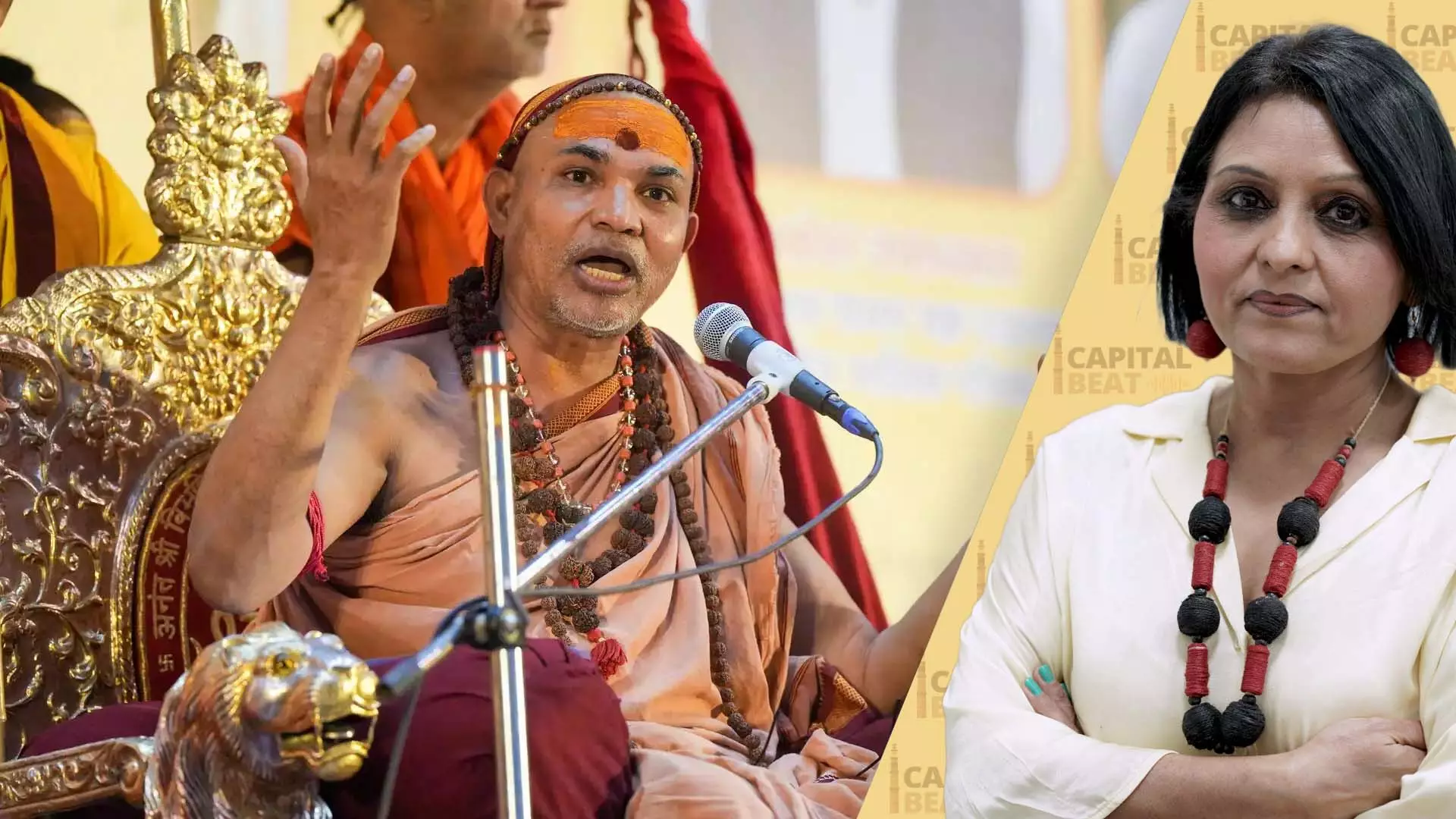
In this Capital Beat episode, Sunita Aron and Sharat Pradhan discussed Shankaracharya Swami Avimukteshwaranand Saraswati’s sit-in protest in Prayagraj, Uttar Pradesh, after his palanquin procession to the Sangam was stopped on Mauni Amavasya, and his disciples were allegedly manhandled.
The discussion also tracked the Magh Mela administration’s public position that the Shankaracharya “was not insulted”, alongside the Shankaracharya’s demand for an apology from the Uttar Pradesh government.
A second strand of the debate focused on an administrative pushback over whether he is a “genuine” Shankaracharya, and how it intersects with an ongoing legal challenge related to his succession.
Protest trigger
The episode opened with the Shankaracharya’s account that his movement plan for Mauni Amavasya had been shared with the mela administration three days in advance, and that he proceeded in a ceremonial palanquin as part of established tradition.
A key claim placed on record in the discussion was that several disciples were detained and some were injured during the confrontation near the route to the Sangam.
Also read: Congress attacks BJP over mistreatment of Shankaracharya at UP's Magh Mela
The programme framed the immediate political question as whether the episode could “snowball” for the BJP in Uttar Pradesh, given the visibility of a Shankaracharya-led protest during the Magh Mela.
Religious hierarchy
Sharat Pradhan argued that the protest had a “reason” because, in his formulation, this “probably never happened before”, and because Shankaracharyas are “held in very high esteem” across the Hindu community.
He described the mela ecosystem as one where Shankaracharyas and akharas traditionally receive special arrangements for bathing schedules and processions, and questioned why the procession should have been stopped.
Also read: Jyotirmath Shankaracharya blasts RSS chief for 'politically convenient' view on restoring temples
He also raised the government’s public line disputing entitlement, pointing to a stated administrative claim that the Shankaracharya is “not entitled” to be referred to as Shankaracharya, and described that move as an “afterthought”.
Title dispute line
Sunita Aron described the incident as an “insult” on the grounds that Shankaracharya's traditionally proceed in a palanquin and are not expected to “walk” to the bathing point as part of the ceremonial practice.
She noted that the legal dispute around succession was not new, and said the issue appeared to be getting foregrounded now despite the Shankaracharya’s public presence at the mela in earlier periods.
Also read: ‘Violation of Sanatana Dharma’: 4 Shankaracharyas refuse to attend Ayodhya temple consecration
Aron also described him as a “rebel Shankaracharya” and said the larger question was why the administration raised the title issue at this moment.
Ayodhya backdrop
Pradhan linked the friction to prior public disagreements between Shankaracharyas and the BJP leadership, including objections raised at the time of the Ayodhya Ram temple consecration ceremony.
He stated: “The problem with the BJP is that everything they talk about religion is closely linked with their political ambitions,” and tied that claim to the timing of the temple inauguration.
He also attributed earlier controversies to the Uttar Pradesh government, including stampede-related questions raised by the Shankaracharya, and argued that dissent is not accommodated within the BJP’s political culture.
Who decides legitimacy
Aron placed on record the Shankaracharya’s stated position on who can decide legitimacy, saying he has publicly argued that the government or the President should not decide, and that the question should rest with other Shankaracharyas.
Also read: Shankaracharya: PM Modi not my enemy; Uddhav Thackeray victim of betrayal
She said two of the four Shankaracharyas had accepted him, while another was “silent”, and that — irrespective of legal outcomes — he retains a significant following.
Aron also raised the silence of other saffron religious figures, including why more voices did not publicly respond to the way the Shankaracharya was being treated.
Hindutva vote bank question
When the discussion turned to whether the “Hindutva vote bank” could drift due to the episode, Pradhan argued the targeting was evident in the government’s posture and in what he called intimidation.
He cited the appearance of enforcement action against Shankaracharyas in the past in the context of Ayodhya objections, and framed the current moment as an extension of that conflict line.
Pradhan also introduced a comparison with Satua Baba, alleging differential treatment in access to the Sangam route and scale of accompanying crowd.
What happens next
The last segment examined whether the protest could escalate into confrontation if supporters gather, and whether the state could remove or arrest the Shankaracharya.
Aron downplayed the prospect of a street-level collision, and projected that the it would shift to court proceedings around succession and title.
Pradhan, in contrast, argued the title dispute was being used for “damage control” to circulate an “imposter” framing, while also stating that recognition in a religious order can continue irrespective of a legal contest.
The content above has been transcribed from video using a fine-tuned AI model. To ensure accuracy, quality, and editorial integrity, we employ a Human-In-The-Loop (HITL) process. While AI assists in creating the initial draft, our experienced editorial team carefully reviews, edits, and refines the content before publication. At The Federal, we combine the efficiency of AI with the expertise of human editors to deliver reliable and insightful journalism.