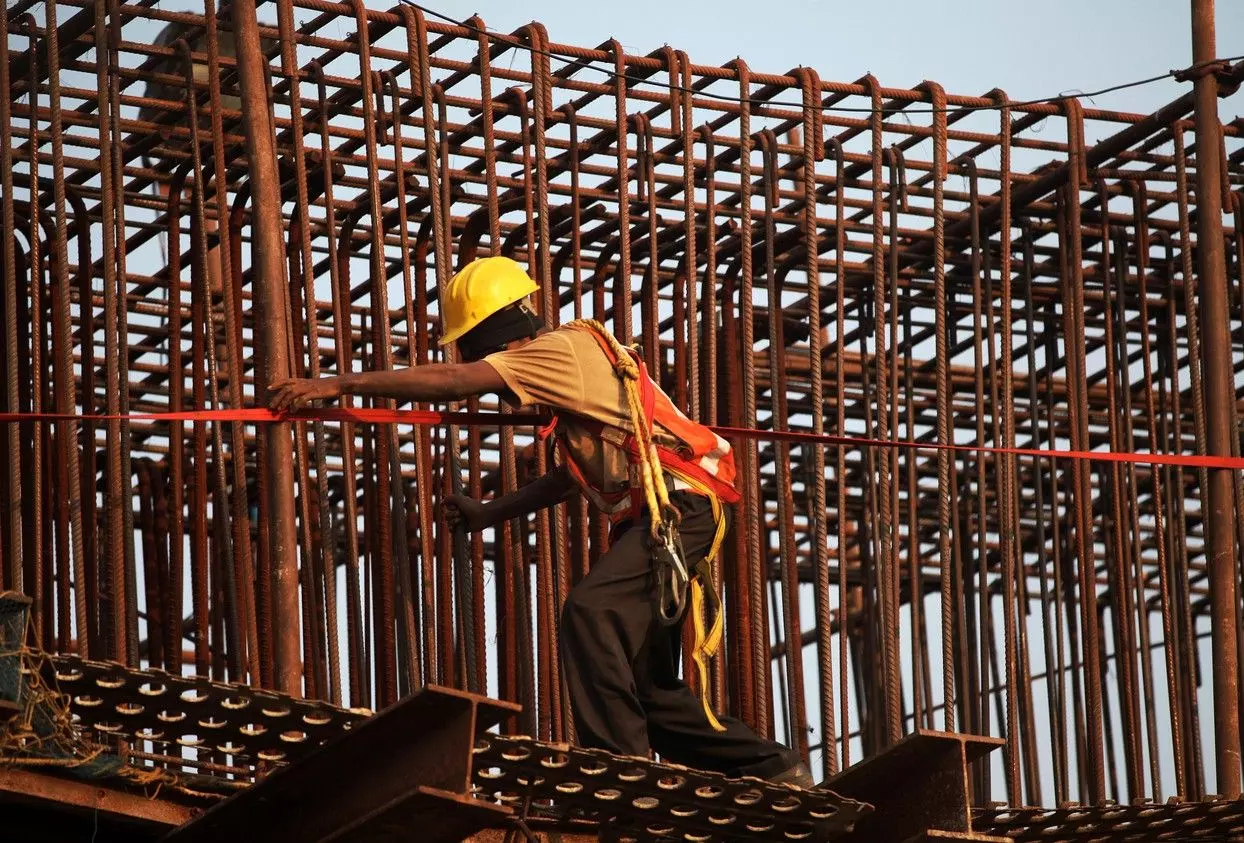
Worker shortage has been a major challenge to the building of Amaravati as the capital of Andhra Pradesh. Representative Photo: iStock
Amaravati labour crisis slows Andhra capital works; World Bank discovers stark reality
The global lender's review flags worker shortage, poor living conditions and contractor negligence as key threats to Amaravati Phase-1 project timelines

While the Andhra Pradesh government has been proudly trumpeting progress on Phase-1 works in Amaravati, backed by funding from the World Bank (WB) and the Asian Development Bank, behind the fanfare of the ambitious capital city project lies a grinding reality that threatens to slow it all down — a severe shortage of construction workers.
Also read: Amaravati is now officially Andhra's capital after President's nod
Recently, a visit to the site by a WB delegation laid bare glaring negligence by contracting agencies. Inspectors discovered an inadequate workforce deployed across projects under the Andhra Pradesh Capital Region Development Authority (APCRDA) and the Amaravati Development Corporation Limited (ADCL). To make matters worse, the labour camps were found to have inadequate basic amenities, something that even human rights activists would be worried about.
Shortage of workers
The issue is not a temporary inconvenience but a long-term one that could hurt not only the project deadlines, but also construction quality and financial progress.
Currently, 88 construction projects are being executed across APCRDA and ADCL, handled by 11 major contracting firms including NCC, L&T, KPC and MEIL. However, the workforce picture is far from being perfect. Contract conditions mandate a minimum of 22,000 workers, with some estimates suggesting that the actual requirement, including technicians and skilled labourers, is closer to 30,000.
Problems identified by World Bank
♦ Lack of minimum facilities for migrant workers from other states
♦ Labourers staying in tin-shed shelters during peak summer
♦ shortage of drinking water, toilets and shaded areas
♦ Delayed payment of wages.
Even the WB’s project documents had projected that Phase-1 construction activity would generate work for between 15,000 and 20,000 workers.
The contractors have claimed in their reports that more than 20,000 workers have been deployed. But representatives of the WB and APCRDA reportedly found that their number was not even 17,000. The situation is equally alarming with the machinery. While reports said that 3,600 vehicles and pieces of equipment are needed, only around 1,100 are currently operational, contradicting the workforce figures and exposing the grim ground reality at the construction sites.
Lack of basic amenities
Among the major issues that the WB team that recently visited construction sites and labour camps in Amaravati identified are: lack of minimum facilities for migrant workers from other states; labourers made to stay in tin-shed shelters during peak summer; shortage of drinking water, toilets and shaded areas; and delayed payment of wages.
What steps World Bank is taking
♦ Under loan conditions, strict monitoring is being enforced across labour welfare, occupational health and safety (OHS), and labour influx management.
♦ Fund releases through Disbursement Linked Indicators are directly tied to progress and adherence to worker welfare standards
♦ Through this review, the WB has pressured contractors, pushing for improved facilities for the labourers and skill-training opportunities for the local workers
The consequences are already showing as workers are reportedly falling sick and walking off sites, while fresh labourers are expressing reluctance to step in and fill the void.
According to the WB team, these problems arise mainly from contractors’ negligence. It has also been alleged that they are not keen to hire local workers.
Also read: Greening the concrete: Vijayawada transforms flyover pillars into vertical gardens
The global lending institution has reportedly come up with many corrective measures aimed at APCRDA and the Andhra Pradesh government. Under the loan terms, strict monitoring is being enforced across labour welfare, occupational health and safety (OHS), and labour influx management. Fund releases through Disbursement Linked Indicators (DLIs) are directly tied to progress and adherence to worker welfare standards.
Through this review mechanism, the WB has effectively pressured the contractors, pushing for improved facilities for the labourers and skill-training opportunities for the local workers.
Its documents have recommended skill development and employment opportunities for landless labourers, nearly 21,000 affected families in the past, besides women and youth.
The shortage issue is not merely related to the labourers. Dependence on migrant workers, labourers’ return to their home states during elections, extreme summer and lack of facilities are among the major reasons.
Amaravati's larger aim could be jeopardised
The stakes are high. If left unaddressed, impediments such as work delays, escalating costs and slipping quality standards risk undermining Amaravati's larger ambition of generating 50,000 jobs in construction, agro-processing and service sectors.
The only long-term solution lies in providing skill training to local youth, women and landless labourers and integrating them into the construction sector. The government has already asked contractors to boost local recruitment.
Also read: Glorious past, bleak future? Faculty crunch, political meddling haunt Andhra varsities
For Amaravati to truly emerge as a world-class capital city, labour welfare and local employment cannot remain secondary. The WB's review is a clear warning signal. The government must convert it into decisive action now — strict action against errant contractors, upgrading worker facilities, and fast-tracking skill development programmes.
Only then can Amaravati deliver on its promise of becoming one of the region’s major growth engines.
(This article was originally published in The Federal Andhra Pradesh.)