








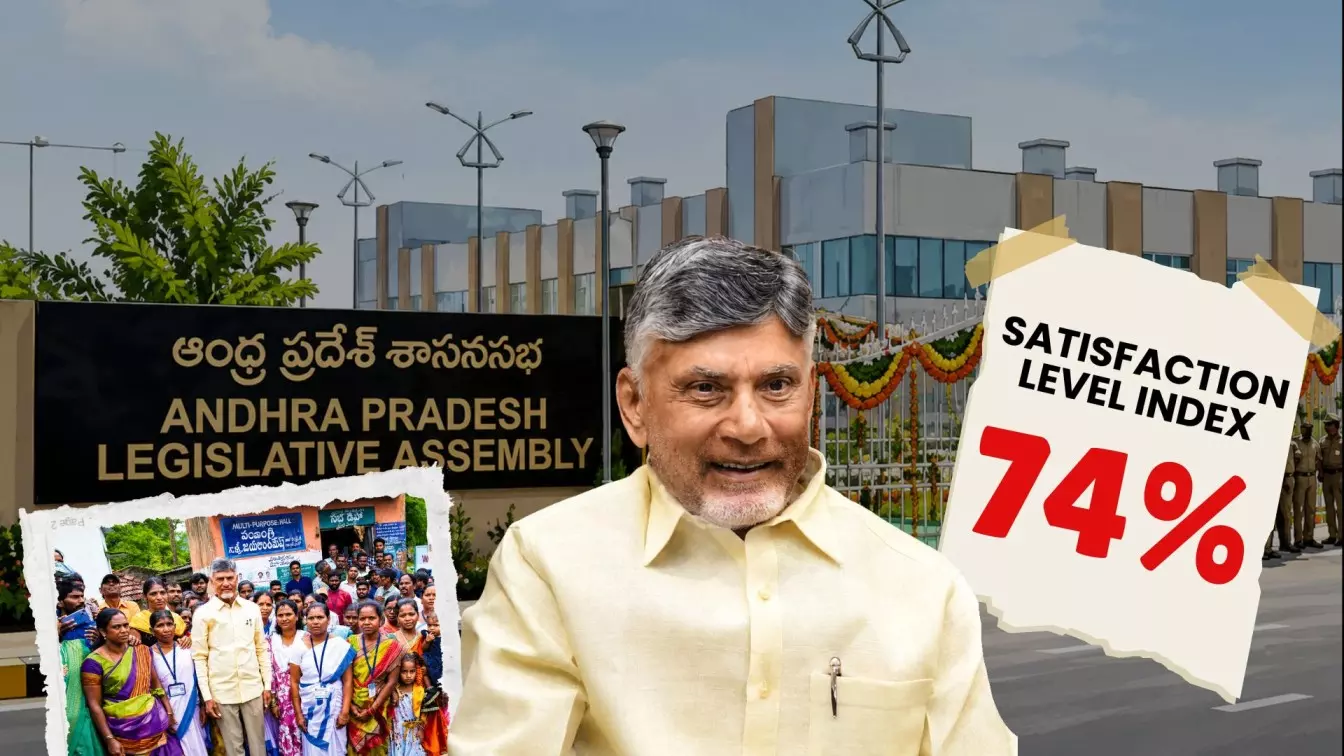
Does Andhra's ‘Satisfaction Levels’ model truly capture ground reality?
CM Chandrababu Naidu’s government says citizen satisfaction has reached 74 per cent but, critics question whether the numbers reflect reality on the ground

A new governance phrase is dominating administrative discussions in Andhra Pradesh — “Satisfaction Levels”. The government, led by Chief Minister N Chandrababu Naidu, said it measures how satisfied citizens are with public services and welfare delivery in the state.
Also read: BJP-Jagan remark: FIR storms against Nageshwar even as he apologises
The state government is using the Real Time Governance Society (RTGS) system to track this feedback mechanism. Through IVRS calls, WhatsApp, Facebook, QR codes and online portals, citizens are asked whether services such as pensions, electricity supply, municipal works and welfare schemes are reaching them effectively.The system is being projected as a major governance reform. But critics argue that the numbers may not fully reflect the experiences of people on the ground.
Also read: Naidu and Siddaramaiah: Latest examples of ‘self-acquittal’ by chief ministers
The issue recently became part of a wider discussion on governance and accountability in the southern state. The Federal Andhra Pradesh last week held a video discussion on this topic in Telugu, which threw up interesting insights. The content for this article is adapted from that discussion.
RTGS model
The RTGS was first introduced during Naidu’s previous tenure in 2017.
According to the government, the collected feedback is directly reviewed by the chief minister. During a recent meeting with district collectors, the CM said overall public satisfaction had risen to 74 per cent this month from 68 per cent earlier.
Monthly targets
Naidu reportedly instructed district collectors to increase the satisfaction figure by 1.5 per cent every month.
Under the model, if a welfare scheme records 85 per cent satisfaction, officials are expected to explain why the remaining 15 per cent of citizens are dissatisfied. Review meetings are then conducted, and corrective measures are discussed.
Also read: BJP-Jagan remark: FIR storms against Nageshwar even as he apologises
Former TDP minister Kalva Srinivasulu described the initiative as a major shift in governance.
“It is the first time a government is talking about the satisfaction among the people. Performance is now measured not by how many files are cleared — but by how many citizens feel satisfied,” he said.
WhatsApp governance
The government has also launched “WhatsApp Governance” under the Mana Mitra initiative, led by IT Minister Nara Lokesh. Through the system, citizens can access exam results, certificates, and grievance-redressal services using WhatsApp.
The government said the initiative reflects its focus on the “Speed of Governance”.
However, opposition leaders and critics have questioned the credibility of the satisfaction figures being presented.
Opposition not convinced
Congress leader N Thulasi Reddy called the government’s claim of 74 per cent public satisfaction a “myth”.
“The 74 per cent satisfaction claimed by Naidu is a myth. There has been no unemployment allowance as promised. Fee reimbursement was shelved. The pension for every woman aged 50 — forgotten. Agriculture has collapsed. Every family is in distress. Then how could you possibly have higher satisfaction levels?” he asked.
Also read: How Andhra is carving itself out as a major defence hub amid stiff southern competition
Critics from labour groups have also raised concerns over the effectiveness of the system.
A larger question being raised is whether citizens feel comfortable expressing criticism during feedback calls made through IVRS systems.
Ground reality
Critics argue that since citizen contact details are already available to the government, many people may hesitate to openly criticise the administration during official feedback surveys.
Analysts also point out that while RTGS may measure departmental satisfaction levels, it may not be able to identify individual corruption or misconduct by officials.
Also read: Amaravati labour crisis slows Andhra capital works; World Bank discovers stark reality
Questions have also been raised about transparency and independent verification. Although the government claims that more than 92 per cent of grievances have been resolved, media reports continue to highlight unresolved land disputes, delayed files, and pending complaints.
Critics say that unless corruption is tackled honestly and grievances are resolved faster, “Satisfaction Levels” could end up becoming just another political slogan rather than a meaningful governance reform.
For Andhra Pradesh, the debate may ultimately come down to one question: Do the numbers on government dashboards truly reflect the reality people experience every day?The content above has been transcribed from video using a fine-tuned AI model. To ensure accuracy, quality, and editorial integrity, we employ a Human-In-The-Loop (HITL) process. While AI assists in creating the initial draft, our experienced editorial team carefully reviews, edits, and refines the content before publication. At The Federal, we combine the efficiency of AI with the expertise of human editors to deliver reliable and insightful journalism.