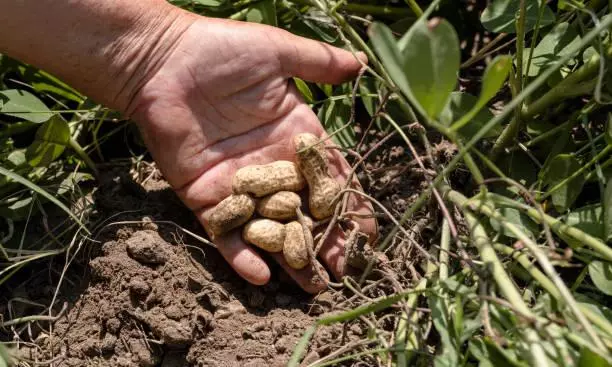
Falling yields, rising oil imports crush Anantapur’s groundnut farmers
Years of drought, policy neglect and sub-MSP prices push farmers in Andhra Pradesh's Anantapur to abandon a once-reliable crop and rethink survival on the land

Groundnut farmers in Anantapur, Andhra Pradesh, are in deep distress. Yields have declined, market prices have plummeted, and cheaper imported edible oils have severely undercut local groundnut oil, wiping out profits.
These challenges have forced many farmers to abandon groundnut for alternative crops, only to find similar losses.
Also Read: How satellite survey glitch has left 80,000 Gujarat groundnut farmers in the lurch
The area under groundnut cultivation has drastically declined, from 8.75 lakh hectares in 2005-07 to just 1.94 lakh acres in 2024-25. The alternative crops are not working well for farmers, either. Despite the Chandrababu Naidu-led Andhra Pradesh government’s Rs 40,000 crore push to turn the region into a horticulture hub, crops like banana and custard apple are not fetching viable prices.
Key pain points
In 2021, when 62 of the 63 mandals received above-normal rainfall, farmers declared a crop holiday across 1.5 lakh acres.
Unlike similar protests in Konaseema, their action received little attention. Farmers cite several reasons for the decline of groundnut cultivation, including dependence on borewell irrigation and the impact of cheap imported oils
Farmers' top concerns:
a) Rising input costs and reduced yields
b) Crop failures and poor-quality seeds
c) Lack of minimum support price (MSP) enforcement
d) Fuel and transport cost hikes
e) Mechanisation limiting access to cattle fodder
f) Delayed or unpaid crop insurance
g) Withdrawal of Rs 12,000 per-acre input subsidy after 2018
h) Marketing challenges, commission agents's exploitation, and difficulty accessing loans
i) Tenant farmers are particularly vulnerable, often ending up in debt with no returns
Voices from the field
C Ramakrishna from Narpala mandal told The Federal Andhra Pradesh that just a quarter of the farmers in his village now cultivate groundnuts, with many shifting to fruits and vegetables due to improved rainfall and employment schemes. Earlier, 80 per cent of his hamlet had migrated for work, but today, most have returned.
Venkata Konda (60) from Bukkarayasamudram sold 5 acres of his 80 acres due to debt. “With real estate booming near the district centre, my family is pressuring me to sell the land, build a house, and live off rent,” he said.
Also Read: Legend, Nandi and a city’s nostalgia: Why Bengaluru still throngs to Kadalekayi Parishe
In Sanapa village, Atmakur mandal, Rajasekhar Reddy (22) said only 2,000 of 7,000 acres are now under groundnut. “Four years ago, my father died by suicide due to debt. We now rely entirely on wage employment,” he said.
Expert panel findings
In 2021, a team of agricultural scientists identified key reasons for the groundnut crisis. These include:
a) 15 of the last 18 years saw droughts
b) 90 per cent of farmland is rain-fed
c) 70 per cent of the population depends on farming
d) Erratic rainfall patterns
e) Lack of farming equipment
f) High input costs
g) Inadequate groundwater
h) Declining soil carbon content
Rainfall data from 1995 to 2020 shows that six years recorded more than 700 mm of rainfall, five years received between 600 and 699 mm, another five years saw rainfall in the range of 500 to 599 mm, four years recorded between 400 and 499 mm, and six years received less than 400 mm of rainfall.
Scientists say 750 mm of well-distributed rainfall is needed for groundnut to thrive.
Changing social needs
CPI(M) leader V Rambhoopal explained that groundnut is drought-tolerant and its haulm is essential fodder for cattle.
However, changing social needs and rising expenses are forcing farmers to grow high-value crops. But millets and pulses can’t meet immediate financial needs, especially due to poor market access.
Social activist SM Basha said farmers need a minimum yield of 1,200 kg per hectare to break even. Yet in the last 26 years, this level was achieved in only five years, resulting in recurring losses.
Rising edible oil imports
Cheaper imports of canola, soybean, and sunflower oil continue to undermine local oilseed farmers. According to ICAR expert E Amarender Reddy, unless these imports are regulated, local oilseed prices will remain depressed.
The Union government admitted in Parliament that 56 per cent of India’s edible oil needs are met through imports from countries like Indonesia, Malaysia, Argentina, Brazil, Ukraine, and Russia. Despite this, import duties on these oils were slashed by 20 per cent, further weakening domestic producers.
Pushed off the land
According to Prof N Purendra Prasad from the Central University of Hyderabad, farmers are wary of growing groundnut due to loss of subsidies, traders refusing to buy at MSP, exploitative seed dealers and commission agents, lack of government-backed loans, and syndicates manipulating e-market prices.
Many youth who tried farming have since given up and taken up jobs or manual labour. Government policy, he said, is increasingly making land easier to convert to real estate, pushing farmers out.
Also Read: Maharashtra: Unseasonal rains dampen mood in onion farming belt
“Corporate farming will take root if farmers are removed from their land. As farming becomes increasingly unviable and debt-ridden, farmers are being nudged to sell. The land will remain—but not the farmer,” said Rambhoopal. “Unless we resist anti-farmer policies, agriculture has no future.”
(This article was originally published in The Federal Andhra Pradesh.)