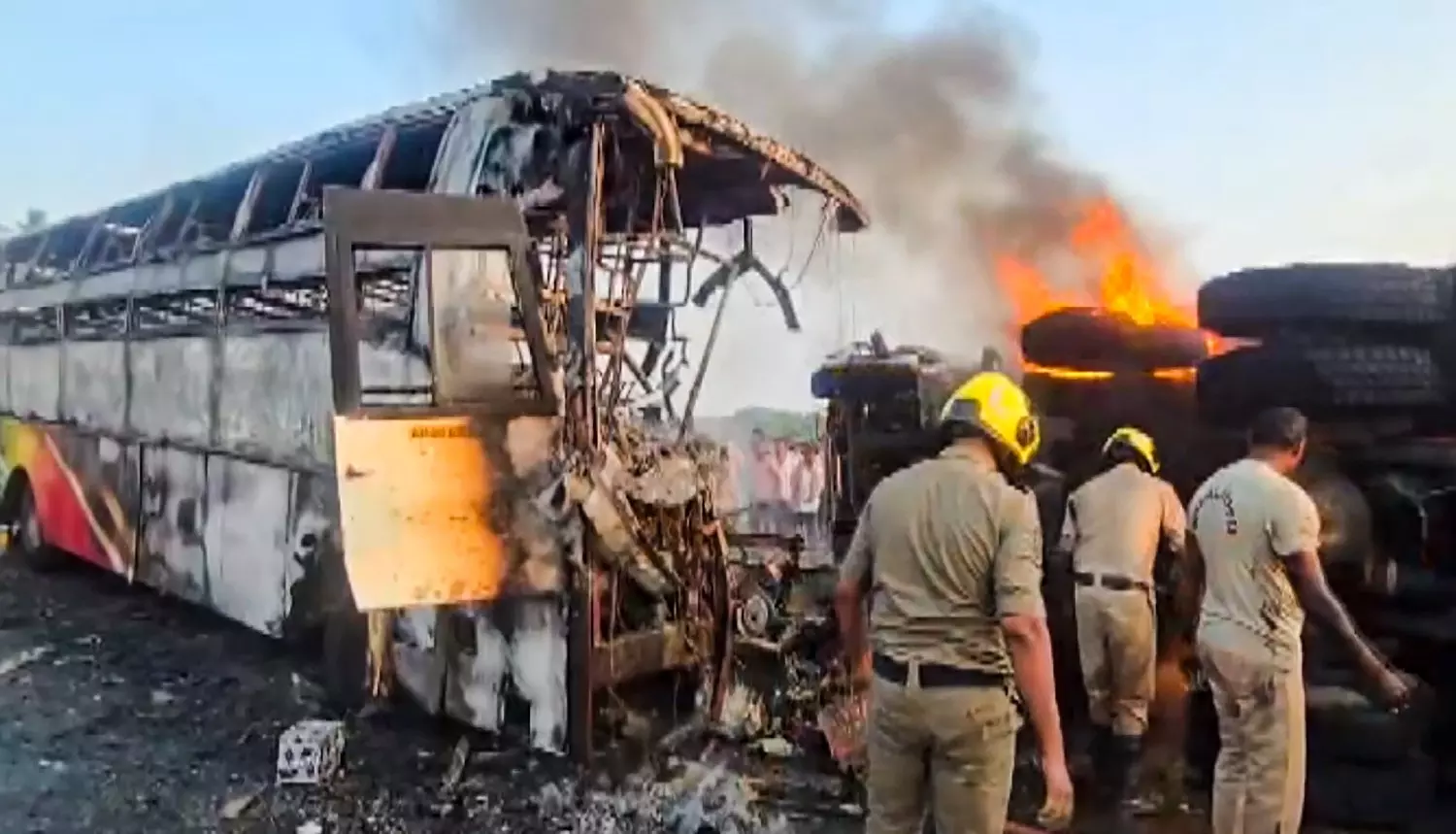
Rescue personnel engage in a rescue operation after a private bus caught fire after hitting a lorry, in Markapuram, Andhra Pradesh, early on March 26, 2026. Photo: PTI
Markapuram bus fire: Why India's highways remain death traps
From missing speed guns to unmonitored toll plazas, systemic failures in road safety enforcement keep killing passengers on Andhra's national highways

In yet another horrific incident of bus fire in Andhra Pradesh, at least 14 people were charred alive early on Thursday (March 26) morning when the private bus they were travelling in rammed a tipper lorry near Markapuram in Prakasam district. The lorry belonged to a nearby granite quarry.
The accident has once again thrown a spotlight on the lawless state of India's national highways.
Memories of Kurnool disaster still afresh
In October 2025, 21 people met a similar fate near Chinnatekuru on the outskirts of Kurnool. The tragedy remained in the headlines across the country for a while. The following month, 19 perished in the Rangareddy district of the neighbouring Telangana when a gravel-laden lorry collided with a state-run bus head-on.
Also read: Kurnool bus fire exposes rampancy of out-of-state bus registrations
In January this year, three persons were killed when a private bus caught fire after hitting a container lorry in Andhra’s Nandyal district. It was going from Nellore in the state to Hyderabad, Telangana.
In 2013, more than 40 people were killed after a Bengaluru-bound bus from Hyderabad caught fire in Mahbubnagar, in the then undivided Andhra.
Similar accidents have been reported from other parts of the country as well in the last few years, including the death of 25 in Buldana, Maharashtra, in 2023, and 26 in Jaisalmer, Rajasthan, in 2025.
Each tragedy triggers a brief flurry of official activity—and then silence.
A parallel, unregulated system
Private bus operators have built what is effectively a shadow transport network alongside the state-run APSRTC (Andhra Pradesh State Road Transport Corporation). From Tirupati alone, 326 private buses—AC (air-conditioned) sleepers, non-AC seaters and everything in between—depart daily for inter-state destinations. Across the state, the number is estimated to exceed a thousand. These operators exploit the Centre's 'One India, One Tax' policy, registering buses in other states while running routes entirely within Andhra. The regulating authorities look the other way.
Also read: Kurnool bus fire: 234 smartphones in luggage cabin likely intensified blaze
State Chief Minister Chandrababu Naidu acknowledged the problem in November last year, a month after the devastating Kurnool incident, and wrote to the Centre about reviewing the policy. Nothing has come of it.
Speed devices that nobody checks
Starting in 2015, all buses sold by manufacturers are required to have a speed-limiting device fitted at the showroom. But here lies the problem: the state transport department has no technical means to verify whether these devices are functioning—or whether they have been tampered with.
Murali Mohan, a transport official from Tirupathi regional transport office, confirmed this gap. "Speed detection cameras like those on Hyderabad's ORR would help rein in vehicles," he told The Federal, adding that private buses do have built-in speed limiters—but whether they actually work is another matter.
Speed guns, which cost around Rs 10 lakh each, are conspicuously absent. Even where they exist, drivers spot them from a distance and slow down. Interceptor vehicles—used effectively in some other states—are barely deployed here. Andhra's Chittoor district, for instance, has just one.
What toll plazas don't do
Thousands of crores have been spent building four and six-lane national highways across AP.
Toll plazas equipped with sophisticated technology collect fees from every passing vehicle. Yet not one of these plazas is configured to calculate average speed between two checkpoints—a method that would instantly flag speeding vehicles.
"If a vehicle crosses one toll plaza at 9 AM and the next at 10 AM, you can calculate exactly how fast it was travelling," said Mohan. The system exists in concept. It is simply not being used.
What works and what should
This correspondent travelled on an APSRTC AC bus from Tirupati to Chennai recently. The bus was capped at 80 kmph on orders from Jagadish, the local regional manager. Every seat had an emergency hammer—a metal rod fitted with a silver-foil-wrapped head—for passengers to break windows in case of fire. These were installed on the manager's initiative.
If a public bus operator can implement this on a three-and-a-half-hour route, why can’t the state transport department enforce similar standards on private operators covering 10-hour overnight journeys?
Also read: 16 violations, unpaid fines: How Andhra bus blaze snuffed out 20 lives after Diwali gala
The road from Tirupati to Tirumala offers another model: vehicles must cover an 18-kilometre ghat (hill) road in no less than 30 minutes. Arrive faster, and an automatic fine is triggered, along with a ban from the hilly route. No such standard exists on any national highway in the state.
At Kurnool, police stop vehicles and ask drivers to wash their faces before proceeding—a well-meaning gesture that misses the point entirely.
Trains don't meet demand
One structural fix would be to increase rail connectivity, reducing dependence on overnight private buses. Around 90 to 95 trains pass through Tirupati daily, with 21 special trains on the Tirupati-Hyderabad route alone—but still not enough to meet demand.
Also read: Kurnool accident effect: Karnataka orders safety audit of all state-run buses
Retired chief ticket inspector and Balaji Railway Division Sadhana Samithi representative Kuppala Girdhar argues that a dedicated Tirupati railway division, station expansion, and a third line are prerequisites for any meaningful increase in train services.
Until then, passengers boarding overnight private buses from Tirupati will continue to undertake journeys with a nervous heart.
(The article was originally published in The Federal Andhra Pradesh.)