








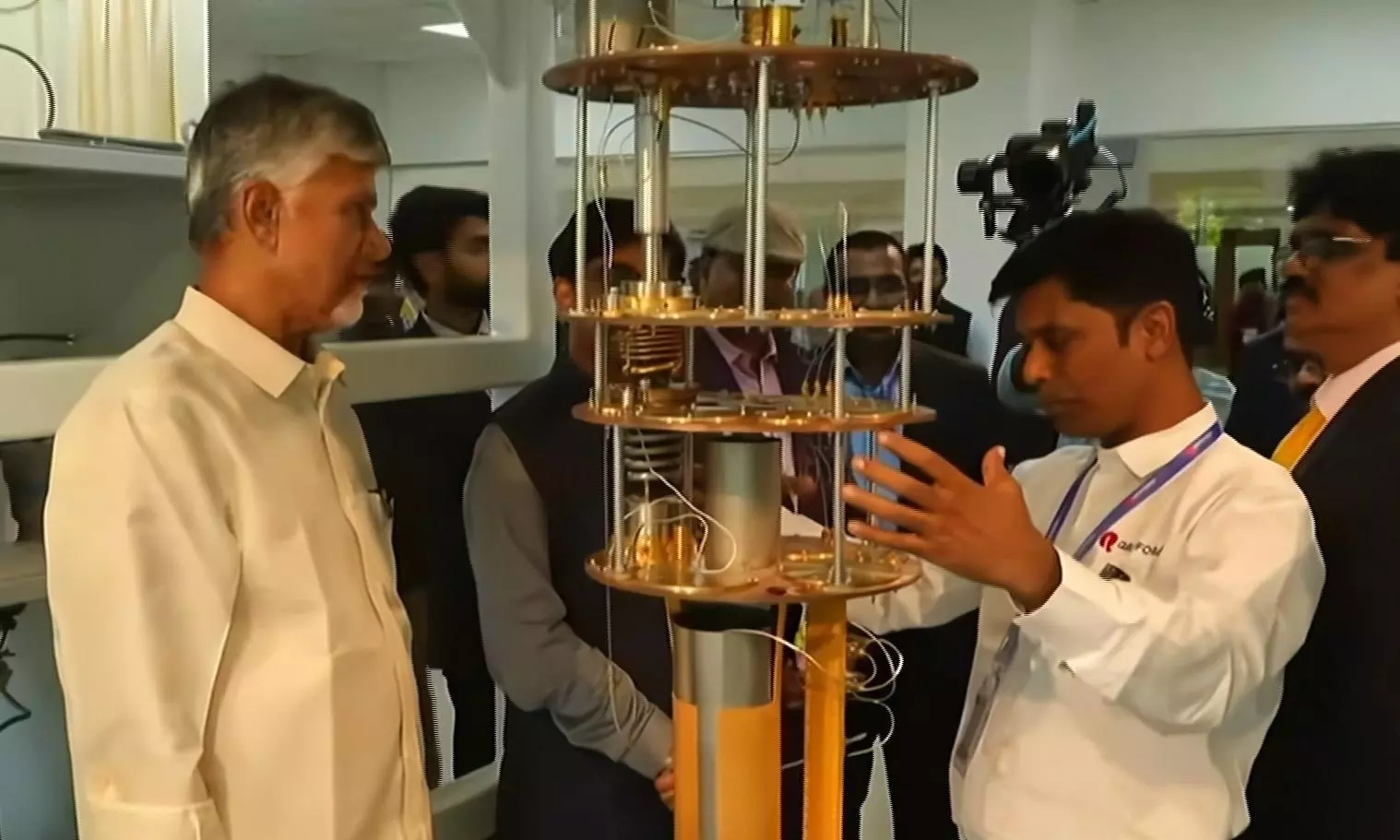
Andhra Pradesh Chief Minister N Chandrababu Naidu inaugurating the Quantum Reference Facility at SRM University-AP, Amaravati, on Tuesday (April 14). Image: X@SRMUAP
Andhra Pradesh switches on a quantum future with two test facilities
Chandrababu Naidu launches India’s first indigenous open-access quantum facility in Amaravati, with 85 pc local components and full-stack hardware access

On a morning that coincided with World Quantum Day, Andhra Pradesh Chief Minister N Chandrababu Naidu on Tuesday (April 14) inaugurated a fully indigenous, open-access quantum computing facility at SRM University in Amaravati, built with components sourced and assembled almost entirely within India.
The Amaravati Quantum Reference Facility (AQRF) houses two systems: Amaravati 1S and Amaravati 1Q. A simultaneous virtual launch took place at Medha Towers in Gannavaram, near Vijayawada.
India’s quantum push
Developed under the Amaravati Quantum Valley initiative, the systems are India’s "first indigenously built" open-access quantum computers, designed, assembled, and tested domestically with a supply chain spanning multiple institutions.
Also read: Quantum physics 100 years on: Experts meet in Germany, where it all began
The AQRF is India’s national quantum hardware testing ground, enabling validation, benchmarking, and certification of quantum components under real operating conditions, according to a press release.
Access to quantum hardware has long been the privilege of a handful of nations and corporations. Researchers elsewhere must queue for remote access to machines they cannot see, touch, or fully understand. The components inside — dilution refrigerators, cryogenic amplifiers, precision control electronics — are dominated by a small circle of Western and East Asian manufacturers. AQRF is seen as a direct challenge to that arrangement.