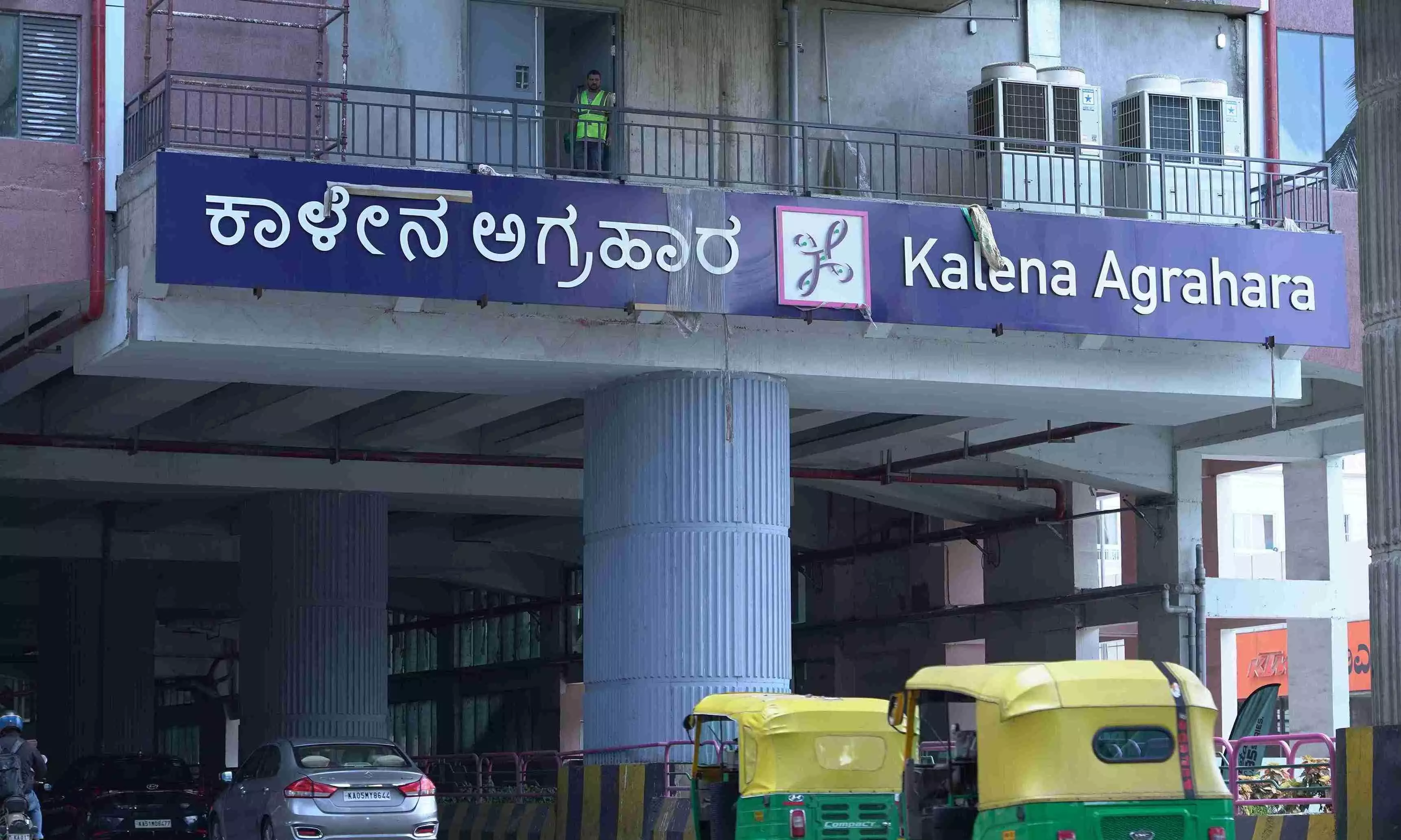
The 21.26-km line from Kalena Agrahara in south Bengaluru to Nagawara in the north will connect several key parts of the city, including areas around the Indian Institute of Management Bangalore (IIMB). Photo: Raghu RD
Bengaluru Pink Line set to open: What commuters say about phase 1
The Phase 1, likely to open by October, may offer faster trips for some commuters on Bannerghatta Road, but those travelling towards north Bengaluru will still need road transport

Bengaluru’s crucial Pink Line is expected to begin operations in phases, with the 7.5-km elevated stretch between Kalena Agrahara and Tavarekere likely to open later this month or next.
Commuters say the opening is likely to ease congestion on the busy Bannerghatta Road. The 21.26-km line from Kalena Agrahara in south Bengaluru to Nagawara in north will connect several key parts of the city, including areas around the Indian Institute of Management Bangalore (IIMB), Jayadeva Hospital and many educational institutions and IT parks.
Opening of elevated section
Construction of the Pink Line began in 2017, with an initial target of completing the project by 2021. However, land acquisition issues, the Covid-19 pandemic and technical challenges delayed the project.
Also read: Bengaluru's traffic nightmare isn't just about cars. Here's why
The line has been built in two formats - a 7.5-km elevated section from Kalena Agrahara to Tavarekere, with six stations, followed by a 13.76-km underground stretch from Tavarekere to Nagawara, connecting 12 stations.
The connectivity
The elevated section will run along Bannerghatta Road before the line goes underground towards Nagawara. Once fully operational, the Pink Line is expected to provide an alternative to buses and private vehicles and improve connectivity between south Bengaluru, the central business district and north Bengaluru.
The Pink Line is expected to provide an alternative to buses and private vehicles and improve connectivity between south Bengaluru, the central business district and north Bengaluru.
For commuters in the first phase, the Kalena Agrahara-Jayadeva stretch is expected to offer some relief. Speaking to The Federal Karnataka, Venkatesh, a resident of Kalena Agrahara, said travelling to Jayadeva by Metro could take less time than by road, particularly during peak hours.
Crucial Jayadeva Metro
Vidyashree, a private company employee, said the service could save time for employees, school and college students and other daily commuters travelling from Kalena Agrahara towards Jayadeva.
Jayadeva Metro Station will also be an important interchange, where the Pink and Yellow lines meet. Photo: Raghu RD
Jayadeva Metro Station will also be an important interchange, where the Pink and Yellow lines meet. The Yellow Line runs between RV Road, where it connects with the Green Line, and Bommasandra, covering south and southeast Bengaluru and connecting industrial and manufacturing hubs.
However, commuters have also raised concerns over fares. Basavaraj, a small trader, said a journey that costs around Rs 30 by bus could cost nearly Rs 70 by Metro. While the Metro may save time, he said fares should not become a burden for ordinary commuters.
Underground sections
The underground section will pass through some of Bengaluru’s busiest residential and commercial areas, including Dairy Circle, M G Road, Shivajinagar, Vellara Junction and Tannery Road. It will also connect with the existing Purple Line at M G Road, improving access to Commercial Street, Residency Road and surrounding areas.
Also read: Bengaluru Metro's Pink Line trial run kicks off
Commuters from east Bengaluru, including Indiranagar, KR Puram and Whitefield, will also be able to use the interchange to travel towards south Bengaluru.
Madhu, a Metro staff member, told The Federal Karnataka that the opening of the Pink Line will make commuting easier, particularly for people travelling from Majestic, Shivajinagar and MG Road. “They can easily change lines and continue their journey without getting stuck in traffic,” Madhu said.
However, the underground section has faced several construction challenges. Hard rock deep underground slowed tunnelling, and geological formations differed from what was initially expected. Maintenance and repair work on tunnel-boring machines also added to the delays.
In older, densely populated areas such as M G Road, Shivajinagar, Vellara Junction and Tannery Road, construction teams also had to consider the safety of buildings above the tunnels. Building stations deep underground added to the technical complexity.
Delayed schedule
According to BMRCL’s schedule, the 7.5-km elevated section is expected to open in September/October. The remaining 13.76-km underground section from Dairy Circle to Nagawara is still under construction, with the full route currently targeted for operations by May-June 2027.
The 7.5-km elevated section from Kalena Agrahara to Tavarekere, with six stations will run along Bannerghatta Road before the line goes underground towards Nagawara. Photo: Raghu RD
Once completed, Nagawara will be the northern terminal of the Pink Line. A future connection from Nagawara to the Blue Line, which will run towards the airport, is also expected to give passengers another option for travelling from south Bengaluru to Kempegowda International Airport.
Project costs rise
The delays have also pushed the project cost beyond Rs 16,000 crore. When the Pink Line was launched, it was estimated to cost around Rs 11,000 crore.
Also read: Bengaluru-Tumakuru Metro project moves ahead: All you need to know
The increase has been attributed to construction delays, higher land acquisition costs, additional compensation to contractors and the technical challenges involved in tunnelling. Rising prices of steel, cement and fuel during the construction period, along with the installation of safety systems, signalling and other technical infrastructure, have also added to the expenditure.
Limited traffic relief
Bannerghatta Road sees severe congestion during peak hours, with thousands of commuters travelling towards central Bengaluru. For many of them, the limited opening of the Pink Line may not offer a significant solution. The commuters still have to depend on road transport from Tavarekere.