How Mysore’s ‘longing for elsewhere’ shaped development | Chandan Gowda interview
Author Chandan Gowda talks about his new book in which he explores how colonial ideas of backwardness shaped Mysore’s development model and India’s continuing pursuit of modernity

The idea of development in colonial India was rooted in a belief that Indian society was backward and had to emulate the industrial West, says author Chandan Gowda. He argues that Mysore’s pursuit of modernity was shaped not only by economic ambitions but also by a desire for recognition, a constant dissatisfaction with the present, and a strong conviction that the future lay elsewhere—and that this future could be achieved by following the West.
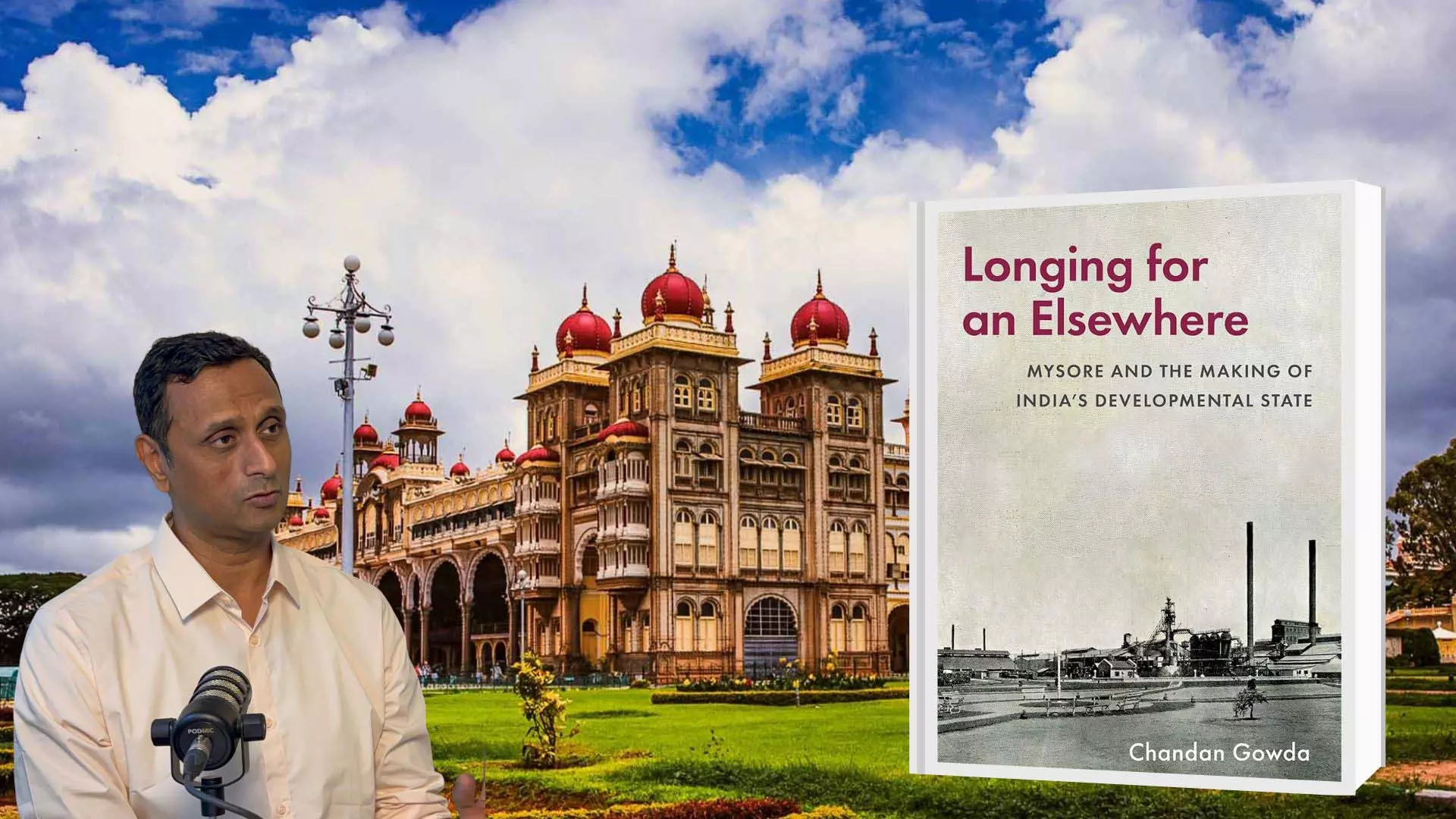
In an exclusive interview with The Federal, Gowda, Professor and Dean, School of Liberal Arts and Sciences, Vidyashilp University, Bengaluru, talks about his latest book, Longing for an Elsewhere: Mysore and the Making of India’s Developmental State, Mysuru’s pursuit of modernity under the tutelage of the Wadiyar kings, and the imprints it has on modern-day Karnataka
What does the title 'Longing for an Elsewhere' mean, and what took you to Mysuru as the subject of your study?
I try to argue in the book that in the middle of the 19th century a certain idea of economic development comes to take root in colonial India. It presumes that India is in a state of backwardness — economic backwardness, by which I mean that we were not industrialised and were largely an agrarian society. The West had industrialised, and that showed the path for the non-West in the way we had to carve out our future.
Also read: A city without flyovers: Why Mysuru is finally building one
This mode of thinking saw history in evolutionary terms—from primitive society through society to industrial society—as a natural sequence of historical evolution. It placed different societies on this timeline at different points in time.
In this view, England was ahead of Germany, which was ahead of Russia, and Asian societies were way below, way behind. This mode of thinking acquired popularity at that time and enslaved the imagination of colonised societies.
They accepted this to be true and felt that if that was the future for us, we might as well do something to build towards it. The initial acceptance of the idea that they were indeed backward and had to lift themselves out of that pathetic state into becoming a developed and industrialised society was a primary moment for the colonised.
Once you get them to accept this story, then colonisation becomes a blessing in disguise. They are bringing in these modern ideas which we didn't have before.
If you had mentioned the word development to Krishnadevaraya (emperor of the Vijayanagara Empire who ruled in the 16th century), Akbar (Mughal emperor whose rule stretched from the late 16th century to the early 17th century) or any of the pre-modern rulers, they wouldn't have understood it because they wouldn't have seen India as backward to begin with. But once the idea of backwardness gets established, it means this: economically, socially and politically, you don't have democracy; socially, you are community-driven; you don't have individualism; you are fatalistic and religious. There was a range of ways in which backwardness was seen.
Coming back to your second question, I was very interested because I am from this part of India.
So, what does “longing for an elsewhere” mean in this context?
The idea was that the future was elsewhere. The West had shown the future, and you had to achieve that future.
The future was as much a theoretically understood one in terms of complete industrialisation and full urbanisation as it was led by a desire to attain certain states of prosperity and certain states in which you imagined modern society—the skyscrapers, railways, great highways, cars—and then the metaphors and images keep multiplying.
You are constantly feeling dissatisfied with how you are and constantly feeling the need to recreate the conditions you feel we ought to have, and that is being supplied by some other country, the way you imagine it.
Also read: Quick guide to Mysore Dussehra fest; the legacy and what not to miss
And so that is a longing—a state of perpetual dissatisfaction with how things are and wanting to emulate or mimic or recreate conditions that you are so sure suggest a modern society. That somewhere else stands in for the future. That's what I meant by a longing for an elsewhere.
The metaphor of longing is a soft metaphor as opposed to a ravenous appetite, which is what you find now. That can't defer the attainment of these material achievements. All the apartment complexes you see everywhere—everything has to have world-class amenities.
Why did you feel Mysuru needed to be studied more closely in the history of India’s development?
Mysore state, as I said earlier, was indirectly ruled by the British. It was the third-largest princely state.
In the history writing on India, the regions that made up princely India, which included more than 500 kingdoms of varying sizes, have been under-researched.
A primary reason is that these rulers were seen as puppets or collaborators of the British. You also did not see major nationalist uprisings or large freedom-movement mobilisation here, which tended to attract historians to account for the emergence of these things.
I felt these reasons weren't justified as reasons to ignore them. Of course, scholars had already written books on Mysore. But comparatively speaking, if Bengal has 10,000 books written on it, Mysuru would have a dozen books written in English scholarship.
Also read: How an upcoming stadium threatens the future of Karnataka's Mysore Silk brand
You have books by Kannada scholars on Mysore, but still the focus has tended to be on literature, and not on development thought and practice.
Occasionally, it is literature and culture, music, wrestling, or the lives of Diwans (chief ministers) and biographies of the kings.
Are you trying to capture a unique aspect of Mysuru that has not generally been discussed in the discourse on politics and development?
Yes, I think that's a good way of putting it. People have tended to use words loosely: Mysuru was progressive, it was a model state, they were forward-looking, etc. I tried to ask: how did it come to be so? What was it that drew them to development in the first place? And then the “why” question: why development and why not something else?
I say this because when, in 1881, there was indirect rule a second time in Mysore, 95 per cent of people in Mysuru state were in villages. The aspiration of the state elite was to make it fully urban. That's the moment of the puzzle.
The hold of the vision of modern civilisation as an urban civilisation is so strong that they are unwilling to see other paths for dealing with local cultural, economic and political formations. For me, there was nothing self-evident about why they accepted this.
The colonial views on history and the future of economic evolution influenced not just the Mysuru elite, by which I mean the maharajas, the Diwan and the bureaucrats, but also economic thinkers outside in British India, such as MG Ranade.
Also read: Why Iran's strike on Israel’s Haifa has reminded some in Mysore of a battle over 100 years old
And secondly, what this meant for what they did by way of projects in the state—one in an industrial project and the other an agricultural project.
In fact, the Wadiyar kings left their imprint on Karnataka through several identifiable projects: the KRS Dam, Bhadrapur Iron Works, the state agricultural university in Bangalore, the Indian Institute of Science, HAL, among several others. If you look at the Wadiyar family’s predecessors, including Tipu Sultan, the British commissioners and then the Wadiyars after their reinstatement, there seems to have been a strong commitment to development across sectors. How do you view this mindset?
Tipu Sultan showed an extraordinary commitment to having a very strong military state, and he was interested in the question of science and technology. As histories of science have shown, he was trying to develop indigenous rocket technology.
He also had a sense of the wider, modern world and its political arrangements. He knew that the British were a colonizing force and was trying to see how best to resist them through friendships with the French.
All of this is there. But the word “development” itself is nowhere to be found in how he was thinking about building a strong, resilient economy.
On the agricultural front, he ensured that the Mysore state was dealing with farmers directly and not through Paligars (also called Polygars who were holders of small kingdoms also) for tax collection purposes. So, land ownership was much more broad-based. Actually, they were all tenants; the state was a landlord and owned all the land.
So, the tenancy in that sense—the number of landholding farmers in Mysore state—is the highest anywhere in India. This tenancy cut across caste. A number of Dalits also held land as tenants.
Also read: Early morning queues, limited tokens: Mysore silk frenzy once again grips Bengaluru
This is the tip of the economic question, but development as a movement from backwardness to progress, as a developed economy, is not there.
You have also dismissed suggestions of a causal link between the pre-independent Mysore state and present-day South Karnataka. Surely there must have been some influence of Wadiyar rule on the modern development of the state, particularly Bengaluru’s emergence as a knowledge hub?
You can look at it in a couple of ways.
One is the pro-industry outlook that was cultivated in the public imagination by Diwan Sir M Visvesvaraya (serving as Diwan to Maharaja Krishnaraja Wadiyar IV), who was most passionate about industrialisation. Mirza Ismail was also no less committed to it, although they differed on the degree, scale or pace of change. The Maharaja (Krishnaraja Wadiyar IV) was also committed to it.
There were a handful of factories in Bangalore—the Mysore Sandalwood Factory, Mysore Labs. They were built in different periods. We had the State Bank of Mysore and the Mysore Economic Conference.
But they never quite succeeded in creating a class of local entrepreneurs or businessmen who would go on to run the show, who would have an investment-making capacity of their own and could then lead a certain kind of industrialisation or modern economy-building effort. That did not happen.
The state continued to be the primary agent in terms of providing capital for various works.
Watch: From royalty to politics: Who is 'Mysuru King' Yaduveer Wadiyar fielded by BJP?
But the pro-industry outlook mattered because soon after Independence, several major public sector units were set up by the Central government in Bangalore.
How important was the choice of Bengaluru as the location for these industries and institutions?
The choice of Bengaluru was a strategic one. It is way down south. Nehru also saw it as a city of the future, where science would have an important place.
He was definitely impressed by what Visvesvaraya and the Wadiyars had tried to do. Visvesvaraya got the first Bharat Ratna.
So, there is something there in terms of a certain kind of continuity.
Setting up these factories meant that ancillary industries came up to supply their needs, and then people moved there for jobs.
There is a question about whether there was already a certain skill base in terms of human resources. That's a difficult question. I don't know. I haven't looked into the recruitment of labour for these units carefully enough to argue clearly one way or another.
But the scientific institutions you referred to earlier—the Indian Institute of Science, and even the Raman Research Institute—they were doing theoretical research.
In fact, Visvesvaraya and Mirza Ismail, across many years, complained that they were not coming up with practical accomplishments of a kind that the state could then profit from industrially.
They were happy that the institutions were there, but they wished they did more applied research.