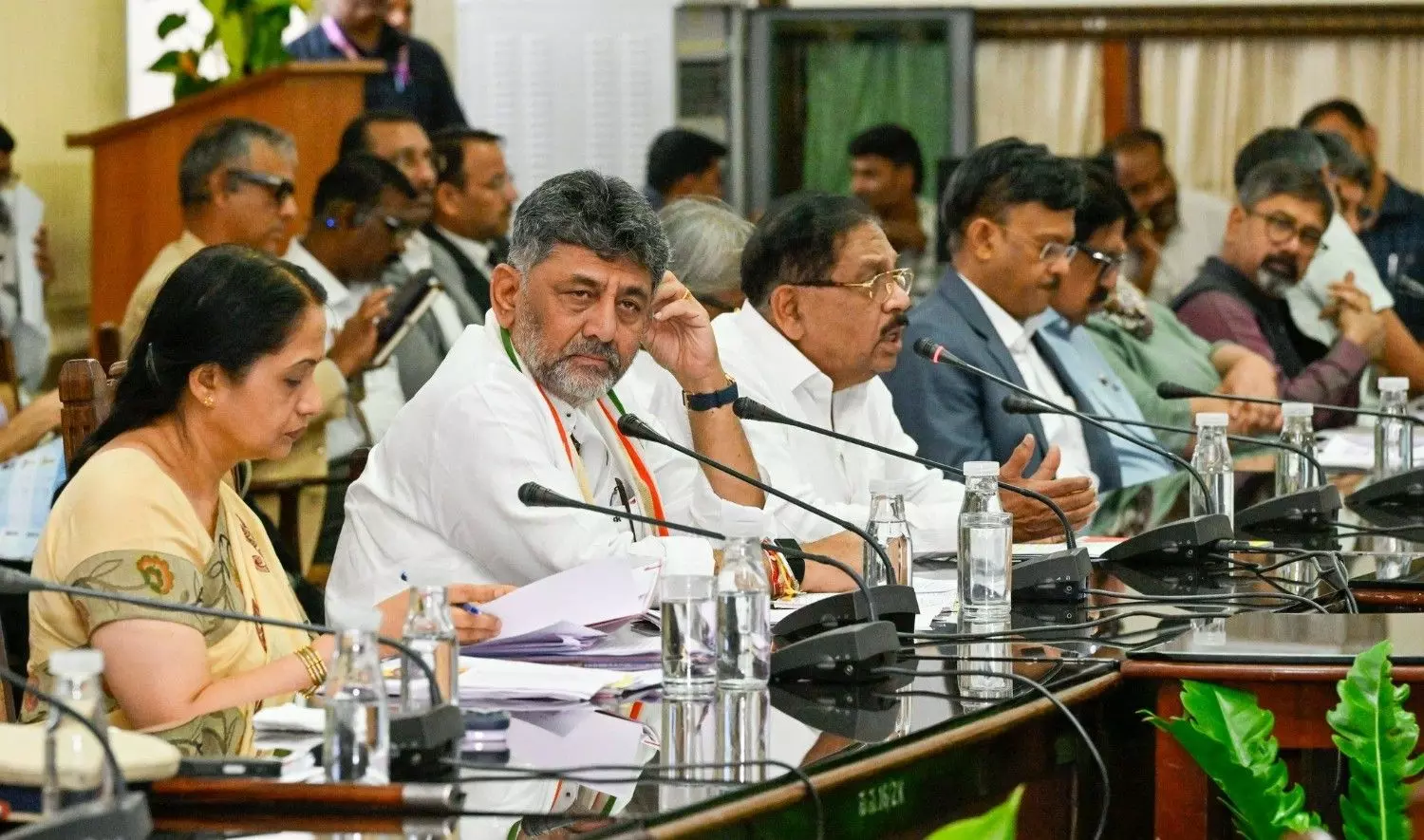
Karnataka Chief Minister DK Shivakumar (2nd left) chairs a meeting in the Vidhana Soudha in Bengaluru on Thursday (June 4). Photo: X/@CMofKarnataka
Day 1 as CM: Why DK Shivakumar is already firefighting
From Ramalinga Reddy's portfolio standoff and Satish Jarkiholi's open dissent to BK Hariprasad's assertion of organisational independence, the new Chief Minister faces tests on multiple fronts

Barely hours after taking the oath as Karnataka’s Chief Minister, DK Shivakumar found himself battling challenges on three fronts. What was expected to be a honeymoon period for the Congress strongman instead turned into a reality check, exposing fault lines within the ruling party and underscoring the complexities of managing power after a hard-fought ascent to the top post.
Shivakumar's first day as Karnataka Chief Minister has already thrown up three significant political challenges, indicating that while he may have secured the state's top post, managing the government, the party, and competing power centres within the Congress could prove far more difficult.
First challenge
The first challenge comes from within his own Cabinet. Senior minister and Bengaluru strongman Ramalinga Reddy is insisting on being given the Bengaluru Development portfolio, citing an alleged promise made by Shivakumar during the formation of the Congress government in 2023 under former CM Siddaramaiah.
Also read: Gruha Jyothi: No free electricity for tenants? What CM DK Shivakumar said
According to party sources, when the Siddaramaiah government took office in 2023, Reddy was initially considered for Bengaluru Development and Bengaluru in-charge responsibilities. However, Shivakumar, keen to establish his own control over Bengaluru politics, is said to have personally visited Reddy's residence with his brother, DK Suresh, and persuaded him to step aside.
For the Congress high command, which only recently managed a delicate leadership transition from Siddaramaiah to Shivakumar, these developments may serve as an early warning.
The understanding, according to Congress insiders, was that Shivakumar would retain control over Bengaluru for the time being, and once he became Chief Minister, the responsibility would be handed over to Reddy. A day after Shivakumar took over as Chief Minister, Reddy is believed to have reminded him of that commitment.
Late at night, Cabinet portfolios were announced, and 'Bengaluru Development' has been allotted to Krishna Byre Gowda, which sources say is in keeping in mind the upcoming Greater Bengaluru Authority (GBA) elections. Seemingly snubbed, Reddy believes he is being sidelined despite being one of the Congress's most senior leaders.
Shivakumar-Siddaramaiah meeting
His supporters argue that he sacrificed the portfolio in 2023 based on Shivakumar's word and that the promise should now be honoured. Some sources even claim that Reddy has hinted at taking a strong stand of quitting from the DKS Cabinet. With the crucial Bengaluru local body elections approaching, any such move from a leader of Reddy's stature could have political consequences for both the government and the party.
Also read: Margaret Alva voices disappointment over all-male Karnataka Cabinet
Interestingly, after the portfolio issue surfaced, Shivakumar, despite stating that the party high command would decide portfolio allocation, met Siddaramaiah and sought his suggestions. The move has reinforced the perception among political observers that Siddaramaiah continues to wield significant influence over the government from outside the administration.
The second challenge emerged from an unexpected quarter — senior minister Satish Jarkiholi.
The controversy revolves around Shivakumar’s ambitious Bharat Jodo Youth Associations programme. The new Chief Minister has announced the formation of 1,000 Bharat Jodo Youth Associations across Karnataka, with each association receiving government funding of Rs 10 lakh. The total outlay for the programme is estimated at Rs 1,000 crore.
While Shivakumar argues that the initiative is aimed at promoting sports, cultural activities, youth engagement and social development, the announcement has already sparked political controversy. Critics have accused the government of using public money to indirectly strengthen the Congress party's grassroots network under the Bharat Jodo banner associated with Rahul Gandhi's political campaign.
Is Jarikholi opposing CM?
Adding to the controversy, Jarkiholi publicly expressed reservations about the programme's financial implications. Speaking to reporters in Bengaluru, he said that while certain welfare initiatives, such as bus pass schemes, may not impose a major burden on the state, the Bharat Jodo programme could become a significant financial liability.
Jarkiholi noted that the scheme's objectives could benefit the public through sports and cultural activities, but acknowledged that the financial commitment would be substantial. His remarks were widely interpreted as a rare public expression of concern from within the Cabinet itself against Shivakumar’s first Cabinet meeting decisions.
Hariprasad's remarks suggest he intends to build an organisational structure that functions independently of the Chief Minister's office.
Shivakumar responded quickly. When reporters sought his reaction, the Chief Minister dismissed the criticism with a sarcastic remark, saying everything comes at a cost and even arranging tea and coffee during a press conference is an expense. Though light-hearted on the surface, the response reflected an emerging difference of opinion within the government regarding spending priorities and the sustainability of large-scale programmes.
KPCC chief's statement
The third, and perhaps the most politically significant, development came from the organisational side of the Congress party.
Just hours after assuming office as Karnataka Pradesh Congress Committee (KPCC) president, senior Congress leader BK Hariprasad issued a statement that has sparked intense political debate. After meeting former KPCC chief and Deputy CM G Parameshwara in Bengaluru, Hariprasad declared that those seeking power, ministerial positions or government posts should follow Shivakumar, while those interested in strengthening the party organisation and strengthen the hands of Rahul, Mallikarjuna Kharge, Sonia Gandhi and Priyanka Gandhi should come with him.
The statement has been interpreted as a clear attempt to distinguish the government from the party organisation and establish an independent power centre within the Congress.
Some leaders in the Congress party say that Shivakumar had long sought to retain control over both the government and the party after becoming Chief Minister. However, the Congress high command's decision to appoint Hariprasad as KPCC president under the "one person, one post" principle has created a new equation within the party.
Hariprasad's remarks suggest he intends to build an organisational structure that functions independently of the Chief Minister's office. By telling party workers that those without power need not worry and that he would stand by grassroots Congress workers, he has effectively sent a message that the party organisation will not merely function as an extension of the government.
Cold war between Hariprasad and Shivakumar?
His references to Rahul, Kharge and Sonia's organisational work were also viewed as an indirect reminder that Congress should remain focused on party-building rather than merely distributing power and positions.
The comments have fuelled speculation that a cold war may be developing between Shivakumar and Hariprasad. Traditionally, smooth coordination between the Chief Minister and the KPCC president is considered essential for political stability. Yet on the very first day of Shivakumar's tenure as CM, visible signs of demarcating power have emerged.
For the Congress high command, which only recently managed a delicate leadership transition from Siddaramaiah to Shivakumar, these developments may serve as an early warning. The challenges before the new Chief Minister are not limited to governance alone. Managing senior ministers, balancing financial priorities, and maintaining harmony between the government and the party organisation could prove to be the defining test of Shivakumar's leadership in the days ahead.