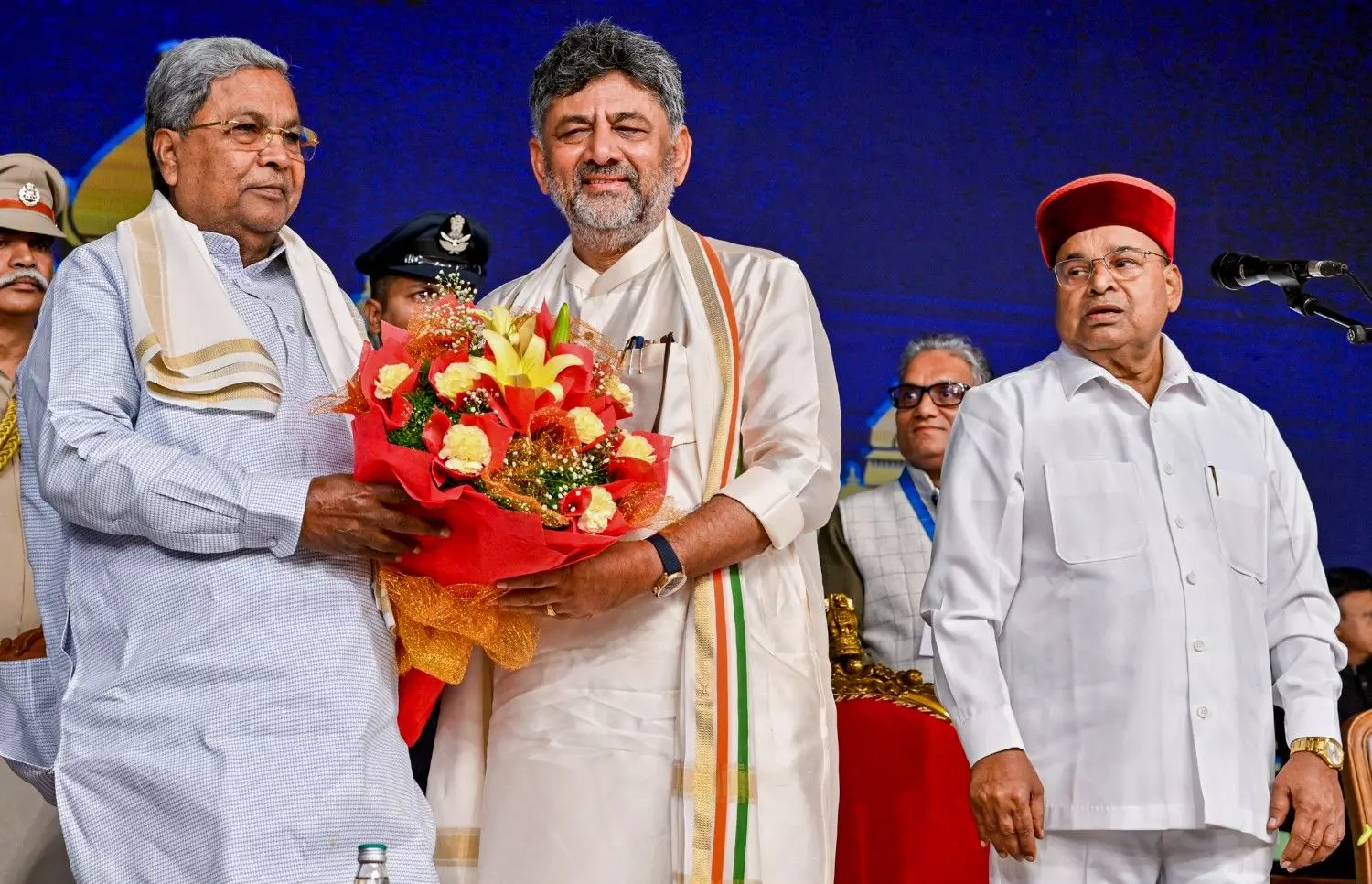
New cabinet with Siddaramaiah clout. How much control does DKS have?
11 out of 13 newly sworn-in ministers trace their allegiance back to the former CM; KPCC chief BK Hariprasad also has Siddaramaiah's backing

Even though Siddaramaiah has vacated the chief minister's chair in Karnataka, his influence continues to cast a long shadow over the new administration led by D K Shivakumar, who took over as his successor on Wednesday (June 3). While DKS, as the new CM is popularly called, has at last attained the state's highest office after years of political striving, the true test of his leadership is only just beginning.
Also read: Why Mekedatu will be an acid test for new CMs DK Shivakumar and Vijay
Some of Siddaramaiah’s robust political weapons, including the powerful social justice platform of AHINDA, a strong mass base, and influence within the Congress high command, remain crucial to the Congress’s future electoral prospects, including the state polls in 2028 and the general polls in 2029.
Is new CM 'alone' in his cabinet?
The composition of the new cabinet so far, to be led by Shivakumar, reflects that reality, with most ministers seen as loyal to either the former CM or the party’s central leadership rather than to the incumbent. DKS thus finds himself in an unusual position — holding the highest office in the state sans a strong group of loyalists in his own ministry. Even the new KPCC chief, BK Prasad, is seen as a Siddaramaiah loyalist.
It will be interesting to see how much influence DKS can wield when Karnataka approaches its next Assembly elections in 2028, as Siddaramaiah and the high command could play a role then as well.
With Siddaramaiah retaining his political relevance and the high command reluctant to push him aside in the run-up to the electoral tests of 2028 and 2029, DKS may well find himself in the precarious position of riding a tiger — a task that is anything but easy.
11 of DKS cabinet's ministers are from Siddaramaiah govt
To understand to what extent Siddaramaiah still holds sway, out of 13 ministers who took oath on Wednesday, 11 were in Siddaramaiah’s cabinet. Eight of them, including Deputy Chief Minister G Parameshwara, KH Muniyappa, M B Patil, Byrathi Suresh, Satish Jarkiholi, K J George, Krishna Byre Gowda, and Yatindra, are considered close to the former chief minister. Yatindra is Siddaramaiah’s son.
The rest, U T Khader, Eshwar Khandre, Ramalinga Reddy and Priyank Kharge, son of the Congress president Mallikarjun Kharge, are not linked to the DKS camp either. Sharan Prakash Patil is said to have been referred to by the Congress high command.
According to observers, DKS’s cabinet has Siddaramaiah's invisible presence. Reddy is known to have differences with DKS since he was not allowed to become Bengaluru in-charge minister in the previous cabinet.
Also read: Can new CM DK Shivakumar deliver for Congress in 2028, 2029? | Capital Beat
Moreover, Parameshwara, who is strongly backed by Siddaramaiah, became the sole deputy chief minister in the DKS cabinet. DKS and Parameshwara are also not known to be close and have had several disagreements.
As DKS, the deputy chief minister was chasing the throne of governance when Siddaramaiah was the chief minister; a similar situation may arise now with Parameshwara becoming the new deputy CM. Speculation is rife that Siddaramaiah played a key role when it came to the selection of the new cabinet and the deputy CM.
New cabinet and AHINDA
Siddaramaiah has deftly executed the AHINDA strategy by ensuring his allies dominate the new cabinet. The 14-member ministry reflects a careful caste arithmetic — four Dalits, including three Scheduled Castes and one Scheduled Tribe (Parameshwara, Priyank Kharge, Muniyappa and Jarkiholi), three Lingayats (M B Patil, Sharan Prakash Patil and Khandre), two Vokkaligas, including DKS himself and Krishna Byre Gowda, two minorities (Khader and George), two Kurubas (Byrathi Suresh and Yathindra Siddaramaiah) and one Reddy (Ramalinga Reddy) who is considered equal to Vokkaligas.
Of the Dalits, Parameshwara and Priyank are Right-Hand Dalit communities, while Muniyappa is a Left-Hand Dalit. Jarkiholi represents the ST community.
The Hariprasad factor
Additionally, senior leader B K Hariprasad, appointed late Wednesday night as the new Karnataka Pradesh Congress Committee chief, is also close to Siddaramaiah. He is critical of soft Hindutva and RSS politics, whereas DKS is often seen as being closer to Hindu religious symbolism and has even sung a few lines of the RSS anthem in the state Assembly in the recent past. Hariprasad publicly criticised DKS for his act and also demanded an apology.
Also read: India's richest CM: D K Shivakumar tops wealth chart
It will be interesting to see how much influence DKS can wield when Karnataka approaches its next Assembly elections, as Siddaramaiah and the high command could play a role then as well. Hariprasad, by virtue of his proximity to both the Gandhi family and Siddaramaiah, could also remain a challenge to the new CM.
Caste census to hurt CM DKS?
Siddaramaiah may also weaponise the caste census issue against DKS, whose Vokkaliga community largely opposes it. The census bolsters AHINDA politics and projects OBCs and other backward communities to be politically stronger than either the Vokkaligas or the Lingayats. OBC politics has been championed by Rahul Gandhi and Hariprasad — potentially squeezing DKS between community sentiment and party ideology.
Siddaramaiah’s support for Hariprasad as the next KPCC chief is not without a reason. The high command is also in no mood to distance itself from the ex-chief minister, who remains the most prominent AHINDA leader with a strong mass appeal in Karnataka. The party wants to make the most out of its influence in the 2028 and 2029 elections, party sources told The Federal.
Hariprasad’s own community identity is also at play. The community is part of the OBC group that forms part of the AHINDA social coalition. His appointment as the next state Congress chief would also boost the caste strategy.
Twenty more ministers remain to be inducted into the DKS cabinet, which will eventually have a total strength of 34 ministers, including the chief minister. Siddaramaiah is likely to see more of his loyalists find a place in the ministry.
Siddaramaiah's diplomacy of 'silence'
A former state minister who served in the Siddaramaiah cabinet told The Federal that the former CM strategically stayed away from the cabinet formation process after stepping down. He did not say much during one of his recent visits to New Delhi when he just thanked top leaders, such as Rahul, Kharge and others. His apparent silence kept the high command and the DKS camp guessing.
Also read: DK Shivakumar as Lord Shiva in Kannada newspaper: Editor faces backlash
Rahul then reportedly called the veteran back to the national capital after he returned to the state. It was during this visit that several rounds of discussions were held, and Siddaramaiah reportedly agreed to accept membership of the Congress Working Committee and received approval for many of his demands.
Sources also claim that Yatindra was appointed minister as a token of gratitude to his father.
In an official statement, AICC general secretary and MP Randeep Singh Surjewala indicated that the high command expects Siddaramaiah to help strengthen the party at the national level. But at the same time, the Congress also wants him to remain at the forefront in state politics. Sources also indicate that Rahul wants Siddaramaiah to transform the OBC Advisory Council into a more active and influential body.