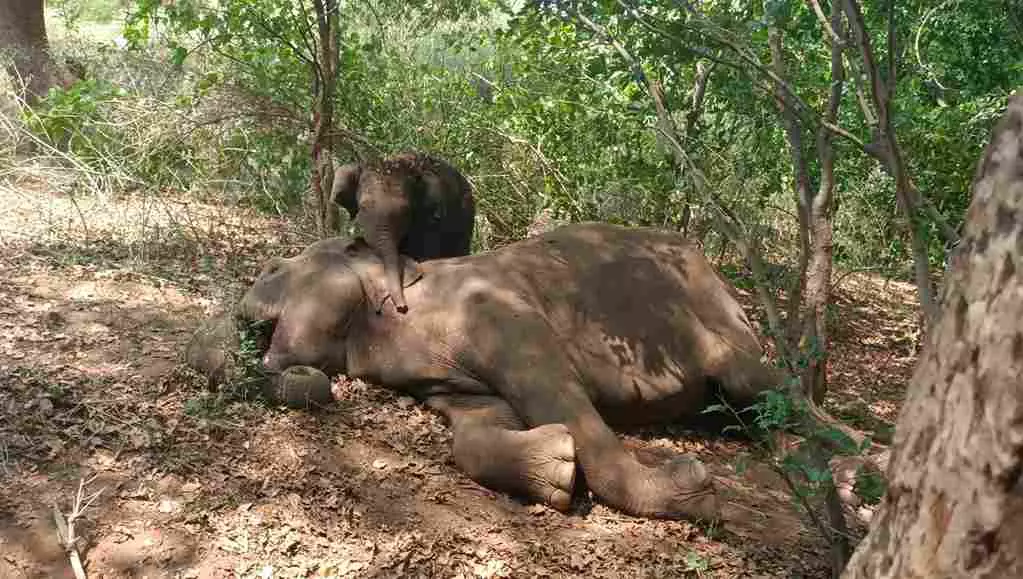
The calf standing by her mother's carcass was discovered on May 11. Post-mortem report showed presence of 35 litres of water and the presence of toxic substances in her stomach. Forest department sources have said that the elephant died because she drank Arkavathy River's contaminated water
Arkavathy River's polluted waters claim elephant's life; calf mourns by her side
A heart-wrenching scene of a grieving calf flags fatal cost of Bengaluru's urban waste, as heavy metals, sewage turn a vital wildlife corridor into a death trap

In a tragic incident, a female elephant, approximately 40 years old, has died after consuming polluted water from the Arkavathy River flowing through the Maggur range of the Cauvery Wildlife Sanctuary in Karnataka. The Arkavathy River is a major tributary of the Kaveri River originating at Nandi Hills, 60 km north of Bengaluru. The river, stretching across 53 km, was once was Bengaluru’s primary source of drinking water from 1936 to 2000 via the Tippagondanahalli reservoir.
The elephant's carcass was discovered around 5 pm on Monday (May 11). According to the post-mortem report, approximately 35 litres of water was found in the elephant's stomach, confirming the presence of toxic substances. Forest department sources have said that the elephant died due to drinking the contaminated water of the Arkavathy River.
A heart-wrenching scene
Last rites
After performing an on-site post-mortem, the elephant's funeral was conducted in accordance with forest department regulations.
Polluted Arkavathy River
Tragedies in the river basin
After the incident, environmentalists flagged the thick layer of aquatic weeds (Eichhornia) and silt, often fuelled by high nutrient runoff and sewage pollution, as a death trap. The elephants became entangled in the dense vegetation, grew exhausted, and were unable to pull themselves out.
Unchecked urbanisation hits wildlife
While Karnataka remains one of the leaders in conservation, boasting a population of 6,013 wild elephants, the state is facing a grim paradox: it can manage the animals, but it cannot seem to protect their environment.
Despite pioneering safety measures like Rail Fence Barriers and launching ambitious rehabilitation plans for 300 elephants displaced into private lands, the government remains largely paralysed against the "silent killers" of rampant urbanisation and human encroachment.
This environmental neglect is effectively turning the state's conservation efforts into a battle for survival against a toxic landscape with elephants losing safe access to basic needs like clean water.
(This article was originally published in The Federal Karnataka)