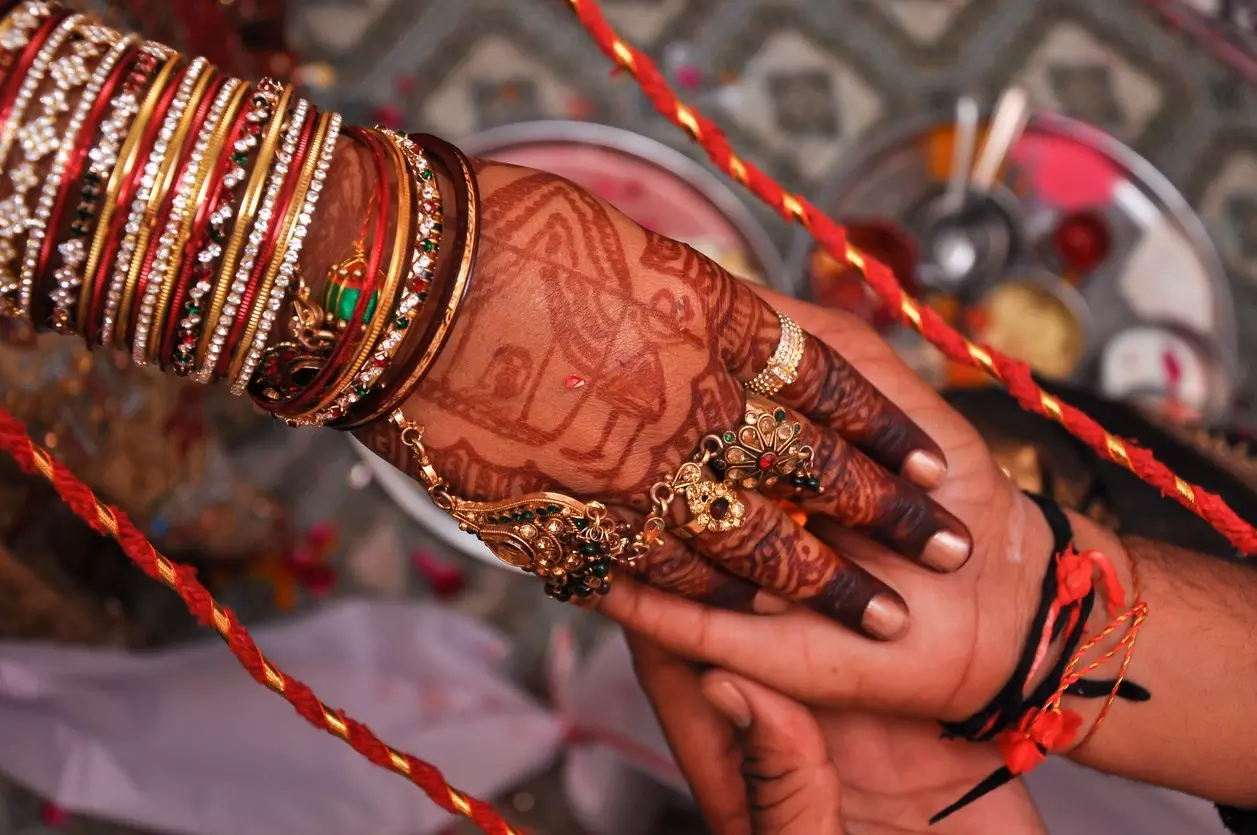
Karnataka's government 'Mangalya Bhagya' mass marriage scheme has failed to deliver on expected lines due to several reasons. Representative Photo: iStock
Why Karnataka 'Mangalya Bhagya' mass-marriage scheme fails to take off
People's preference for grand weddings as a social statement and the lack of publicity on the government's part are seen as factors ailing the 5-year-old programme

The ambitious ‘Mangalya Bhagya’ scheme launched by the Karnataka government in 2020 to help men and women from poor families to get married without bearing a crippling financial burden is not getting a positive response on the ground. Even benefits worth Rs 55,000 from the authorities have not helped things.
Despite benefits offered by the government under the scheme, which sees mass marriages held at ‘A’ grade temples across Karnataka, it has been found that not a single marriage took place under the programme in the state’s Hassan district or at the prominent Basavanagudi Dodda Ganapati Temple in Bengaluru over the last five years. In Mandya, Ramanagara, and parts of North Karnataka, too, the picture has been disappointing.
Since the scheme's inception, between 900 and 950 marriages have taken place in 20 selected temples in Karnataka.
Scheme got good response initially
The scenario was always not the same. When the scheme was originally started under the name of ‘Saptapadi’ by the state’s previous Bharatiya Janata Party (BJP) government in 2020 (it was renamed as ‘Mangalya Bhagya’ by the current Congress-led dispensation, which came to power in 2023), it received a good response. Marriages were started at all ‘A’ grade temples, and they were conducted once in two or three months. However, the demand slowly went down.
Also read: Will serve full five-year term, says CM Siddaramaiah, rejects power-sharing talk
The state’s Muzrai department, which is responsible for conducting the programme, invited applications for marriages time and again, but the response never took off. While some marriages were held recently at some prestigious temples, the scheme was stopped in many others.
The benefits worth Rs 55,000 that the government offers for the scheme include ‘mangalya’ (sacred gold necklaces) featuring eight grams of gold, cash assistance for a sari and blouse for the bride, and Rs 5,000 for a 'pancha', shirt and other expenses for the bridegroom.
People still prefer big weddings
As the Muzrai department tried to learn why the scheme failed to deliver on the expected lines despite the benefits, one of the major reasons that was found is the people’s desire for luxury touches. Be it among the poor or wage labourers, the prevalent mindset is that if a wedding is not celebrated on a grand scale, it will not be given much value. Government-sponsored marriages or mass marriages are looked down upon as something for the needy. Many do not hesitate to marry by even taking a hefty loan, and government benefits are considered too modest.
'Muhurat' is another factor
In the Hindu faith, ‘muhurat’ (auspicious time) is also considered a significant part of the marriage ceremony. However, under the ‘Mangalya Bhagya’ scheme, the marriages are supposed to be held on dates fixed by the government or authorities of the concerned temples. Many a time, families do not get the dates of their preferences, and they decide to go ahead with their own timetables.
Lack of publicity
A lack of energy on the officials’ behalf is another reason for the scheme’s failure, despite its noble intention. The fact that not a single wedding took place in Hassan district under the scheme since it was launched shows that neither the local administration nor Muzrai officials have taken a leading role to raise public awareness about it. The authorities have not shown much interest apart from issuing circulars.
Also read: How routine, diligent policing has kept communal peace in Mangaluru
Had the ASHA workers or panchayat officials been more involved to educate the public about the scheme, the result would have been vastly different in the rural areas. The poor show in urban areas such as Basavanagudi in Bengaluru also shows that the publicity is no better in the urban areas either.
Benefit package in times of high inflation
The government’s benefit package has also come under scrutiny. While the assistance with eight grams of gold and a cash aid of Rs 5,000 is appreciable, they might not look attractive to all amid today’s steep inflation. Bureaucratic hassles, including visiting government offices for submission of documents, to avail the benefit, also deter the common man.
Since inclusion of even eight grams of gold, the price of which is ever skyrocketing, and other benefits in a package of Rs 55,000, becomes difficult, the Muzrai department has considered a revision of the total expenses to be paid to each couple. Sources in the department said talks were held with the state finance department to release funds either by raising the package value or without compromising the yellow metal’s weight.
To address the issue of fixing ‘muhurats’ as per people’s preferences, discussions are also being held within the government to enable the temples to fix auspicious days for mass marriages, even as the days fixed by the government remain.
Also read: Thousands of women march in Belthangady seeking justice for Dharmasthala victims
The government has also focused on giving more publicity to the scheme at the district religious councils and tehsil levels to promote it in the rural areas. It has been said that the government has expressed interest in extending the scheme to more number of prominent temples, which are financially strong and come under Grade A.
Scheme has delivered in Mysore region
The ‘Mangalya Bhagya’ scheme, however, has seen happier outcomes in the Mysore region. The local administration’s focus on publicity and faith in the local temples has seen a greater participation in the mass-marriage events. In Nanjangud, for example, more than 90 marriages have been conducted at the local Srikanteshwara Temple.
Also read: Karnataka cabinet gives conditional nod for matches at Chinnaswamy Stadium with safety rules
Besides the abovementioned factors, the renaming of the scheme could also be another reason why its success has been limited. As the nomenclature changes (from ‘Saptapadi’ to ‘Mangalya Bhagya’), people may also feel baffled and wonder whether there is any continuity in the scheme.
(This article was first published in The Federal Karnataka)