Maharashtra govt’s legal support for MES reignites Belagavi border row with Karnataka
The Maharashtra government’s decision to officially support MES has renewed attention on the decades-old dispute over Belagavi and other border areas claimed by both states

The Maharashtra government’s decision to extend legal support to the Maharashtra Ekikaran Samiti (MES) for the first time has once again brought the long-standing Belagavi border dispute into the spotlight.
The move has drawn sharp criticism from the Karnataka government and pro-Kannada organisations. Belagavi is not merely the name of a district; it is regarded as a symbol of Karnataka’s pride and identity. However, Maharashtra has continued to claim Belagavi as its own for the past nearly seven decades.
Also read | Priyank Kharge slams BJP over caste census demand, says Cabinet will decide
At the centre of this dispute is the Maharashtra Ekikaran Samiti (MES). While the Maharashtra government had allegedly been supporting the organisation behind the scenes for years, it has now officially announced legal assistance for the first time. The state has decided to appoint special lawyers to represent the case, with the entire cost to be borne by the Maharashtra government. This development has once again drawn national attention to the decades-old Belagavi border dispute.
How the Belagavi border dispute began
Before Independence, Belagavi was part of the erstwhile Bombay Presidency. Following the reorganisation of states on linguistic lines in 1956, Belagavi, Karwar, Nipani, Khanapur and several other regions were merged with the then Mysore State (present-day Karnataka).
Maharashtra, however, opposed the decision and began demanding that Marathi-speaking areas be included in its territory. To resolve the dispute, the Central government constituted the Mahajan Commission in 1966 under the chairmanship of retired Justice Meher Chand Mahajan. The commission’s report, submitted in 1967, recommended that Belagavi and 264 villages should remain with Karnataka.
It also proposed transferring some villages in Nipani and Khanapur to Maharashtra, while suggesting that a few villages in Akkalkot and Solapur be transferred from Maharashtra to Karnataka. Maharashtra rejected the Mahajan report as well and eventually took the dispute to the Supreme Court.
“All Kannadigas are one, and Kannada is one. Whatever anyone does, if a struggle becomes inevitable, we will have to respond in an appropriate manner,” said Vatal Nagaraj, president of the Kannada Chaluvali Vatal Paksha.
MES at the centre of the dispute
After the Mahajan report was submitted, the MES intensified the border issue into a sustained movement. Every year on November 1, Karnataka Rajyotsava is observed by the organisation as a “Black Day.”
It has repeatedly passed resolutions in the Belagavi City Corporation seeking the merger of Belagavi with Maharashtra, blackened Kannada signboards, and called for shutdowns in border areas, often leading to tensions. According to the Karnataka government, Maharashtra has been strengthening the organisation financially and politically by extending special schemes for Marathi-speaking residents in border areas, scholarships, healthcare benefits, and monthly pensions for the families of MES workers.
More recently, the inclusion of MES leaders in a high-powered committee chaired by Maharashtra Chief Minister Devendra Fadnavis and the announcement of official funding have further intensified Karnataka’s opposition.
Where Karnataka and Maharashtra stand
Karnataka maintains that the States Reorganisation Act of 1956 is final and that the Mahajan report firmly supports its position. It asserts that Belagavi is an inseparable part of Karnataka both geographically and administratively, leaving no scope for altering the state boundary.
Maharashtra, on the other hand, argues that state boundaries should be determined on linguistic lines and continues to demand the transfer of 865 villages, including Belagavi, Karwar and Nipani. The petition filed by Maharashtra in the Supreme Court in 2004 has remained pending for nearly two decades due to changes in benches and other procedural reasons.
Also read | Parameshwara warns of drought-like situation in Karnataka, to seek advance NDRF funds
“If they legally support the MES, there is little we can do about it. But when it comes to our land, water and language, we will not step back. We must ensure that the situation at the border does not escalate into conflict,” local political leaders said.
MES loses political ground
The MES, which once exercised significant influence over Belagavi politics, has witnessed a considerable decline in recent years. The growing strength of national parties such as the BJP and the Congress in the border region, along with greater unity among pro-Kannada organisations, has contributed to this shift.
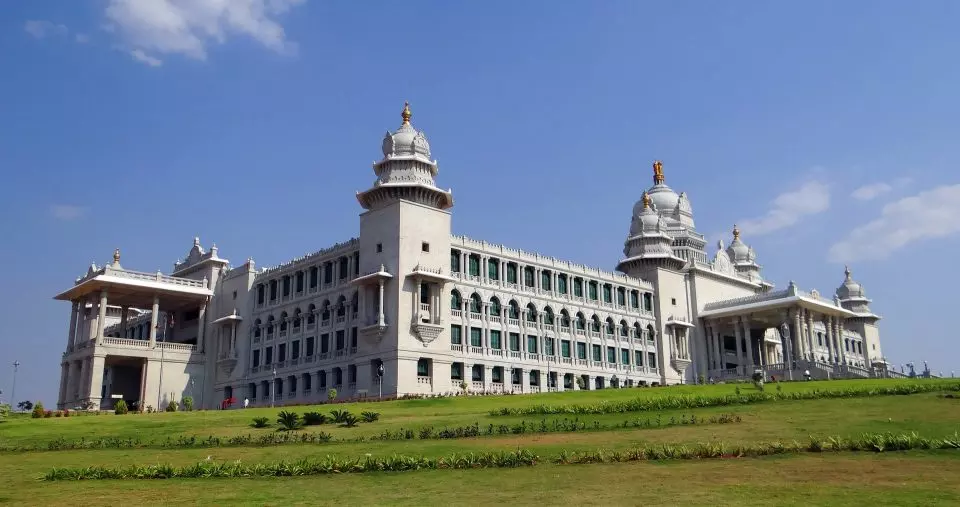
The Karnataka government has also reinforced its presence by constructing the Suvarna Vidhana Soudha in Belagavi and holding the state legislature’s winter session there every year. In the 2021 Belagavi City Corporation elections, the BJP secured a clear majority, resulting in the MES losing power in the civic body for the first time.
For many young people in the border region, employment opportunities, industrial growth and economic development have become far more important than the decades-old border dispute, even as political leaders continue to raise the issue.
(This article was originally published in The Federal Karnataka.)