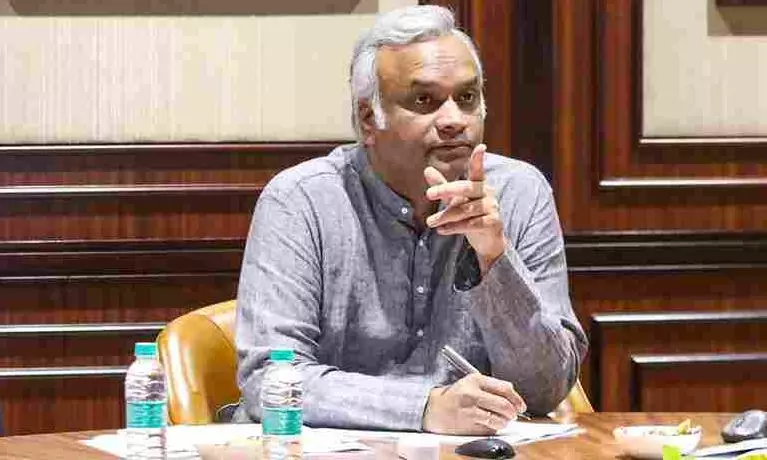
The letter written by Karnataka home minister Priyank Kharge regarding the registration of the Rashtriya Swayamsevak Sangh (RSS) has currently sparked intense debate in political and public circles.
What does the law say about this? Is it really mandatory for the RSS to register themselves?
Senior advocate Vikram Padake has provided a detailed legal analysis on this question of public interest.
Registration is optional
Speaking to The Federal Karnataka, he clearly stated: "Neither the Constitution nor any law of this country has any mandatory rule requiring organisations like the RSS to register. This is entirely optional. Therefore, no one has the authority to force them to do so."
Under Article 19(1)(c) of the Constitution, citizens are granted the fundamental right to form and run associations and organisations.
"The government has no legal provision to block the public programmes or activities of any organisation solely on the ground that it has not registered. No one has the authority to curtail fundamental rights," he explained. The Constitution protects the fundamental rights of citizens.
Rules on donations and income tax?
Responding to a question about RSS funds and accountability, the senior advocate referred to the Income Tax Act.
Under its 'Body of Individuals' provision, both registered and unregistered organisations are recognised. Under the principle of mutuality, the RSS runs on 'Gurudakshina' — funds voluntarily contributed by its volunteers every year on the occasion of Gurupurnima. Since members themselves collect money and use it for their own activities, it falls under the principle of mutuality and remains outside the scope of taxation.
This matter has already been legally settled many years ago.
Does a family have registration?
"Small shopkeepers or banana vendors register to avail government benefits. But the family system, which is the very foundation of society, has no registration. Similarly, asking for registration from an organisation that — with no profit motive — simply does yoga, prayer, and thinks about the nation's welfare in public spaces, is both laughable and a violation of fundamental rights," Vikram Padake reiterated.
What if matter goes to court?
Answering what might happen if this matter reaches a court, he said the court would primarily look at two aspects.
First, the court would ask what personal harm has been caused to the person raising the issue, or what public damage has occurred. Second, the court could look within the existing legal framework to see if any provision explicitly requires mandatory registration.
Since the Constitution is supreme in the country, neither the judiciary, the executive, nor the legislature can force compliance with a rule that does not exist in law, he pointed out.
'Not a government notice'
Speaking on the legal validity of the home minister's letter, he said: "The letter written by Priyank Kharge is not an official government 'notice'.
"It is merely a question raised or an opinion expressed by him as a people's representative, under freedom of expression. Whether to respond to it or not is entirely up to that organisation. The home minister's jurisdiction arises only when law and order in the state is disturbed — but if goes beyond that and interferes in such matters that would be unconstitutional," he said.
Finally, Vikram Padake remarked that the public is observing everything closely, and people understand very well what is politically motivated and what is the truth.
(This article was originally published in The Federal Karnataka)