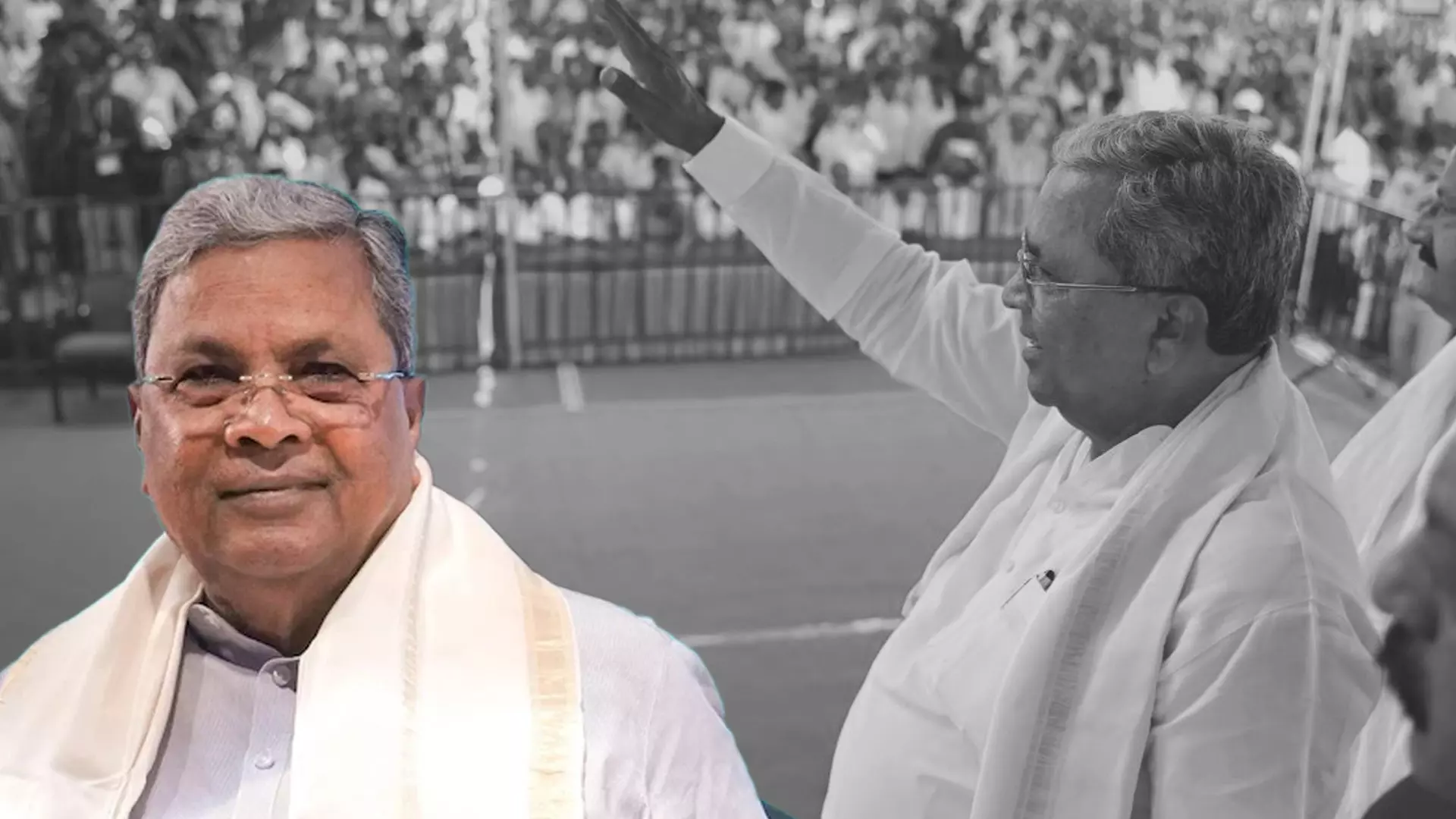
Secrets of Siddaramaiah's record run as CM: Experience, adaptability, smart governance
The Congress leader becomes Karnataka’s longest-serving chief minister. What explains his political durability and governance choices?

Karnataka Chief Minister Siddaramaiah has become the longest-serving chief minister in the state’s history, completing a cumulative tenure of seven years, seven months, and 20 days. With this, he has surpassed the record held by former chief minister Devraj Urs, marking a significant political milestone in Karnataka’s contemporary history.
The achievement places Siddaramaiah in a rare national league of long-serving chief ministers, alongside leaders such as Jyoti Basu in West Bengal, Naveen Patnaik in Odisha, and Pawan Kumar Chamling in Sikkim. While the numerical record is clear, the political significance of Siddaramaiah’s tenure lies in the conditions under which it was achieved.
Speaking to The Federal, consulting editor KS Dakshina Murthy, who has closely tracked Karnataka politics for decades, attributed Siddaramaiah’s longevity to political experience, adaptability, and governance choices rooted in welfare delivery.
Political grounding
Siddaramaiah’s political career spans nearly four decades, beginning in the socialist stream and the Janata Dal. He worked closely with former Prime Minister HD Deve Gowda during his early years, gaining a close view of coalition politics and governance.
Also read: Dinesh Amin Mattu on Siddaramaiah vs Devaraj Urs: Why this record could define a legacy
“He comes with a very rich experience,” Dakshina Murthy said, noting that Siddaramaiah has navigated multiple political phases and ideological shifts. He served a full and relatively stable term as chief minister between 2013 and 2018, a period marked by fewer controversies following the turbulent tenure of BS Yediyurappa.
Over time, Siddaramaiah emerged as a mass leader known for direct communication and metaphor-laden public speeches. This oratorical style helped him consolidate his standing within the Congress as a leader with state-wide appeal.
Welfare as strategy
A defining feature of Siddaramaiah’s recent tenure has been the rollout of large-scale welfare guarantee schemes. These include free bus travel for women and direct financial assistance to women from lower-income households—initiatives that initially attracted scepticism over fiscal sustainability.
“People laughed at these promises initially,” Dakshina Murthy noted, adding that questions were raised about how the government would fund them. However, over the past two-and-a-half years, the schemes have been implemented without administrative breakdown.
The guarantees have become embedded in everyday governance, with beneficiaries integrating them into daily life. Siddaramaiah’s ability to translate campaign promises into operational policy strengthened his authority within both the party and the government.
Also read: Will continue in politics till I have people's blessings: Siddaramaiah
The success of these schemes has also influenced national politics, with similar welfare models being adopted by other parties, including the BJP, in different states.
Comparing legacies
While Siddaramaiah has overtaken Devraj Urs in tenure, Dakshina Murthy cautioned against simplistic comparisons. Urs governed during the 1970s, a period marked by Congress dominance under Prime Minister Indira Gandhi.
“It was probably easier for Devraj Urs,” he said, referring to the political environment of the time. Despite this, Urs is remembered for transformative land reforms and policies benefiting backward classes, which continue to shape Karnataka’s social structure.
Urs, Dakshina Murthy observed, was a self-driven leader who pursued reform despite not being under pressure to do so. His legacy rests on structural changes rather than political survival alone.
In contrast, Siddaramaiah operates in a far more fractured political landscape, with competition from the BJP, Janata Dal (Secular), and shifting caste alignments. Managing these layers has been central to his continued hold on power.
Party dynamics
Siddaramaiah’s rise within the Congress followed his exit from the Janata Dal, where he had once been seen as a potential successor to Deve Gowda. Internal tussles, particularly as Deve Gowda backed his son HD Kumaraswamy, led to Siddaramaiah’s marginalisation and eventual departure.
Also read: Karnataka BJP’s R Ashoka labels Siddaramaiah 'biggest borrowing CM'
At the same time, the Congress in Karnataka was facing a leadership vacuum after the SM Krishna phase. The party leadership, led by Sonia Gandhi, backed Siddaramaiah as a credible and experienced leader capable of reviving the organisation in the state.
That decision, Dakshina Murthy said, “worked,” allowing Siddaramaiah to become one of the Congress’s most prominent regional leaders.
Centre-state challenges
Unlike Devraj Urs, who enjoyed strong backing from the Centre, Siddaramaiah governs amid strained Centre-state relations. Opposition-ruled states, including Karnataka, Kerala, Tamil Nadu, and West Bengal, have accused the Union government of favouring BJP-ruled states.
Despite this, the Congress’s strong majority—136 seats in a 224-member Assembly—has ensured government stability in Karnataka. This numerical advantage has helped Siddaramaiah withstand both external pressure and internal dissent.
The party leadership, however, remains cautious, aware that missteps could lead to electoral setbacks and a BJP resurgence.
Budgets and finances
Siddaramaiah is also among the chief ministers who have presented the highest number of state budgets, with his upcoming presentation expected to be his 17th. Critics argue that welfare spending has strained state finances, pointing to rising electricity, water, and property charges.
Also read: Siddaramaiah no Devaraj Urs, yet a cut above the rest
Dakshina Murthy countered that state finances are more complex than such claims suggest. “He has managed to pull it off for the last two-and-a-half years,” he said, noting that fears of fiscal collapse have not materialised.
According to him, the government has followed a calibrated approach to revenue generation, effectively redistributing resources to sustain welfare commitments.
Leadership question
Looking ahead, Siddaramaiah’s future hinges on internal Congress dynamics, particularly his relationship with Deputy Chief Minister DK Shivakumar. While some believe Siddaramaiah will complete his term, others expect a leadership compromise to balance party interests ahead of the next election.
Dakshina Murthy described it as a “tough situation” for the Congress, with any decision likely to leave one faction dissatisfied. He suggested that a negotiated settlement remains the most probable outcome.
For now, Siddaramaiah’s record stands as a testament to political endurance in a fragmented era—one shaped by experience, welfare governance, and careful party management.
(The content above has been transcribed from video using a fine-tuned AI model. To ensure accuracy, quality, and editorial integrity, we employ a Human-In-The-Loop (HITL) process. While AI assists in creating the initial draft, our experienced editorial team carefully reviews, edits, and refines the content before publication. At The Federal, we combine the efficiency of AI with the expertise of human editors to deliver reliable and insightful journalism.)