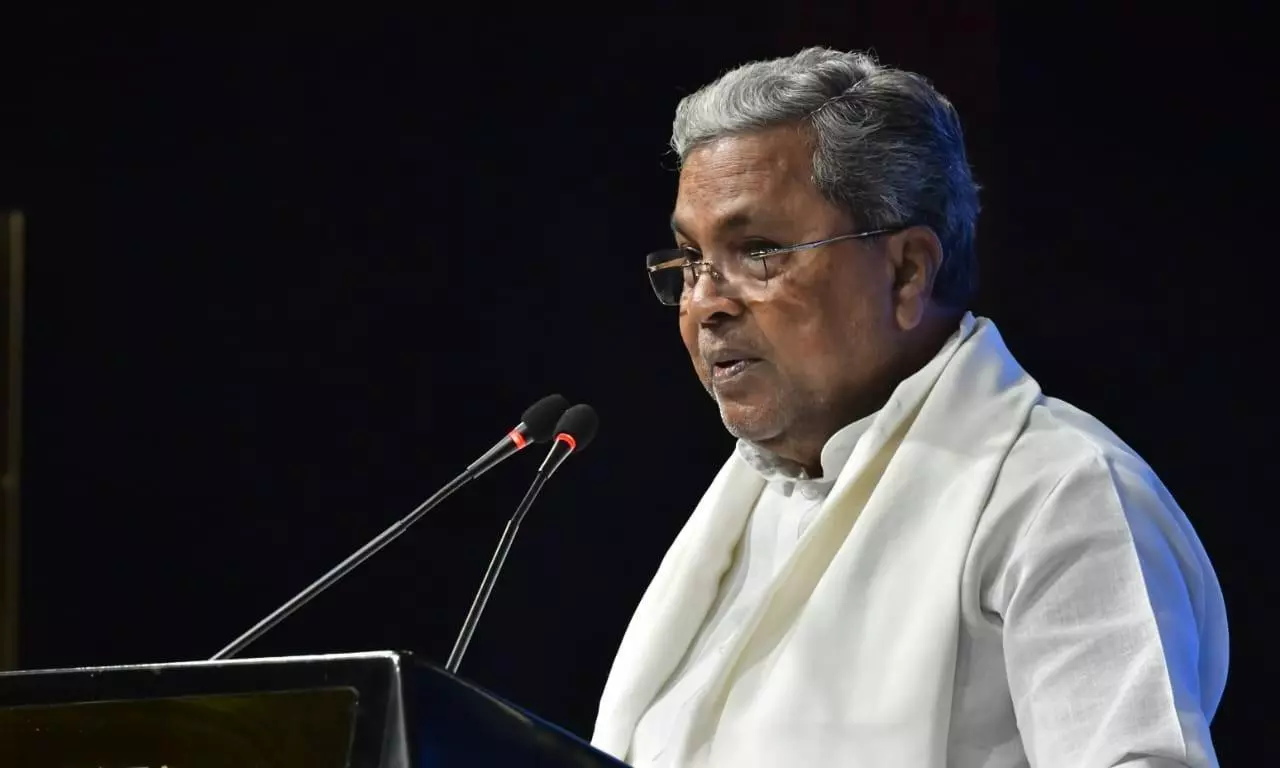
Siddaramaiah ready to present record 17th Budget amid a triple challenge
An additional burden of nearly Rs 31,000 crore is set to weigh on the Karnataka government as Chief Minister Siddaramaiah prepares to present the 2026–27 Budget in the first week of March

Karnataka Chief Minister Siddaramaiah has begun preparations to present the 2026-27 Budget, which is almost certain to be tabled in the first week of March. While this will mark his record 17th Budget in the state’s political and economic history, he faces three major fiscal challenges.
Even as the government allocates substantial funds annually for its flagship guarantees, fresh pressures are emerging in the form of compensation for the Krishna Upper Stage-3 project, increased state contribution under the new G Ram G scheme, and revenue losses due to GST rate rationalisation. These are expected to impact the state’s fiscal calculations significantly.
Also read: Why Tamannaah? War of words over Mysore Sandal Soap's new brand ambassador
Siddaramaiah has begun pre-Budget consultations with departments, reviewing the progress of schemes announced last year and assessing new proposals. Agriculture, irrigation, and infrastructure development are likely to receive priority in the upcoming Budget.
Rs 18,000 crore burden from Krishna Upper Stage-3 project
The Krishna Upper Stage-3 project, considered the lifeline of north Karnataka, is one of the government’s biggest financial commitments. It is estimated that around Rs 75,000 crore will be required over four years for land acquisition and rehabilitation.
At a special Cabinet meeting held on September 16, 2025, compensation rates were finalised. For submerged lands, compensation has been fixed at Rs 30 lakh per acre for dry land and Rs 40 lakh per acre for irrigated land. For land acquired for canal construction, the rates are Rs 25 lakh per acre for dry land and Rs 30 lakh per acre for irrigated land.
To meet the estimated Rs 78,000 crore required for land acquisition and rehabilitation, the government had earlier decided to provide nearly Rs 18,000 crore annually to the Water Resources Department over four years. Accordingly, about Rs 18,000 crore must be allocated in the 2026-27 Budget alone.
Also read: Karnataka govt has no money for public welfare but spends Rs 2 crore on ads
This could force the government to either resort to additional borrowing or reduce allocations to other departments. Accommodating such a large amount within fiscal limits remains a major challenge.
Change in Centre-state share for VB-G Ram G scheme
The Centre’s revamp of the Mahatma Gandhi National Rural Employment Guarantee Scheme (MGNREGS) into the Viksit Bharat – Guarantee for Rozgar and Ajeevika Mission (Gramin) (VB-G Ram G) scheme has increased the financial burden on states. Under MGNREGS, the Centre bore 90 per cent of the cost and the state contributed 10 per cent. Under the new scheme, the state’s share will rise to 40 per cent.
In 2024–25, Karnataka spent Rs 6,824 crore under MGNREGS, with the Centre contributing Rs 6,251 crore and the state Rs 573 crore. With the revised sharing pattern coming into effect in 2026–27, the state may face an additional annual burden of Rs 3,000-Rs 4,000 crore. The government is yet to finalise how it will provide for this increased commitment.
Rs 9,000 crore loss due to GST rationalisation
GST, a key source of the state’s own tax revenue, has also been affected by rate rationalisation. Karnataka’s GST growth rate has reportedly declined from 12 per cent to 5 per cent following rate restructuring. This could result in an annual revenue shortfall of nearly Rs 9,000 crore.
Experts say delays or shortfalls in central transfers are compounding the state’s financial stress. They also point out that while compensation for the Krishna project cannot be deferred further, development spending must continue simultaneously.
The state is already spending around Rs 55,000 crore annually on its five guarantee schemes — Shakti, Gruha Jyothi, Anna Bhagya, Gruha Lakshmi, and Yuva Nidhi. With inflation and an increase in beneficiaries, this expenditure could rise further by 2026-27.
Challenge of managing the additional burden
Taken together — Rs 18,000 crore for Krishna Upper Stage-3, around Rs 4,000 crore for the VB-G Ram G scheme, and Rs 9,000 crore due to GST losses — the state faces an additional burden of nearly Rs 31,000 crore.
To avoid breaching the Fiscal Responsibility Act, the government may have to cut allocations to key sectors such as Public Works, Education, and Health. Alternatively, it could consider raising taxes on petrol, diesel, or liquor, though that risks public backlash.
How Siddaramaiah balances welfare commitments with fiscal discipline in his record 17th Budget will be closely watched.
(This article was originally published in The Federal Karnataka)