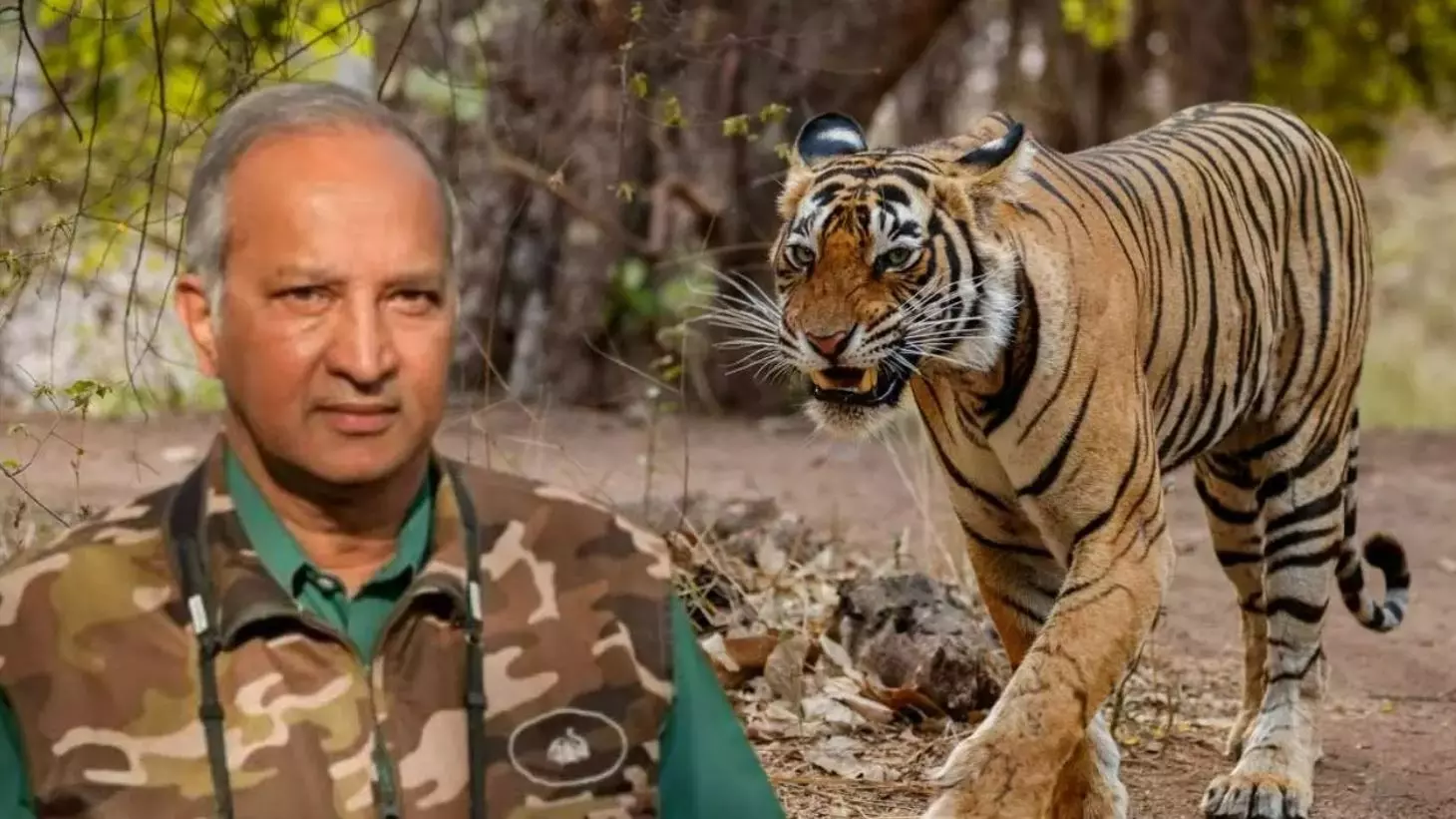
Unscientific capture, release of tigers: Expert Dr Ullas Karanth slams Karnataka govt
Dr Karanth says government must frame strict plan to relocate villagers living near tiger reserves; existing rehabilitation package must be implemented properly

The Karnataka Forest Department’s tiger capture operations have triggered widespread outrage amid rising human-wildlife conflict in villages along forest fringes. Renowned zoologist and wildlife expert Dr K Ullas Karanth has strongly criticised forest officials, accusing them of creating problems in the name of tiger conservation.
A series of tiger deaths in Nagarahole, Bandipur and Biligirirangana Hills wildlife sanctuaries has alarmed wildlife enthusiasts. Excessive human interference, poaching threats, and negligence by forest officials have been cited as key reasons behind these incidents.
'Stop destroying habitats'
In this backdrop, The Federal Karnataka spoke to Dr Karanth about the unscientific practice of capturing tigers from protected zones and releasing them elsewhere.
Also read: Vulture chick hatches at Ramadevara Betta Vulture Sanctuary for fifth consecutive year
Speaking in detail, he said, “Tiger conservation in Karnataka has no scientific foundation. The first step should be to stop destroying habitats. Unnecessary entry of water tankers, solar pumps and JCB machines into dense forests must be strictly curbed. Forest officials are doing exactly what should not be done. This is why tiger attack incidents are increasing,” he said, expressing concern.
“Tackling tiger attacks or conducting capture operations without addressing the root problem is meaningless. Tigers have been attacking cattle for the last five years. Forest officials are sending JCBs into tiger reserves in the name of removing lantana and cultivating fodder grass. Normally, natural prey populations increase year after year. Tigers also increase in number depending on the availability of prey. But it is the lack of foresight among forest officials that is driving human-wildlife conflict,” he alleged bluntly.
He further said, “Tiger numbers are rising in Chikkamagaluru. In the name of forest tourism, the department is taking large groups of people into protected zones. People carry mobile phones and cameras, disturbing wildlife. Humans are recklessly playing with nature,” he remarked sharply.
Call to relocate villages situated near tiger reserves
In the 1980s and 1990s, there was hardly any interference in forests. Tiger numbers were in balance with the carrying capacity of the habitat. But after 2010, everything has gone out of sync. Promoting forest tourism has turned forests into tourist destinations. With artificial waterholes coming up inside natural forests, ecological balance has been disrupted. Tourism may increase revenue for the forest department, but wildlife has been pushed into distress — a concern repeatedly raised by wildlife lovers.
Also read: ‘Will the tail wag the dog?’ Karnataka minister’s remark triggers CM race buzz again
Dr. Karanth suggested that the government must frame a strict plan to relocate villages situated near tiger reserves. The existing rehabilitation package must be implemented properly. Those who have already been relocated must be provided adequate basic facilities and compensation. Only then, he said, can communities be gradually integrated into conservation efforts.
Human settlements and interference in tiger reserves have become a key reason for human-animal conflict. The root issue must be addressed first. Forests must be treated as forests. Governments should take firm decisions — relocating man-eaters or problematic tigers immediately, and in unavoidable situations, even ordering their elimination. However, he alleged that officials are damaging tiger reserves in the name of eco-tourism.
Villages along forest fringes must be relocated with dignity, following the model of the Bhadra Tiger Reserve. Basic infrastructure must be ensured. Only then will it be possible to protect tiger habitats inside forests, he said.
He also stressed that the forest department should not behave in a monopolistic manner when it comes to wildlife conservation. Wildlife enthusiasts, environmental experts, and civil society groups working in the field of wildlife and ecological protection must be taken into confidence, he advised.
Scientific tiger census
Earlier, tiger census exercises were conducted using traditional methods such as tracking pugmarks. But Dr. Karanth introduced the camera trap-based survey for the first time in India, enabling accurate wildlife population estimation that is now widely followed.
Dr. Karanth is regarded as a pioneer who brought revolutionary changes in wildlife conservation and tiger research in India. He carried out extensive scientific studies in Nagarahole and Bandipur and played a crucial role in strengthening the implementation of the Project Tiger programme.
It was based on his insight that tiger stripes are as unique as human fingerprints that he laid the groundwork for scientific tiger counting. In 1990, he was the first to fit radio collars on tigers to study their movement and behaviour.
He has served as a member and advisor to the National Tiger Conservation Authority (NTCA) and the Karnataka government’s tiger conservation foundation. At present, he heads the Centre for Wildlife Studies in Bengaluru, mentoring hundreds of young wildlife researchers. In 2012, he was awarded Padma Shri by the Government of India.
(This article was originally published in The Federal Karnataka)