








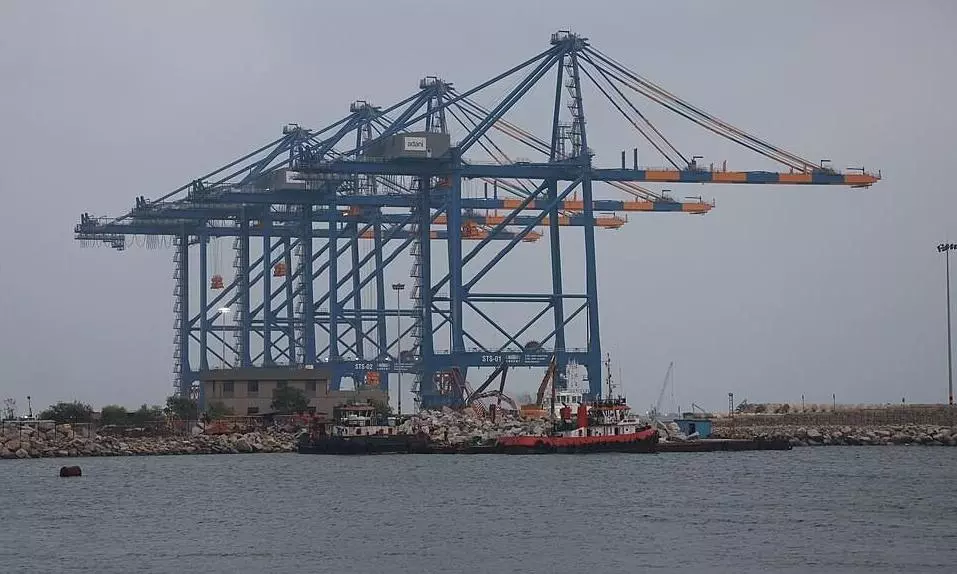
Manufacturing zones, stuffing centres, and dry ports will be established near Vizhinjam and Kochi ports, while Vizhinjam will be developed as India's leading green bunkering port. Photo: Wikimedia Commons
Kerala Budget 2026-27: Maritime plan, infra push, here are the highlights
Chief Minister VD Satheesan unveils Mission Samudra, economic corridors, and welfare initiatives while acknowledging a Rs 20,500-cr revenue shortfall and mounting state liabilities

Kerala Chief Minister VD Satheesan on Friday (June 19) presented the UDF government's first Budget for 2026-27 in the Assembly, unveiling a mix of fiscal reforms, infrastructure projects, and welfare initiatives aimed at reviving the state's economy while acknowledging the severe financial pressures facing the government.
The revised Budget, presented four months after the previous Left government tabled the Budget for the current financial year, reflects a Rs 20,500 crore shortfall in expected revenue compared with the estimates made in January 2026.
In the Budget, prepared against the backdrop of the White Paper released by his government, Satheesan, who also holds the Finance portfolio, said the state's accumulated liabilities, including those of the Kerala Infrastructure Investment Fund Board (KIIFB) and Kerala Social Security Pensions Limited, stand at Rs 87,012 crore.
Also Read: Kerala Budget: Pivot to port-led growth sparks row over land reforms and privatisation
Satheesan said the aim of his government is to build a data-driven administrative system that will help accelerate the implementation of schemes and programmes and ensure that the benefits of development reach all Keralites while keeping people at the centre of governance.
Even while highlighting the financial stress, the Budget unveiled several ambitious development initiatives.
Highlights:
- The centrepiece is Mission Samudra, a maritime development programme that seeks to transform Kerala into a global maritime hub over the next five years with an allocation of Rs 400 crore.
- Satheesan said the government's Mission Samudra project plans to leverage Kerala's 600-km coastline, two international seaports, one container transshipment terminal, and 17 non-major ports to build a maritime economy centred on logistics, manufacturing, and port-led development.
- The state will be developed as an integrated "Port City" linking roads, railways, sea routes, and inland waterways with manufacturing zones and greenfield cities, the chief minister said.
- Manufacturing zones, stuffing centres, and dry ports will be established near Vizhinjam and Kochi ports, while Vizhinjam will be developed as India's leading green bunkering port.
- The Budget also proposes a Kerala Maritime Policy to strengthen port-led industries and logistics, besides promoting maritime tourism and education through public-private partnerships at the state's non-major ports.
- Another major announcement is the creation of a Southern Kerala Economic Corridor connecting Thiruvananthapuram, Kollam, and Alappuzha. An Invest Kerala Cell will function as a single-window platform to facilitate investors with land acquisition, statutory approvals, and post-investment support.
- Satheesan also announced plans to develop Kerala into South India's premier aviation-logistics hub centred around the state's four international airports, earmarking Rs 200 crore for preliminary infrastructure and planning activities.
- To boost entrepreneurship, the government will launch the Kerala MSME Growth Scheme, targeting the establishment of around 10,000 micro, small, and medium enterprises across the state with financial assistance and expert mentoring.
- The Budget promised to operationalise the second medical college in Thiruvananthapuram, establish a new medical college at Haripad, and improve facilities at medical colleges in Kasaragod, Idukki, Wayanad and Manjeri.
- The Budget also touched upon one of the five key Indira Guarantees promised by the UDF by announcing that initial steps would be taken to implement the Oommen Chandy Health Insurance Scheme, which proposes free health insurance cover of up to Rs 25 lakh for every family.
- The Budget also places emphasis on education and future skills. It proposes establishing a Kerala Knowledge Valley to attract leading universities, reviving the semester in Kerala programme for international students, creating a Global Job Watch Tower to monitor changing employment trends, and setting up a Future Readiness Think Tank focusing on artificial intelligence, quantum computing, and biotechnology.
- In the agriculture sector, the support price for rubber will be increased from Rs 200 to Rs 250, while a Krishi Sakhi - Women Farmers Development Programme - will be launched.
While many government employees had expected announcements on long-pending service benefits, the revised Budget stopped short of introducing major new concessions.
Also Read: Tightrope walk for Satheesan: All eyes on Kerala Budget as UDF faces tough choices
The Budget noted that KIIFB's reliance on off-budget borrowings at higher interest rates has increased the state's debt burden and created macroeconomic concerns. To address the issue, the government announced the constitution of an Expert Committee to recommend structural reforms and overhaul KIIFB's operational framework.