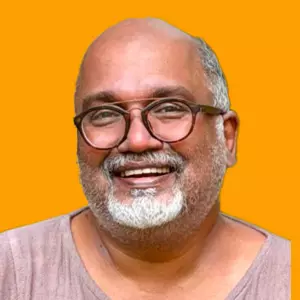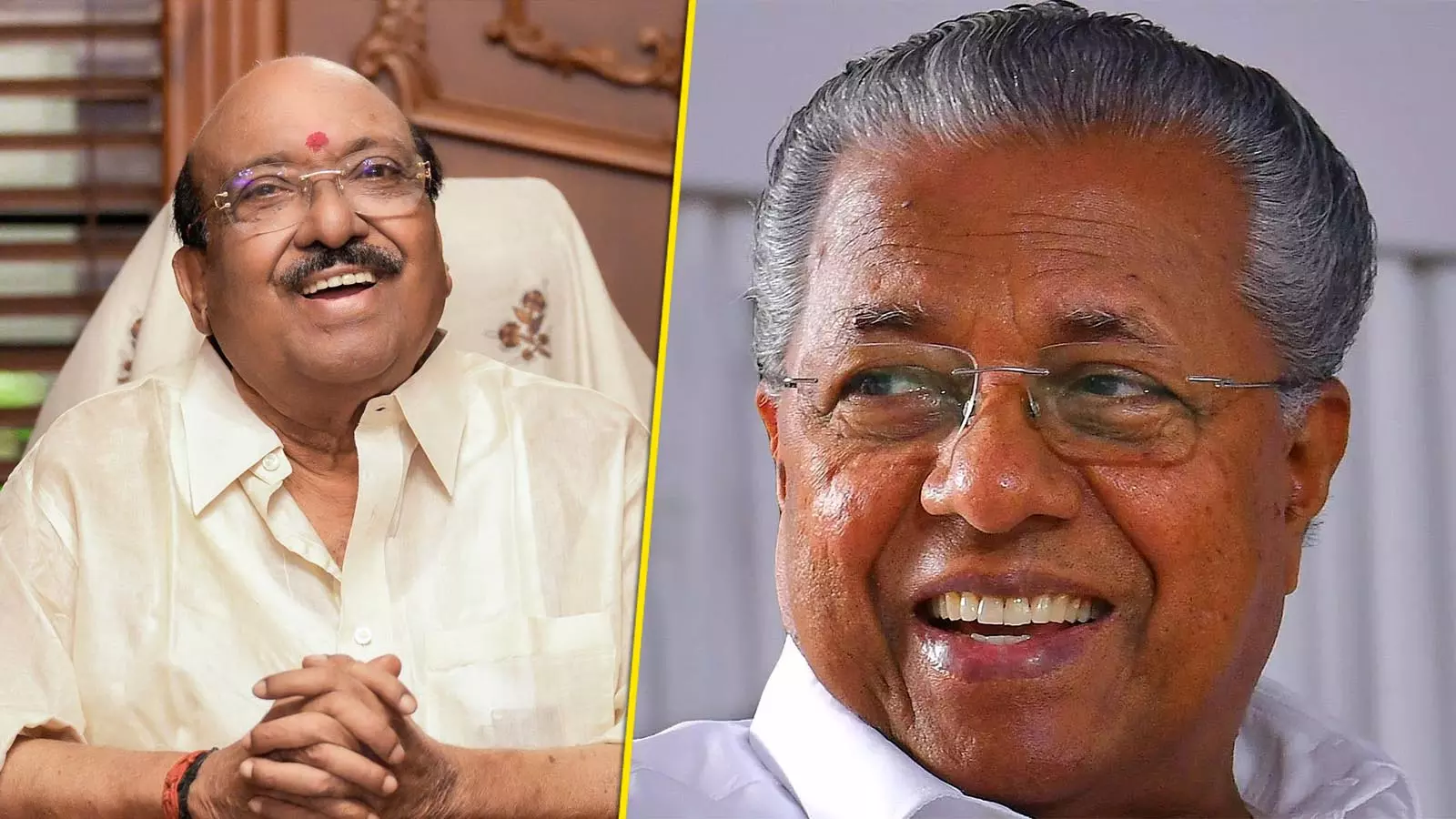
Vellappally Natesan’s (left) political proximity to the Chief Minister Pinarayi Vijayan (right) stand as symbols of a deeper unease within the ruling front.
Why Kerala CM's car-pooling with Vellappally could be a costly ride for the Left
The community leader's proximity to Pinarayi Vijayan and his subsequent Muslim League attacks have sparked CPI(M) fears of losing minority voters

Community leader Vellappally Natesan was recently seen arriving in Kerala Chief Minister Pinarayi Vijayan’s official car to attend the Global Ayyappa Sangamam, which caused a stir within the ruling party.
The Sree Narayana Dharma Paripalana (SNDP) Yogam general secretary, known for his remarks and controversies, has never been a stranger to controversy. Once known as a strong advocate of oppressed class politics and minority alliances. He was seen as part of a broader social reform legacy that challenged caste hierarchies through political solidarity. Over the years, however, that image has steadily changed.
Shift in stand
However, there was shift in his ideology when his son, Thushar Vellappally, launched the Bharath Dharma Jana Sena and aligned it with the NDA, which was unsettling among SNDP’s traditional support base.
Also read: Chennithala hits back at Kerala CM, accuses him of pursuing divisive communal politics
While Vellappally himself continued to speak the language of social justice, his political positioning appeared increasingly ambiguous. At one point, he even collaborated with upper-caste organisations to consolidate Hindus under a single umbrella, coining the slogan “Nayadi muthal Namboothiri vare” — from the downtrodden castes to the upper-caste Brahmins — with the blessings of the Sangh Parivar.
The latest car trip added a new layer to this ambiguity, leaving Left fretting over the minority vote bank. For the Left, already struggling to retain minority confidence, the optics were uncomfortable.
Defensive statement
Vellappally’s remarks on communal representation and minority privileges deepened the controversy and the visuals and the statements reinforced the perception that his political journey has moved far from his earlier rhetoric of minority solidarity, placing the Left in a position where it must not only defend its policies but also its political associations.
This is the same Vellappally who made despicable communal allegations when the Kerala government announced financial assistance to the family of auto driver Naushad, who lost his life while trying to rescue a migrant worker
The political discomfort was evident not only in the defensive responses of CPI(M) leaders but also in the unease among the grassroots workers who fear that such associations could further alienate minority voters.
Also read: CM Vijayan predicts bigger LDF win in upcoming Kerala polls
“The Chief Minister has explained to the party leadership that Vellappally was not exactly asked to get into his car, but that the community leader approached him and he was in no position to refuse. Whatever the explanation, the damage has already been done,” a CPI(M) leader in Malappuram said.
Minority vote bank
Left leaders are well aware that Vellappally Natesan’s attacks on the IUML, which can be read as attacks on Muslims, particularly in Malappuram, could cause serious political damage, not only by strengthening the narrative of Jamaat-e-Islami influence but also by alienating Muslim organisations more broadly.
For instance, a section of Sunni voters, traditionally a strong base of the Indian Union Muslim League (IUML), had shown some affinity towards the Left during the anti-CAA protests and, to some extent, in the 2021 Assembly elections. That support, however, is now beginning to waver.
“Vellappally Natesan is roaming across Kerala in a state of rage, spreading venomous hatred. If the state government had the political will, this campaign of hatred could have been stopped long ago. This is the same Vellappally who made despicable communal allegations when the Kerala government announced financial assistance to the family of auto driver Naushad, who lost his life while trying to rescue a migrant worker who had fallen into a drain. At that time, there was a Pinarayi Vijayan who sharply criticised him. But today, instead of restraining a man who is spewing poison across Kerala, the government has chosen to parade him in its official car,” said Sathar Panthalloor, a prominent Sunni youth leader.
Also read: 2026 elections: LDF, UDF and BJP enter election mode in Kerala
This unease has come at a time when the Left is already struggling with an erosion of minority confidence, particularly among Muslims. Kerala Left has been caught in a precarious situation with minorities going against it for perhaps the first time in two decades. Though minority voting has traditionally shifted towards the Congress-led UDF in Lok Sabha elections under broader national political considerations, it had invariably returned to the Left in Assembly elections, a pattern that had continued since 2006. The reversal seen in 2025, therefore, marks a significant break from a long-established trend.
Now we are talking about losing Muslim and OBC votes, and their respective vote banks, but what we area actually losing are secular voters
The local body election results only deepened this anxiety. In several districts, the UDF’s gains were widely attributed to a consolidation of Muslim votes behind the IUML, strengthening the Congress-led front’s social base. For the CPI(M), this was not merely a question of lost seats but of a shaken political compact that had sustained it across multiple electoral cycles.
Seeking to explain this shift, the CPI(M) began pointing to what it described as the growing influence of Jamaat-e- Islami on the IUML and, by extension, on the UDF. The party argued that this influence represented a conservative ideological turn that did not sit well with Kerala’s secular traditions. The UDF and the League rejected the charge, accusing the Left of attempting to delegitimise minority political assertion by associating it with religious extremism.
Against this backdrop, Vellappally’s remarks acquired added political significance. His allegation that minority communities enjoyed disproportionate benefits in school allocations and institutional representation echoed long standing grievances among sections of backward Hindu communities. His unresolved dispute with the IUML over aided school allocations, which he claims favoured Muslim organisations at the expense of Ezhava institutions, further sharpened his criticism.
The IUML, however, has consistently maintained that educational allocations followed historical and administrative considerations rather than communal preferences. League leaders argue that projecting Muslims as unfair beneficiaries only deepens social suspicion and distorts Kerala’s complex social history.
Party insiders admit that the CPI(M) strategy is not sound and that the party is trapped in a Catch-22 situation. It is trying to hold on to the OBC Hindu vote base while simultaneously attempting to regain the trust of Muslim voters, a balancing act that is proving extremely difficult. Often, this effort slips into echoing the BJP’s narrative, with BJP leaders also courting Vellappally Natesan and appearing to stand alongside the CPI(M) in competing for the same OBC vote bank.
“Now we are talking about losing Muslim and OBC votes, and their respective vote banks, but what we are actually losing are secular voters, who feel increasingly alienated. We need to address the situation politically and return to the basics. Old-school politics still has relevance,” a CPI(M) Malappuram district committee member told The Federal.
Impact on elections
All these developments point to a larger transformation in Kerala’s political discourse. Identity, once carefully balanced within a broader framework of welfare and class politics, has moved to the forefront due to its perceived closeness to leaders like Vellappally.
For the UDF, the moment has provided an opportunity to consolidate minority confidence and present itself as a safer political space. For Muslim voters, the question is no longer just about development promises but about political dignity and security.