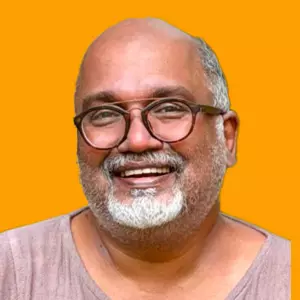
V D Satheesan has increasingly taken on the role of a tough-speaking opposition leader. File photo
Why and how VD Satheesan became the inevitable choice as Kerala CM
Kerala's new CM transformed himself from an often-overlooked Congress leader into the central architect of the UDF’s landslide victory and state’s new political power

On 7 April 2026, barely 36 hours before Kerala went to the polls, I met the then Leader of the Opposition V D Satheesan, at his MLA office in Paravur. The room was crowded with party workers and local leaders, but he made time, settling down for a brief video conversation.
I opened with a direct question. Was I speaking to the next Chief Minister of Kerala? Satheesan’s reply was immediate and firm. No, he said. This was not the party’s custom. The Congress does not project a chief ministerial candidate in advance.
Satheesan’s confidence in winning
Yet his confidence about the outcome was unmistakable. The United Democratic Front (UDF), he said, was headed for a decisive victory. Not just a win, but a sweeping one. Ninety seats were assured, and the tally could go up to 102. He spoke of constituencies like Vaikom, where he had addressed a rally the previous day, as if they were already in the bag.
Also read: Protest rally for V D Satheesan as Congress CM race intensifies in Kerala
I brought up his emotional statement during the campaign that he would go into political exile if the UDF failed to win. Satheesan brushed it aside as an expression of conviction. But when pressed on what he would actually do if that situation arose, he paused, smiled, and said, “That is a good question. I do have an answer. I have thought about it and even have a plan. I will disclose it in my last press conference, if at all that situation arises.” (This situation did not arise!)
UDF’s victory
It never came to that. The UDF went on to secure a record-breaking 102 seats, ending a decade of Left Democratic Front (LDF) rule in a thumping victory. Much of that outcome bore the imprint of Satheesan’s relentless organisational work, his ability to stitch together factions, and his insistence on disciplined messaging.
In the Assembly, Satheesan built a reputation as a serious and prepared speaker
Today, as he assumes office as the Chief Minister of Kerala, that moment in Paravur reads not just as confidence, but as a measure of political instinct.
Early days
V D Satheesan was born in Nettoor in Ernakulam district, not Paravur, where his political career would later take root. Like many Congress leaders of his generation, his early grounding came through student and youth politics. He rose through the Kerala Students Union (KSU) and the Youth Congress, though not without setbacks.
Also read: How UDF won Kerala after a decade: From 'total disarray' to total dominance
Several positions that seemed within reach slipped away at the last moment. He missed out on top posts in both the KSU and the state Youth Congress, experiences that shaped his reputation as someone who often came close to power but had to wait his turn.
Electoral journey
His electoral journey reflects a similar arc. In 1996, as a 32-year-old Youth Congress leader, Satheesan contested from Paravur for the first time and lost. It was a setback that could have stalled a young politician. But five years later, in the 2001 UDF wave, he made his mark decisively, defeating the sitting MLA, the late P Raju of the CPI. That victory established him in the constituency and marked the beginning of a long legislative career.
As Chief Minister, how he balances that instinct for confrontation with the demands of governance will shape the next phase of his political career
In the Assembly, Satheesan built a reputation as a serious and prepared speaker. During the 2006 government led by V S Achuthanandan, he took on then Finance Minister T M Thomas Isaac in an open debate over the lottery policy. It was a defining moment that underlined his willingness to engage on policy issues in detail rather than rely on political rhetoric alone.
Rise of V D Satheesan
Despite his growing stature, the phase of the Oommen Chandy government from 2011 to 2016 proved frustrating as he was overlooked for a ministerial berth. It reinforced the perception that he was a leader who often missed positions between the cup and the lip. Yet he did not retreat into silence. He questioned his own government on several issues, including leadership decisions and governance concerns, earning both criticism and respect within the party.
Also read: FCRA row: VD Satheesan accuses BJP of targeting minorities
His role became more prominent during the first term of Pinarayi Vijayan. Satheesan emerged as a leading figure among a group of younger Congress MLAs known informally as the Green MLAs. They pushed issues such as environmental protection, transparency, and a more contemporary political engagement. They were also more visible on social media and attempted to reshape how Congress communicated with a changing electorate.
A tough orator
At the core of Satheesan’s political persona is an intellectual streak. He is known to read widely, from Malayalam literature to contemporary global thinkers like Yanis Varoufakis. This reflects in his public interventions, which are usually measured, structured, and backed by study.
Of late, however, there has been a perceptible shift in his public style. Satheesan has increasingly taken on the role of a tough-speaking opposition leader. His interactions with the press have at times been more confrontational, even aggressive.
Also read: Kerala CM accepts Satheesan’s challenge for public debate ahead of elections
There have been instances where he has shown impatience with criticism, a departure from his earlier measured tone. Within sections of the Congress, there is quiet talk that he is trying to step into a more assertive mould, one that some compare to the style associated with Pinarayi Vijayan.
When Satheesan was under attack
During this phase, he also slipped into making expansive claims, at times stretching or getting ahead of verifiable facts. Whether as part of a high-voltage election strategy or the pressures of leading the opposition, this tendency gave his critics an opening. The Left, especially its social media ecosystem, seized on it. A sustained campaign emerged portraying him as a ‘liar’, with labels and wordplay targeting his credibility.
Satheesan, however, sought to turn that attack on its head. He argued that the CPI(M) cadres were in effect amplifying his visibility, keeping him constantly in the public conversation even through negative campaigns. In his telling, the criticism only ensured that he remained in the limelight during a crucial political phase.
Leadership race
When it came to the leadership race within the Congress, what tipped the balance in favour of Satheesan was not just internal arithmetic, but a wider mobilisation of public sentiment, with civil society, intellectuals, and sections of the media projecting him as the moral face of the opposition against the Left government.
Also read: UDF landslide in Kerala: The multiple factors that toppled Left
Satheesan carried this by building an ecosystem of support beyond the Congress structure, engaging civil society voices, amplifying issue-based campaigns, and translating that external legitimacy into internal political weight, just like the late CPI(M) stalwart V S Achuthanandan did when he was ignored by the party in 2006. This helped him win the confidence of the party high command, not merely through legislative numbers, but by making his leadership appear both inevitable and politically necessary. That tension between restraint and aggression now travels with him into office. His journey from a young leader who lost his first election to a legislator who repeatedly missed out on power, to the central figure in a major electoral victory, has been marked by persistence and adaptation.
As Chief Minister, how he balances that instinct for confrontation with the demands of governance will shape the next phase of his political career, and in many ways, the direction of Kerala’s politics itself.