Unhappy with proposed wages, Kerala nurses fight HR threats in strike for dignity
As private hospital nurses go on strike seeking Rs 40,000 in minimum wage, HR issues blacklisting threats; government pleads helplessness after partial revision

On the morning of March 4, the corridors of Baby Memorial Hospital were tense and unusually quiet. Trainee nurses had been instructed to report for an in-service class at 8 am even as a statewide strike by private nurses had begun across Kerala demanding a minimum monthly salary of Rs 40,000.
When the trainees arrived, they say there was no class waiting. Instead, they allege that hospital administrators asked them to report for regular duty. When some refused and said they were joining the strike called by the United Nurses Association, the conversation quickly turned confrontational.
HR’s blunt message
“They told us clearly that we should either start working or leave the job,” said a 24-year-old nursing trainee who was present there on that morning. “We asked them to give the termination in writing if they wanted us to quit. But they refused.”
Also read: Kerala private hospital nurses on strike demanding Rs 40,000 minimum wage
According to the trainee, the message from the hospital’s human resources department was blunt. “The HR manager told us that if we continued to strike we would be blacklisted and no hospital in India would give us a job,” she said. “Many of us earn less than Rs 15,000 a month,” she complained.
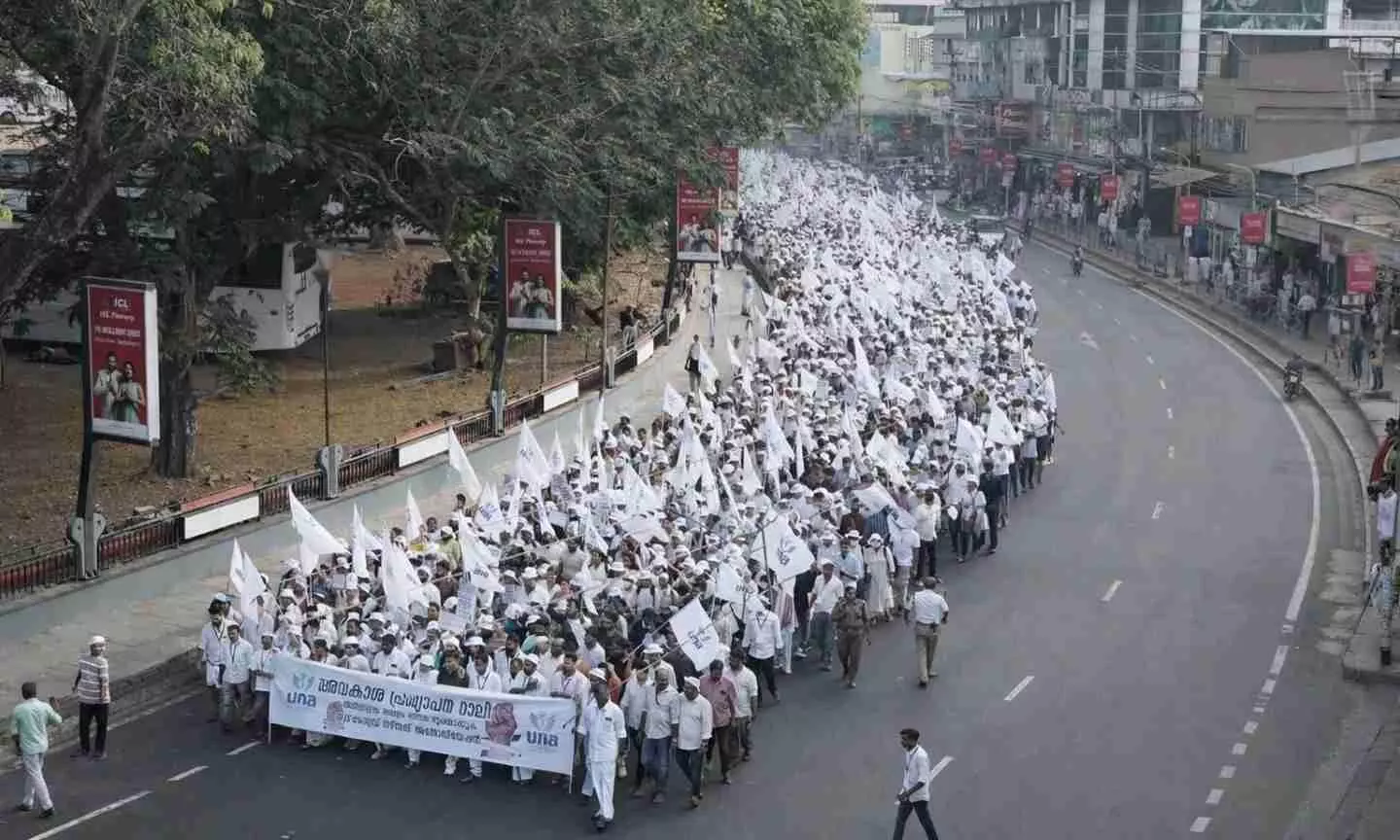
Scenes like these, according to nurses’ unions, were reported in several hospitals on the first day of the strike. The agitation disrupted services in several private hospitals, where nurses walked out of duty and hospital administrations scrambled to maintain emergency care. The protest marks the latest chapter in a long struggle by Kerala’s private sector nurses to secure better wages and working conditions.
Critical part of global healthcare workforce
Kerala produces one of the largest pools of trained nurses in the world. Malayali nurses are employed across the Gulf, Europe and North America, forming a critical part of the global healthcare workforce. Yet nurses working within the state’s private hospitals say their wages remain among the lowest in the healthcare system.
The current strike centres on the demand for a minimum monthly salary of Rs 40,000 for staff nurses. According to the United Nurses Association, the last meaningful wage revision was implemented in 2018 and salaries have not kept pace with the rising cost of living.
Also read: Over 500 nurses detained in Chennai after staging hunger strike for permanent jobs
In response to the protests, the Kerala government issued a notification proposing revised salaries for private hospital staff. The proposal sets the minimum monthly salary for staff nurses with GNM or BSc qualifications in the range of Rs 25,450 to Rs 30,800 depending on experience, and Rs 40,000 in hospitals with more than 800 beds. However, the union says the revision still falls well short of what nurses have been demanding.
Fundamental issues unaddressed
Jasmine Sha, state leader of the United Nurses Association, says the proposed wage structure fails to address the fundamental issues faced by nurses. “The figure announced by the government is essentially a recalculation of the earlier wage with incremental additions. It does not bring any meaningful change to the lives of nurses,” he said.
Sha added that the demand for a Rs 40,000 basic salary is based on recommendations and legal principles that have already been recognised in the past. “So far, 314 hospitals have reached an agreement with us, and around 171 remain. We expect them as well to sign the agreement ensuring a minimum salary of Rs 40,000,” he said.
However, the strike has created political fault lines as well. The UNA’s strike directed to the government and the presence of Congress and BJP leaders at their secretariat march on March 4 has not gone down well with the LDF. They allege that the strike against the state government is uncalled for and the situation is complicated.
Limitations of government
“We have always been supportive of the cause of nurses,” said Health Minister Veena George. “This is essentially a labour issue, and as far as the strike itself is concerned, it does not directly fall under the Health Department. However, the government intervened in good faith and issued the order revising wages.”
Also read: How can one become a nurse in India or overseas?
She added that fixing a blanket minimum wage also raises practical concerns for parts of the healthcare sector. “A uniform minimum wage could affect small-scale hospitals quite severely. We have to consider that nearly 1,750 small hospitals with 10 to 15 beds in rural areas have closed in recent years. There could be several reasons for this, including the strengthening of the public health sector,” Veena George told The Federal.
“At the same time, the entry of large corporate players into the healthcare sector is a reality. If smaller hospitals struggle to sustain themselves, it is these big corporate hospitals that may ultimately benefit,” she added.
SC recommendations remain unimplemented
In 2016, during a wave of nursing protests across the country, the Supreme Court emphasised the principle of equal pay for equal work and directed the Union government to examine the conditions of nurses in private hospitals. Following this direction, the Union government constituted the Dr Jagadeesh Prasad Committee to study the financial structure of hospitals across the country. The committee examined hospitals across 28 states and eight Union Territories and recommended that nurses in private hospitals should be paid salaries comparable to those in the government sector.
“For nearly a decade we have been asking for the implementation of these recommendations,” Sha said. “What we are demanding today is not charity. It is our rightful wage.”
Also read: Veena George injured during KSU protest at Kannur station, misses train
The United Nurses Association was formed on November 16, 2011 in Thrissur by Sha and six other nurses. What began as a small gathering quickly evolved into a collective movement against low wages, bonded labour practices and exploitative contracts in the private healthcare sector. Within a few years, the United Nurses Association had become one of the most visible labour movements among healthcare workers in Kerala.
Pending litigation complicates matters
But despite repeated protests, enforcing wage standards in private hospitals has proved complicated. The Kerala Clinical Establishments (Registration and Regulation) Act, 2018 provides the state government with powers to regulate private healthcare institutions. Although the law primarily deals with the registration and regulation of hospitals, it also allows the government to prescribe minimum standards for services and staffing conditions. These provisions have been used to frame guidelines on nurses’ wages and employment conditions.
Also read: The emotional cost of media fear-mongering over West Asia crisis
However, hospital management associations have challenged aspects of the law and subsequent government orders in court. While the Kerala High Court upheld the validity of the legislation and related regulatory measures, private hospital managements have moved Supreme Court challenging the provisions. The pending litigation has effectively limited the government’s ability to strictly enforce wage revisions across the private healthcare sector.
Kerala’s nurses have long been celebrated as “angels in white”, particularly during the COVID-19 pandemic when healthcare workers were hailed as heroes. But as Sha puts it, praise alone does not sustain families. “Calling us angels will not feed our homes,” he said. “We are only asking for the wages that our work deserves.”