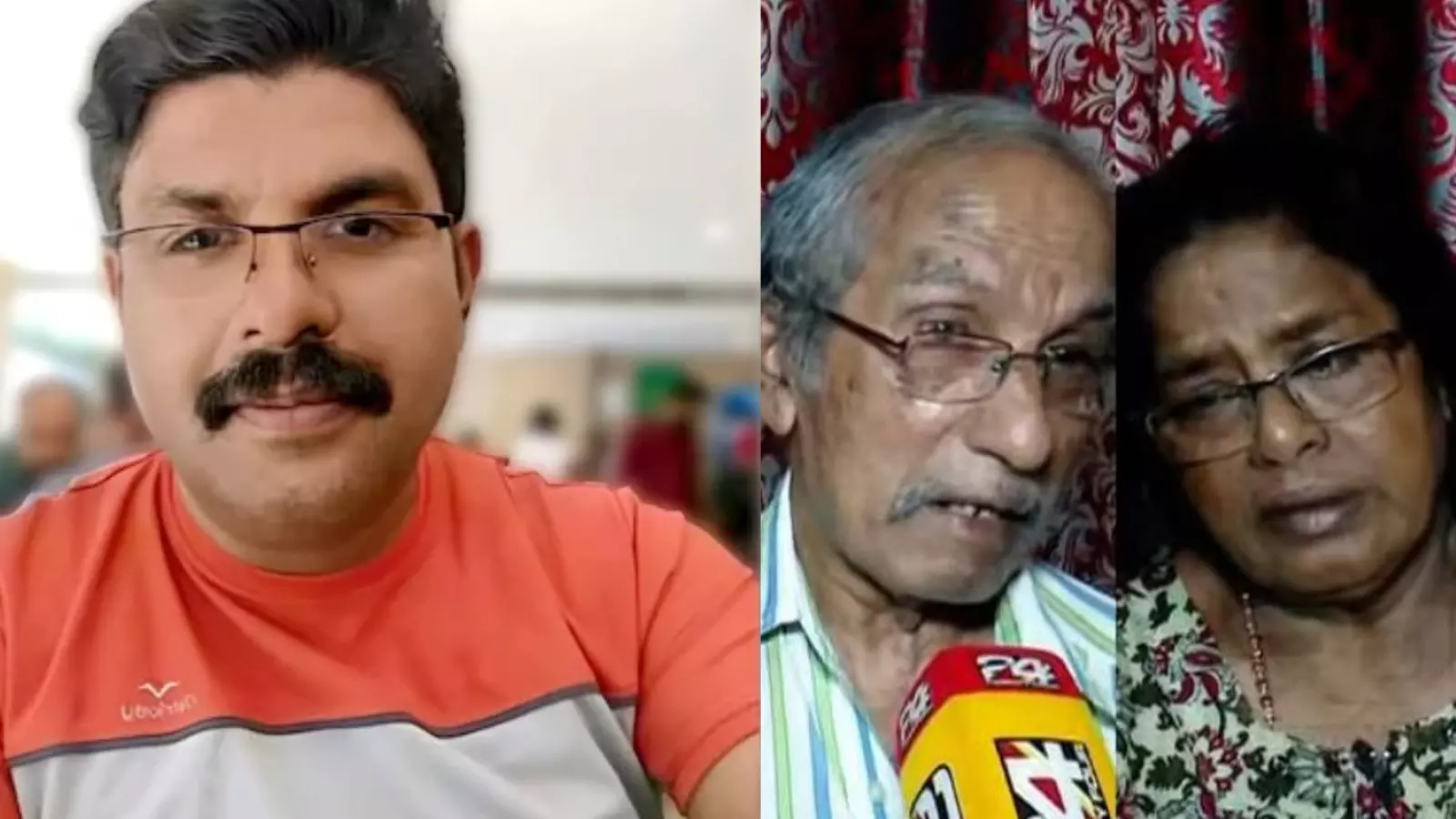
Deepak (left) died by suicide after a social media post involving him went viral. His distraught parents talk to the media after his death
Suicide of Kozhikode man exposes perils of social media trials
Deepak’s death after a viral bus video reignites debate on gender, digital justice and unchecked public shaming

Kozhikode native U Deepak's suicide on January 18 in Kerala has not remained a personal tragedy for long.
Instead, it has stirred up a major gender debate in the state, and raised questions about accountability and justice in the age of social media.
Deepak, a 42-year-old sales manager, died by suicide at his home in Govindapuram, couple of days after a video accusing him of misbehaviour on a bus went viral. The video had been recorded and shared by a former panchayat member and social media content creator Shimjitha Mustafa, who alleged that Deepak had intentionally touched her with his elbow while standing in a crowded bus.
She described the act as inappropriate and a violation of her personal boundaries.
The clip spread rapidly across social media platforms. Many users initially praised the woman for speaking up. Supporters framed the video as an example of women refusing to stay silent about everyday harassment in public spaces. And that women should call out misconduct and make men accountable.
Case of unnatural death
Then Deepak died. Overnight, the emotional direction of the story reversed.
Deepak’s family said he had been deeply distressed after the video went viral. They maintained that he had no intention of behaving inappropriately and that the contact could have been accidental given the crowd inside the bus. According to them, the public scrutiny and humiliation affected him severely.
Also read: SC orders sweeping reforms to curb student suicides, tightens rules for universities
On the morning of January 18, his parents found him dead in his locked room. Police registered a case of unnatural death and began an investigation. Later, based on the family’s complaint, a case for abetment to suicide was registered against the woman who had posted the video.
The Kerala State Human Rights Commission also sought a report from the police, asking for details on the circumstances that led to the suicide. Even as official inquiries moved forward, the public conversation moved much faster about
Deepak was no longer just a man accused in a viral video. He was now a man who had not survived the consequences of a social media trial.
Sympathy changes direction
Images of Deepak with his parents began circulating. His profession, his routine travels, his quiet life were discussed. He was described as a son, a worker, a breadwinner.
Many people who had earlier supported the woman’s right to speak began expressing discomfort with how quickly a private accusation had become a public trial. The sympathy that had initially surrounded the woman slowly shifted towards the dead man and his family. This shift did not happen through organised campaigns alone.
Also read: Crisis brews in Kerala BJP with cadre suicides in Thiruvananthapuram
Feminist voices themselves appeared divided over the issue. For many, the debate was no longer limited to harassment alone, but had shifted to other questions: should allegations be made public before any investigation begins? Whether social media influencers should assume the role of arbiters, and above all should public opinion be allowed to determine guilt.
Toxic masculinity
Feminist supporters of the woman argued that her allegation remained valid. She stood by her claim even after Deepak’s death. She said the contact was intentional and that she had a right to document and speak about her experience. They pointed out that suicide cannot automatically invalidate an allegation.
“Why does he commit suicide if he was not guilt-ridden? Did he not believe in the judiciary and the police system if he thought he was innocent? Why did he not try to prove his 'innocence'? These are the usual questions that are thrown at women, let the same standards be applied to men,” asked Dr Malavika Binny, a feminist historian.
“Let me also point out that the suicide is caused by patriarchy and fragile toxic masculinity which bestows on men an inflated ego which prompts men to harass women believing that there will be no retaliation - and when that ego bubble is burst, it ends in violence, either against the victim or against the self,” added Binny.
At the same time, many within progressive circles quietly admitted that something had gone wrong. They felt that the line between testimony and trial had blurred and that social media had replaced institutions and inquiry.
Reject aggression
Seena Panoli, a feminist researcher and activist wrote on Facebook, “Deepak has died by suicide. We do not truly know what he went through. Even today, there may be many things we cannot arrive at a conclusion based only on what we see. Yet, I saw even completely unexpected people posting judgments suggesting that he took his life because he was guilty. The situation is deeply distressing.”
“My position is that feminism must reject aggression. We must avoid instant reactions and sweeping conclusions. We already have enough lived experience and moral strength to speak, to protest, and to fight without distortion. That alone should be our truth, our ethics, and our strength. Always,” added Seena.
Meanwhile, men’s rights activists, often referred to as meninists or men's association, believe that Deepak’s death is not an isolated incident. According to them, men are increasingly vulnerable to public accusations, and that reputations could be destroyed without evidence. They believe legal safeguards are weaker for the accused than for the accuser and demanded stricter punishment for what they called digital defamation.
Male victimhood gains ground
Self-styled men’s rights activist Rahul Eashwar, who was earlier jailed for disclosing the identity of a survivor in the Rahul Mamkootathil MLA case, used the episode to push a concerted campaign demanding the formation of a men’s commission.
The narrative of male victimhood, long confined to the margins, appear to be attracting wider public sympathy. Videos and posts seeking justice for Deepak were widely circulated on social media, and the campaign gathered momentum with support cutting across party lines.
As public sympathy shifts towards Deepak, the woman who posted the video finds herself increasingly isolated. Her earlier social media posts have come under scrutiny and her intentions are being questioned. Even within her political circles, support has weakened. Though she served as an IUML panchayat member in Areecode between 2020 and 2025, several UDF workers and leaders are openly questioning her conduct in ways that critics say border on personal and gendered vilification.
The Deepak case exposed how quickly moral positions can reverse when death enters the story. His death does not prove that the allegation was false or true. It only proved that consequences triggered by social media trials are irreversible.
(Suicides can be prevented. For help please call Suicide Prevention Helplines: Neha Suicide Prevention Centre – 044-24640050; Aasara helpline for suicide prevention, emotional support & trauma help — +91-9820466726; Kiran, Mental health rehabilitation — 1800-599-0019, Disha 0471- 2552056, Maithri 0484 2540530, and Sneha’s suicide prevention helpline 044-24640050.)