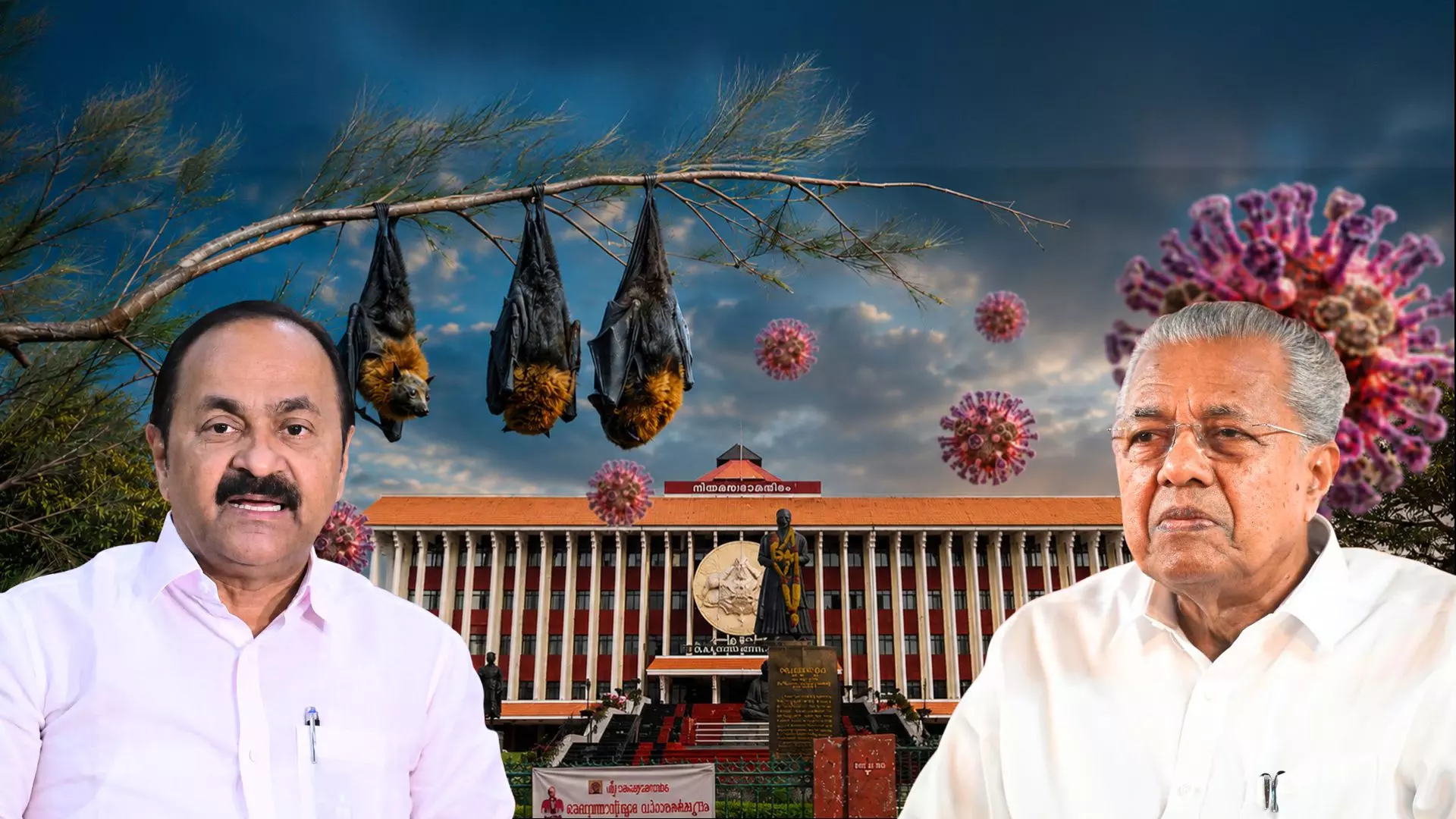
Nipah, Shigella outbreaks in Kerala put UDF govt’s health response under scrutiny
While govt. assures situation is under control, Opposition LDF has pointed to gaps in coordination and communication in handling public health emergencies

Kerala is once again facing a familiar, but serious public health challenge.
The resurfacing of the deadly zoonotic disease Nipah, the spread of Shigella infections in different parts of the state, and the arrival of monsoon-related diseases have come together at a critical moment. The situation has emerged as an early test for the newly elected UDF government and its handling of public health emergencies.
While the government has maintained that the situation is under control, criticism over coordination, communication, and response has already begun to dominate the political narrative. Questions are being raised not just about disease management but also about leadership during a crisis.
Early concerns
The concerns became more visible following the confirmation of a Nipah case in Kozhikode. Opposition leaders and critics pointed to what they described as gaps in coordination and communication during the initial stages of the response.
One of the criticisms centred on the absence of Health Minister K Muraleedharan from the affected district immediately after the case emerged. The minister later defended his decision, saying he remained in Thiruvananthapuram to coordinate the state's overall response and facilitate communication between departments.
Also read: Nipah patient stable, all contact tests negative: Kerala Health Minister
There were also public discussions over differing statements regarding the confirmation of the case and the condition of the patient. In an outbreak such as Nipah, where rapid response and public confidence are crucial, communication becomes as important as containment measures.
Communication questions
The confusion did not end with Nipah.
During the Shigella outbreak, the health minister faced criticism over inaccuracies in figures shared with the public. There was also controversy over references to suspected cholera cases that had not been confirmed and confusion regarding the identification of affected locations.
Also read: Kerala reports fourth Shigella death as 7-year-old dies
While such errors may appear minor in isolation, public health experts often stress that clarity and accuracy are essential during disease outbreaks. Every statement from authorities can influence public behaviour, preparedness and confidence in the system.
As a result, public perception has become a major part of the discussion surrounding the government's response.
The benchmark
Kerala has witnessed a different model of crisis management in the past.
The state's response to the 2018 Nipah outbreak and later the COVID-19 pandemic earned national and international attention for its speed, coordination and communication under former Health Minister K. K. Shailaja. That reputation continues to shape public expectations even today.
Also read: COVID era: It was the season of virus, it was the season of science
The current government is inevitably being measured against that benchmark.
Any delay, contradiction, or communication gap is therefore likely to attract immediate scrutiny from both political opponents and the public.
This is particularly significant because Kerala's public health system has long been considered one of the state's strongest governance pillars.
Political reversal
The current debate also carries a significant political dimension.
When the Left Democratic Front (LDF) was in power, the Congress-led United Democratic Front (UDF) frequently targeted the health department over various issues. Nearly every controversy involving public hospitals or disease management became a political flashpoint.
Among the most vocal critics at the time was Muraleedharan, who now serves as health minister.
Also read: Beyond the red sunset: Why India’s Left outlasts Kerala electoral defeat 7 mins read
His earlier remarks on Nipah and COVID-19 have resurfaced amid the latest controversy, with opponents highlighting statements he made while in opposition. The renewed attention has added to the political pressure surrounding the government's handling of the current outbreaks.
The irony has not gone unnoticed.
The same questions once directed at the LDF government are now being directed at the UDF administration: Are systems responding quickly enough? Is there adequate coordination? Is communication reaching the public effectively?
A different opposition
At the same time, the opposition's approach has displayed an interesting contrast.
The LDF has criticised the government over what it sees as lapses in handling the Nipah and Shigella situations. Questions have been raised regarding coordination, communication and response time.
However, opposition leaders have also argued that a public health crisis should not be reduced entirely to political point-scoring. That position differs from the highly confrontational atmosphere that often characterised earlier debates around health emergencies.
The contrast has become part of the larger political discussion surrounding the outbreak response.
Trust matters
The broader challenge extends beyond politics.
Nipah requires precision and rapid containment. Shigella outbreaks demand swift identification and local intervention. Monsoon diseases require strong preparedness at the grassroots level. Each challenge alone can strain public health systems; together, they create significant pressure.
What Kerala is witnessing now is pressure from multiple directions.
A government under intense scrutiny. An opposition eager to hold it accountable. And a public that remembers previous successes and expects similar standards.
The central question remains whether Kerala can respond with the same clarity, confidence and control that defined its earlier public health responses.
Because in public health, trust is often the most important tool available to any government. And once that trust begins to weaken, rebuilding it can become far more difficult than containing any outbreak.
The content above has been transcribed from video using a fine-tuned AI model. To ensure accuracy, quality, and editorial integrity, we employ a Human-In-The-Loop (HITL) process. While AI assists in creating the initial draft, our experienced editorial team carefully reviews, edits, and refines the content before publication. At The Federal, we combine the efficiency of AI with the expertise of human editors to deliver reliable and insightful journalism.