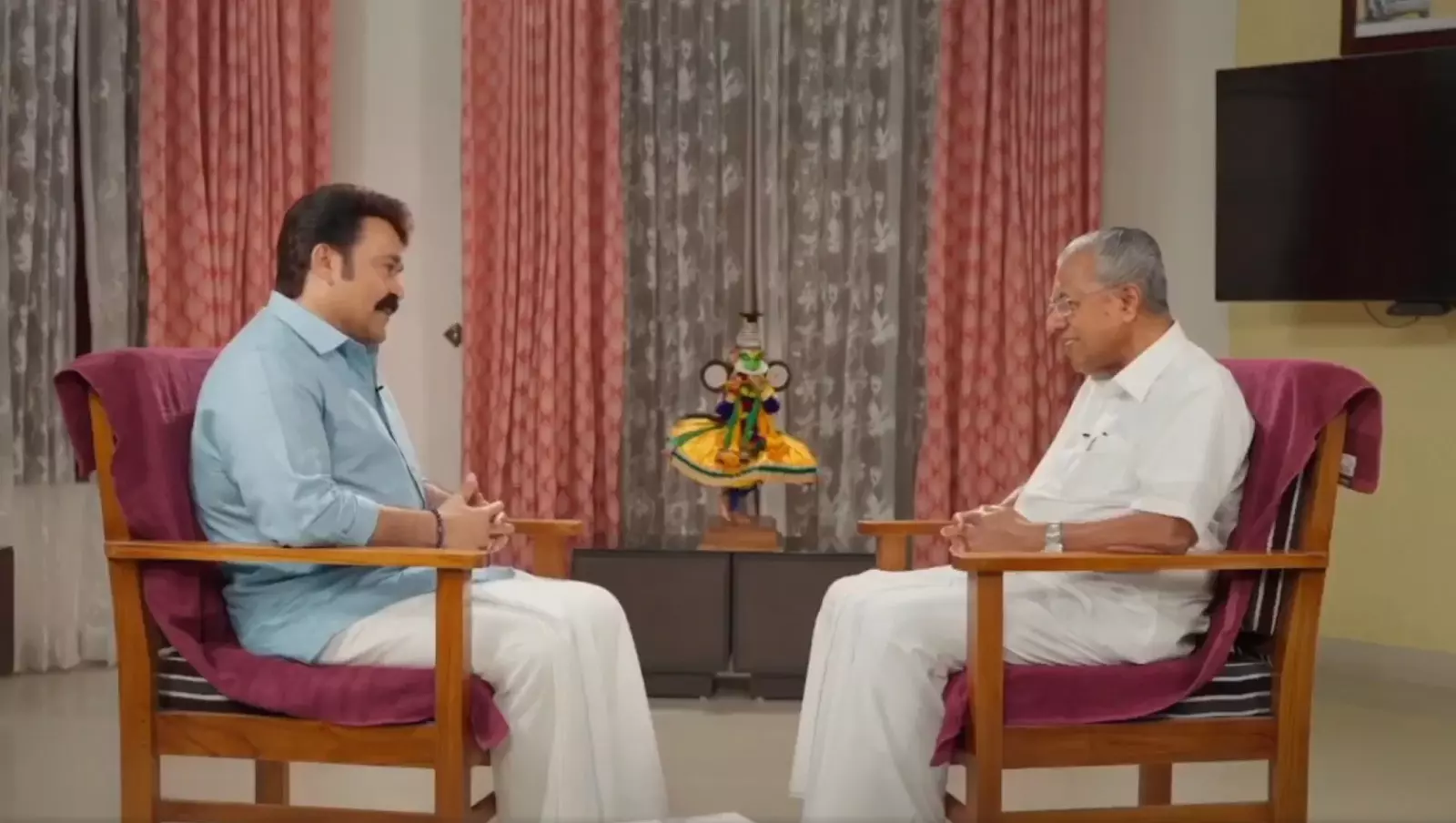
“The only fear I have is towards my party, not the accusations,” said Pinarayi Vijayan, in a startling, candid confession during his high-profile, televised conversation with Mohanlal. In a programme that was otherwise framed as reflective and personal, that sentence cut through the relaxed tone and revealed the Kerala CM's ideological spine beneath the anecdotes.
The interview, aired on February 26, 2026 on multiple TV channels and CM’s social media handles, was not pitched as a political cross-examination. Instead, it unfolded as a long-form conversation that moved through memory, childhood, cinema, literature and personal loss. Yet, politics was never entirely absent.
It surfaced in fragments, in pauses, in the way Pinarayi chose to frame his life story. And, when he spoke of fear, it was not fear of the Opposition, not fear of investigative agencies, and not fear of media scrutiny. It was just fear of failing his party.
That formulation matters in Kerala’s political vocabulary.
Fear of failing party
For decades, Pinarayi has been portrayed as a disciplined organisation man, shaped by cadre politics and hardened by ideological battles. His public persona has often been described as stern and controlled. In this conversation, he allowed glimpses of vulnerability, recalling reading the Ramayana and Mahabharata to his mother, speaking about her influence, remembering childhood fears of darkness and ghosts, and narrating how he was present when she passed away.
But, when the discussion turned to allegations and criticism, which had been a recurring feature of his political career, the tone shifted subtly.
Mohanlal asked him whether accusations disturb him. Pinarayi’s answer was direct. He said he does not believe he has done anything wrong in his life. Allegations, he indicated, do not unsettle him. What matters to him is whether he has upheld the expectations of his party.
“The only fear I have is towards my party, not the accusations.”
Long-held ideological grounding
The remark underscores a hierarchy of accountability. For Pinarayi, political legitimacy flows first from the party structure to which he belongs, the Communist Party of India (Marxist).
It is the collective judgement of the organisation that has shaped him. This is consistent with his political biography.
Pinarayi emerged from student activism and trade union work, rising through the ranks of the CPI(M) in Kerala. His career has been defined less by personality-driven politics and more by organisational positioning. Even as Chief Minister, he has repeatedly emphasised collective responsibility and party discipline.
In that sense, his statement during the interview was not a rhetorical flourish but a reiteration of long-held ideological grounding.
Personal glimpses
The setting of the conversation made his confession even more striking. The programme was visually intimate, shot at the Cliff House, his official residence. Mohanlal’s approach was conversational, occasionally playful. He asked about cinema preferences, about humour, about whether Pinarayi smiles enough. The Chief Minister responded with unexpected ease, even recalling film dialogues and admitting his fondness for action films.
There were moments of visible emotion, especially when he spoke about his mother and his long-time comrade Kodiyeri Balakrishnan, former state secretary and Politburo member of the party. He described reading epics aloud to her because she could not read herself, suggesting that those early engagements with literature shaped his outlook. He spoke about detachment, about learning to face life’s adversities. He also referred to the torture he endured during the Emergency period, linking those experiences to his later insistence on accountability in custodial death cases when he held the Home portfolio.
The interview has drawn varied reactions. Supporters view it as a rare humanising portrait of a leader often reduced to a caricature. Critics argue that the soft format allowed him to avoid sustained questioning on contentious issues. Some in the Opposition have suggested that the timing and tone were politically convenient.
Yet, even within that debate, the statement about 'fearing only the party' stands out. It signals how Pinarayi wants to be understood not as an individual navigating accusations defensively, but as a cadre answerable to a collective.
It reinforces the idea that his authority derives from ideological commitment rather than charisma. It also reflects the centrality of the CPI(M)’s internal mechanisms in shaping leadership accountability.
No public accountability?
At the same time, the line invites scrutiny. If the only fear is towards the party, where does public accountability sit? Is electoral verdict not also a form of fear? Is media criticism entirely external noise? Those questions remain open. The interview did not push aggressively in that direction.
What it did offer was a layered portrayal. A leader who remembered lantern-lit nights of childhood fear. A son who sat beside his dying mother. A political activist who endured custodial torture. And, a Chief Minister who insists that his conscience is clear.
By the end of the conversation, viewers had seen smiles rarely broadcast and heard reflections seldom articulated in press conferences. Responding to a question about the way he is portrayed as the tough guy, Pinarayi said the image is “branded” that way.
“That is something that gets branded. Because I am a Left activist, particularly when I come in the position of a senior leader of the CPI(M), there has been great interest among certain sections in portraying me as someone different from the ordinary. A human being has many moods. If there is any agitated side, that is the image that will be displayed always. The moments of happiness may also be with them (media) , but they may choose not to show them. I do not become overly disturbed about the news that comes about me. When something incorrect appears, many political workers often call media organisations and ask, ‘Why did you report it like that? Is that right?’ I have never called anyone. Whatever news appears, I let it remain there. That is the approach I have adopted.”