2026 elections: Why Congress believes returning to power in Kerala is possible | Discussion
Capital Beat panel examines Congress momentum, Left challenges and BJP’s prospects in the next Assembly elections

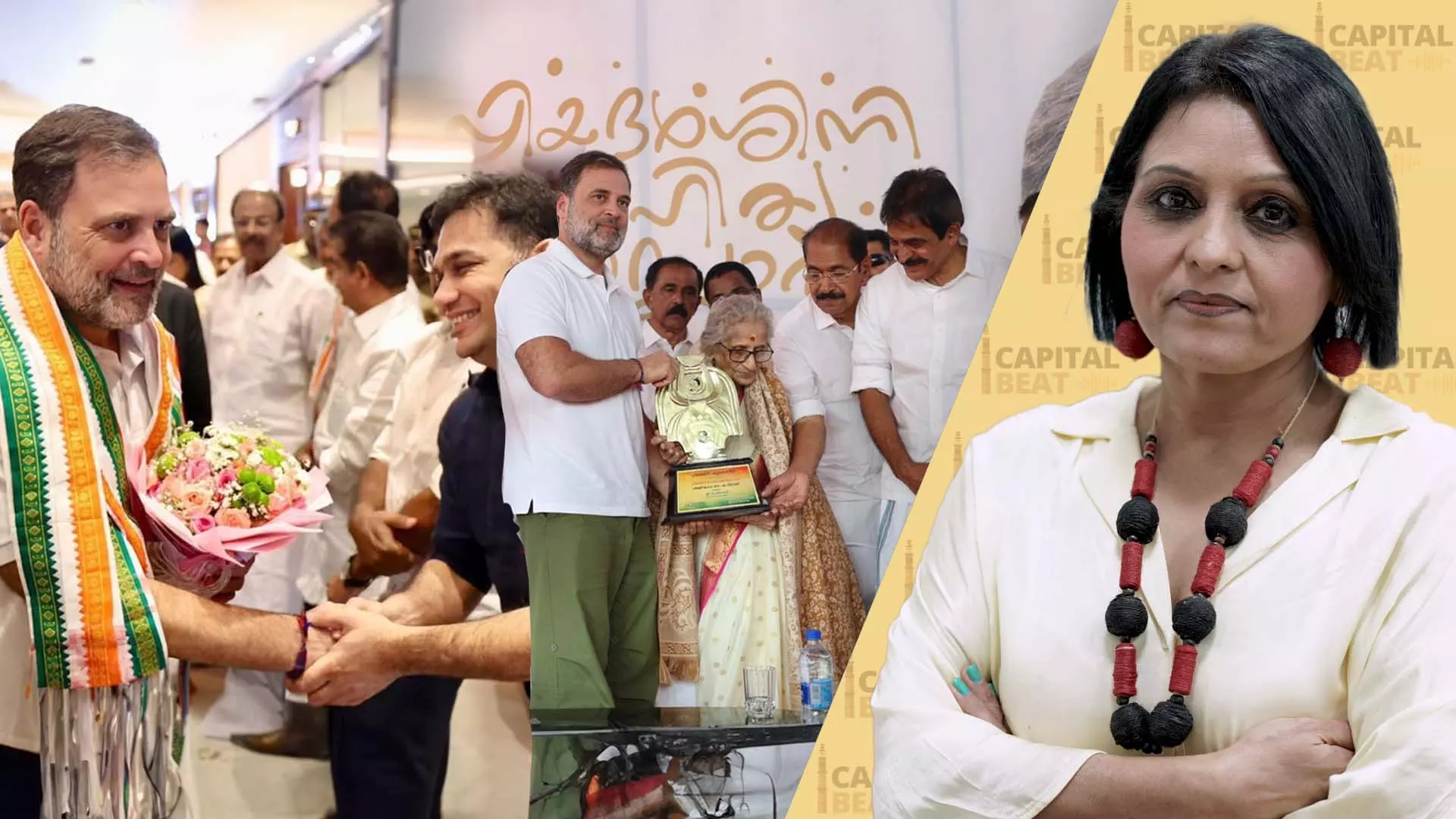
Rahul Gandhi’s visit to Kerala and his participation in the Maha Panchayat event marked a renewed push by the Congress ahead of the next Kerala Assembly election, a development discussed in detail on The Capital Beat, hosted by Neelu Vyas. Senior journalists MG Radhakrishnan and Anand Kochukudy examined whether the Congress-led United Democratic Front (UDF) can convert recent electoral gains and visible optimism into a decisive victory against the ruling Left Democratic Front (LDF), while also assessing the Bharatiya Janata Party’s position as a third force.
The discussion centred on the backdrop of the recent local body election results, which saw the Congress register a stronger-than-expected comeback in Kerala. The civic polls were described as a significant morale booster for the party, especially given its historical organisational disadvantages at the grassroots level compared to the Left. The panellists noted that the results altered prevailing political assumptions and reshaped the pre-election narrative in the state
Also Read: Siddaramaiah no Devaraj Urs, yet a cut above the rest
Rahul Gandhi’s Kochi programme was highlighted as both symbolic and strategic. He arrived later than scheduled and addressed a large gathering that included newly elected Congress representatives as well as candidates who had lost the civic polls. The inclusion of defeated candidates was presented as a deliberate attempt to sustain morale and underline that the local body elections were only a preliminary stage before the Assembly contest.
Kochi event and post-civic poll momentum
The Kochi Maha Panchayat was attended by thousands, leading to major traffic disruptions in the city. During his address, Rahul Gandhi spoke on issues he has consistently raised in public forums, including concerns around freedom of expression and criticism of governance failures attributed to the LDF government in Kerala. The panel noted that his speech also directly targeted the Left’s performance, linking it to the electoral setback the LDF faced in the civic polls.
Anand Kochukudy described the civic poll outcome as unexpected for most political observers and mainstream media, stressing that Congress had managed a rare organisational recovery at the local level. He underlined that the party framed the local body election as a “semi-final,” with the Assembly election positioned as the decisive test of its revival. One of the central points discussed was whether this momentum could be sustained over a longer and more complex electoral cycle.
Also Read: Siddaramaiah-DKS feud pushes Karnataka govt to the brink; has Congress learnt nothing?
The panel also touched on the broader political context, including national-level signals from the Communist Party of India (CPI) about potential alliances with Congress in other states. However, it was emphasised that Kerala’s political landscape has historically remained a bipolar contest between the Congress-led front and the CPI(M)-led Left, with limited relevance for alliance dynamics elsewhere.
Congress factionalism and leadership questions
A significant portion of the discussion focused on internal Congress dynamics, particularly factionalism and leadership ambitions. M.G. Radhakrishnan pointed to a long-standing tradition of internal rivalry within the party, noting that while older factional structures may have weakened, competition over the chief ministerial post remained evident. The names of VD Satheesan, Ramesh Chennithala and KC Venugopal were identified as central to this debate, with Venugopal having publicly stated that he was not in the race.
Radhakrishnan observed that public statements do not always reflect internal strategies, adding that Congress has, in the past, struggled to consolidate gains despite favourable conditions. He warned that unresolved leadership contests and internal calculations could still influence the party’s electoral prospects. “Congress does have a pattern of squandering away its gains very quickly,” he said.
Anand Kochukudy elaborated on reported understandings between senior leaders to manage leadership aspirations and prevent central intervention. He referred to precedents within Kerala politics, including past arrangements involving rotational leadership and negotiated power-sharing, while also noting that such formulas have faced challenges in other states. The discussion acknowledged that candidate selection and seat-sharing with allies such as the Indian Union Muslim League would be critical factors.
Community signals, Left vulnerabilities and BJP’s role
The role of influential community organisations emerged as another key theme. The panel discussed recent public interventions by leaders associated with the Sree Narayana Dharma Sangham and the Nair Service Society, both of which had criticised VD Satheesan. Radhakrishnan described this development as unusual, given the historical alignment patterns of these groups, and suggested it posed a complex challenge for the Congress-led front.
The discussion also addressed allegations that the LDF was adopting a form of soft Hindutva to counter electoral erosion, a claim strongly rejected by CPI(M) general secretary MA Baby. Radhakrishnan argued that the LDF appeared increasingly isolated, facing a consolidation of minority support behind the UDF and a decline in its traditional Hindu vote base. “The anti-incumbency wave is absolutely visible now,” he said, referring to the difficulties confronting Chief Minister Pinarayi Vijayan’s government.
On the BJP, the panel noted that while the party had secured close to 20 per cent of the vote in the last Lok Sabha election in Kerala, its performance in the subsequent panchayat polls fell short of expectations. The loss of Christian support and structural demographic constraints were cited as limiting factors. Despite organisational resources and central backing, the BJP was assessed as facing significant hurdles in translating vote share into Assembly seats in the current scenario.
The programme concluded by reiterating that Rahul Gandhi’s Kochi visit had formally set the tone for the Congress campaign in Kerala, while underscoring that multiple variables—including internal cohesion, community dynamics and campaign execution—would shape the final outcome.
The content above has been transcribed from video using a fine-tuned AI model. To ensure accuracy, quality, and editorial integrity, we employ a Human-In-The-Loop (HITL) process. While AI assists in creating the initial draft, our experienced editorial team carefully reviews, edits, and refines the content before publication. At The Federal, we combine the efficiency of AI with the expertise of human editors to deliver reliable and insightful journalism.